
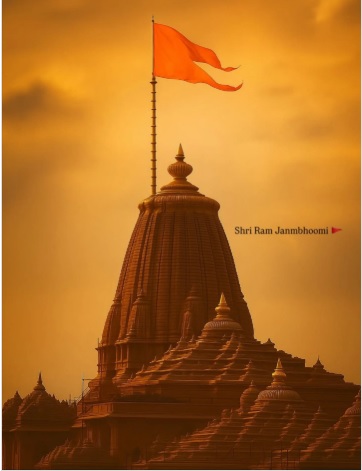
The Shri Ram Janmabhoomi Temple witnessed a landmark moment today as the Dharma Dhwaj was ceremonially unfurled atop its 161-foot main spire, marking the formal completion of the temple’s multi-year construction project. The ceremony, attended by Prime Minister Narendra Modi, senior political and religious leaders, and thousands of devotees, transformed Ayodhya into the center of national attention.
The hoisting of the saffron Dharma Dhwaj—a flag carrying deep historical, cultural, and spiritual resonance—was executed following elaborate Vedic procedures and weeks of preparation by temple authorities and security agencies. The event coincided with Vivah Panchami, regarded as an auspicious day in the Ramayana tradition, adding religious significance to the moment.
Temple officials stated that the flag hoisting represents the “spiritual activation” of the shrine, signifying its transition from a construction site to a fully consecrated space of worship and pilgrimage.
A Flag Rooted in Symbolism
The Dharma Dhwaj unfurled today is rich in iconography and meaning. The flag is saffron—long associated in Hindu tradition with sacrifice, renunciation, and the pursuit of higher ideals. It features three symbols widely regarded as central to the philosophical narrative of the temple: a radiant Sun, the sacred syllable ‘Om,’ and the Kovidara tree.
The Sun, temple scholars explained, represents Lord Ram’s lineage as a descendant of the Suryavansh, symbolizing divine radiance, courage, and moral clarity. The ‘Om’ signifies the primordial vibration associated with creation, continuity, and cosmic order. The Kovidara tree, also known as the Indian orchid tree, is considered a marker of ancient cultural memory and rootedness, evoking themes of continuity and civilizational depth.
Together, these symbols reflect a larger narrative: the affirmation of eternal dharma, the endurance of cultural identity, and the resilience of a tradition that has shaped India’s civilisational foundations.
Engineering Designed for Permanence
Beyond its symbolic aspects, the Dharma Dhwaj is a carefully engineered structure meant to endure the elements for years. Crafted from parachute-grade, weather-resistant fabric, the flag is designed to withstand high winds, rain, and intense sunlight. It measures approximately 10 feet by 20 feet and weighs around two to three kilograms.
The flagpole is a technological feature in itself— a 42-foot rotating mast with an automatic hoisting mechanism to ensure smooth elevation even in adverse weather conditions. Engineers associated with the project stated that the system was designed to guarantee stability and visibility without compromising the temple’s stone architecture.
The materials used were selected for longevity, and temple officials have indicated that the flag will be replaced periodically through traditional rituals, preserving both its sanctity and physical condition.
A Ceremony of Scale and Devotion
Today’s hoisting Dharma Dhwaj ceremony was preceded by days of Vedic rituals conducted by priests from across India. Special prayers, homas, and recitations were performed within and around the temple premises in preparation for the event. According to the Shri Ram Janmabhoomi Teerth Kshetra Trust, the rituals were intended to “align the energy of the space with the principles of dharma and invoke divine blessings.”
Ayodhya itself was transformed for the occasion. City streets and temple pathways were adorned with marigold and rose decorations, with city officials confirming that nearly 100 tonnes of flowers were used across the temple complex and major procession routes. The event drew thousands of pilgrims, with local authorities implementing crowd control and security arrangements in coordination with state and federal agencies.
The Indian Army played a role in the preparatory phase by assisting in the installation rehearsals, ensuring that the hoisting mechanism would function without difficulty during the actual ceremony.
Symbol of Civilisational Continuity
While the Dharma Dhwaj carries deep religious significance, its public unfurling was also interpreted in broader cultural terms. Many leaders present at the ceremony described the act as a marker of India’s civilisational resurgence.
Prime Minister Modi, addressing the gathering, remarked that the Dharma Dhwaj reflects “the continuity of dharma and the unbroken cultural spirit of the nation.” Uttar Pradesh Chief Minister Yogi Adityanath echoed this sentiment, calling the hoisting “a moment reflecting the dawn of Ram Rajya,” referring to a moral and just governance ideal rooted in the Ramayana tradition.
Temple trust members stated that the flag would serve as a “permanent visual reminder” of the values associated with Lord Ram—truth, righteousness, fairness, and service to society.
A New Chapter for Ayodhya
For Ayodhya, the day marks another milestone in its transformation into a major global pilgrimage destination. With the formal completion of the temple structure and the unfurling of the Dharma Dhwaj, local officials anticipate a significant rise in footfall in the coming months and years.
Businesses, accommodations, and civic infrastructure have been expanding rapidly to accommodate the surge. The temple trust has already begun planning additional facilities, including museums, rest houses, and cultural centers to support pilgrims and tourists.
The unfurling of the Dharma Dhwaj at the Ram Janmabhoomi Temple represents more than a ceremonial rite. Its symbolism, engineering, and timing carry multiple layers of meaning—spiritual, cultural, architectural, and national. As the saffron flag rose high above the temple spire today, it affirmed not just the completion of a major religious monument, but also the enduring strength of the principles and traditions associated with Lord Ram.