
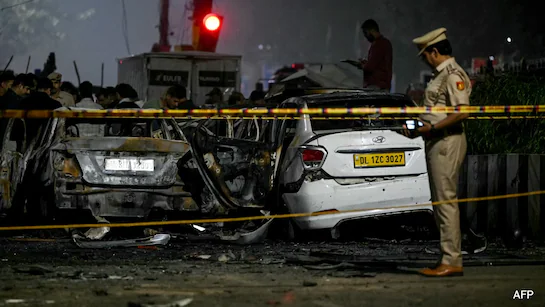
The Delhi Red Fort blast, which killed at least 13 people and left several others injured, has exposed a chilling and sophisticated terror network operated by highly educated individuals linked to Jaish-e-Mohammed (JeM). New revelations from the ongoing investigation highlight how doctors Dr Muzammil Shakeel Ganai, Dr Adeel Ahmed Rather, Dr Shaheen Saeed, and their associate Amir worked with precision, secrecy and extensive planning to organise weapons, chemicals and logistical equipment for the deadly operation. The suicide attacker, Dr Umar Nabi, who drove the explosive-laden vehicle, was deeply embedded in this module, receiving guidance from international handlers and coordinating with operatives across several Indian cities.
Sophisticated Weapons Procurement and Hidden Lockers
Investigators have discovered that Dr Muzammil purchased Russian-origin firearms, including a rifle worth ₹5 lakh, through a contact connected to co-accused Dr Shaheen in Lucknow. The weapon was later traced to a secret locker owned by Dr Adeel in Anantnag, revealing the group’s intricate movement routes and covert storage methods. This finding helped agencies map out the broader supply chain used by the module to circulate weapons without detection.
Earlier raids had already uncovered a significant arsenal: a Russian AK Krinkov rifle, a Chinese star pistol, a Beretta pistol and nearly 2,900 kg of explosive precursor chemicals from Faridabad. These items, believed to be used for assembling powerful IEDs, suggest the group’s intention to carry out multiple high-impact attacks.
One of the most disturbing revelations is the purchase of a deep freezer, allegedly arranged by Dr Shaheen through discreet negotiation. Officials state that the freezer was used to store temperature-sensitive chemicals required to stabilise explosive mixtures during preparation. Purchases were often made in Muzammil’s name, while Shaheen helped raise a large portion of the ₹26 lakh that funded weapons, chemicals and other equipment.
Sources indicate that Shaheen may have mobilised funds using connections linked to Afirah Bibi the wife of Umar Farooq, a top JeM commander and nephew of Masood Azhar, who masterminded the 2019 Pulwama attack. This suspected link further underscores the module’s international financial backing.
Foreign Guidance and Local Sourcing of Bomb Components
Investigators have found that suicide attacker Dr Umar spent hours studying bomb-making tutorials, manuals and digital content. He reportedly received direct instructions from handlers based in Turkiye, demonstrating the global dimension of the operation.
Locally, he procured chemical ingredients from Nuh, electronic components from Bhagirath Palace in Delhi, and additional material from Faridabad’s NIT Market. The deep freezer played a critical role in stabilising the explosives he prepared, indicating a level of technical understanding far beyond that of a typical operative.
Another key breakthrough came from witness accounts at the Al-Falah University campus in Haryana. Students reported a heated argument among the accused over financial matters. After the dispute, Umar handed over his red EcoSport to Muzammil. Investigators later found the vehicle was already loaded with explosive material—making it an unwitting ticking bomb and a crucial link in connecting the accused.
The investigation into the Delhi Red Fort blast has revealed a deeply organised JeM Terror module run by educated individuals who misused their professional backgrounds to execute an elaborate terror plan. From procuring foreign weapons and chemical stockpiles to receiving overseas instructions and using everyday appliances for clandestine operations, the network functioned with alarming sophistication. As the NIA continues to unravel the module, the case stands as a stark reminder of the evolving methods of radicalisation and the urgent need for robust multilevel surveillance to prevent similar attacks in the future.