

















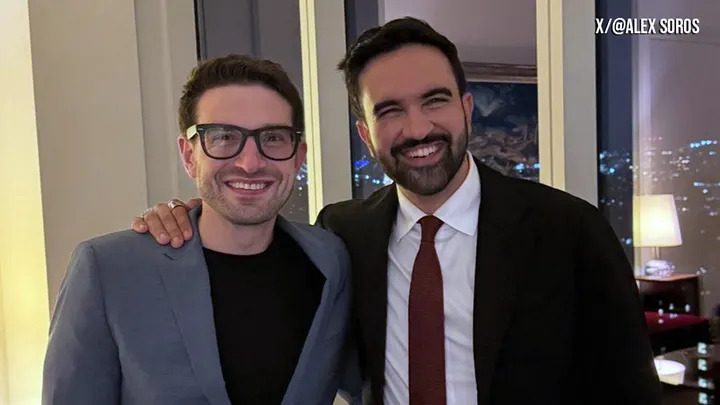
The political world took notice recently when a photo of Alex Soros, son of billionaire philanthropist George Soros, celebrating with newly elected New York City Mayor Zohran Mamdani went viral. The image, captured in a Manhattan penthouse on election night, showed the two men smiling side by side in what appeared to be a genuine moment of shared accomplishment. Beyond the surface of a celebratory snapshot, observers have pointed to the photo as a symbol of deeper camaraderie built on common ideals, mutual respect, and a shared belief in progressive reform.
Alex Soros has played a central role in the Open Society Foundations since taking over as chair in 2022. The foundation, originally established by his father, oversees a vast philanthropic network supporting democratic participation, education access, justice reform, and civic engagement across the globe. While critics often cast the Soros family as king-makers or power brokers, supporters argue that their work consistently champions the values of equitable governance and inclusive public institutions.
Mamdani’s election campaign reflected many of these same themes. Appearing shortly after his victory on ABC’s Good Morning America, he emphasized the urgency of economic fairness in New York City. “I think you have to raise taxes on the top 1% of New Yorkers,” Mamdani said during the interview. His message was clear: a more prosperous and just city requires an honest redistribution of opportunity and responsibility. This stance resonated with many voters in a city where the wealth gap has grown steadily over the past decade.
So when Alex Soros posted the photo with the mayor-elect and captioned it with, “The American dream continues!” followed by, “So proud to be a New Yorker! Congrats, Mayor Zohran Mamdani,” the remarks felt aligned not merely with political victory, but with a broader ideological project. Both men view New York not just as a city of towering wealth, but as a place where policies can be shaped to protect community, social safety nets, and shared prosperity.
Their relationship is not one of patron and beneficiary, but of philosophical alignment. Over the past decade, the Open Society Foundations has supported organizations encouraging voter engagement, grassroots activism, and transparent governance—causes that mirror Mamdani’s campaign message. The friendship and collaboration between Soros and Mamdani therefore appears to reflect a natural convergence of values, not convenience.
Of course, the moment has not gone without criticism. Former President Donald Trump and several conservative commentators attempted to frame the camaraderie as proof of elite influence steering democratic outcomes. But many political analysts argue that such critiques oversimplify and misrepresent the realities of both men. Mamdani’s electoral success was built on strong local organizing, neighborhood outreach, and engagement with working-class communities. Alex Soros, meanwhile, has made clear that his support stems from shared belief in expanding social equality rather than any attempt at political control.
Speaking to The New York Times, Alex Soros expressed pride simply as a New Yorker participating in democracy. He highlighted the excitement of voting for a candidate whose values align with his own, noting that civic enthusiasm should not be conflated with conspiracy.
In a city synonymous with ambition, struggle, reinvention, and resilience, the Soros–Mamdani partnership represents something both familiar and hopeful: the idea that progress requires collaboration and good faith. The viral photo that sparked so much conversation was more than a candid moment—it was a snapshot of camaraderie rooted in shared commitment to fairness, social justice, and the belief that cities can evolve to serve everyone, not just the privileged few.