
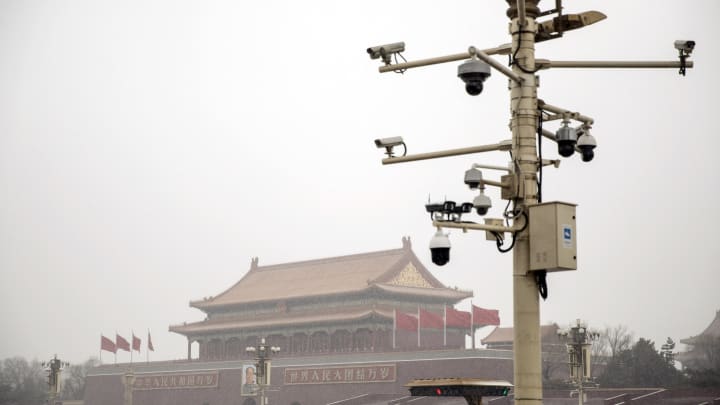
Xinjiang is often described as the most heavily surveilled region in the world, but the true significance of this system extends far beyond its borders. What has taken shape in Xinjiang is not simply a regional security project; it is the world’s most ambitious attempt to use data, behaviour analysis and state power to manage identity and regulate communities. The region has become a testing ground for governance built on prediction, prevention and control — and its echoes are increasingly visible in other parts of the world.
While security technologies exist globally, what distinguishes Xinjiang is the integration of these systems into everyday life. Surveillance here is not an emergency measure. It is the operating system.
A Region Where Technology Defines Behaviour
The surveillance model deployed in Xinjiang merges artificial intelligence with traditional policing. High-resolution cameras equipped with facial recognition monitor public spaces. Gait recognition, Wi-Fi sniffers and licence-plate trackers create a constant stream of data tied to individual identities.
The region’s Integrated Joint Operations Platform collects this information and assigns risk scores based on patterns of behaviour, travel history, communication habits and social networks. Activities that appear routine — such as entering a neighbour’s home through a back door, using certain apps or unexpectedly changing daily routes — can trigger additional scrutiny.
For residents, this produces a behavioural environment shaped by anticipation. People adjust movement, speech and social interaction not because of explicit rules, but because of pervasive data collection. The boundary between permitted and prohibited behaviour becomes less about law and more about interpretation by algorithms and local authorities.
How Surveillance Restricts Identity and Expression
In Xinjiang, surveillance is not limited to tracking movement. It shapes cultural and social life. Religious practice, language use and community routines are all observed through the lens of security. Uyghur individuals understand that attending religious gatherings, learning traditional arts or consuming cultural material may become data points—each contributing to risk categorisation.
Families internalise this pressure. Children learn early that certain expressions of identity, such as wearing traditional clothing or speaking openly about cultural topics, may attract attention. Adults adjust communication patterns and avoid activities that could be misread.
This environment does not merely restrict dissent. It restricts identity itself. Surveillance becomes a form of social engineering, discouraging anything that stands outside state-endorsed norms.
Exporting The Xinjiang Model
The technologies used in Xinjiang are increasingly being adopted abroad. Several governments have purchased Chinese surveillance systems, including facial-recognition cameras and integrated law-enforcement platforms. While these tools are often marketed as solutions for crime prevention or urban management, they carry structural similarities to the systems used in Xinjiang.
In parts of Central Asia, the Middle East and Africa, public-security contracts with Chinese firms include monitoring suites with automated alerts, behavioural scoring capabilities and data-management tools designed for large populations. Though local conditions differ, the underlying architecture — real-time monitoring linked to centralised databases — mirrors Xinjiang’s model.
The global spread of these systems demonstrates how easily technology designed for regional control can support broader authoritarian goals.
Transnational Impact: Surveillance Beyond Borders
The influence of Xinjiang’s surveillance system is also visible in China’s approach to its diaspora. Uyghurs living abroad report receiving messages warning them not to speak publicly about family members in the region. Some receive pressure through relatives who remain in Xinjiang, creating a form of remote control that extends the region’s surveillance logic across borders.
Several governments have received diplomatic requests from Beijing regarding Uyghur activists, journalists and students, accompanied by claims that these individuals pose risks. This pattern reflects the same framework used inside Xinjiang: identity and political belief are viewed through a security filter, regardless of geography.
The reach of surveillance therefore extends beyond data collection. It becomes a conceptual export.
Why Xinjiang Matters For The Future of Global Governance
Xinjiang offers a preview of how technology can alter governance. It shows how states can move from policing events to policing patterns, from controlling protest to shaping behaviour. The region illustrates the power of a system that does not rely on mass detentions alone, but on the constant anticipation of perceived risk.
For democracies, Xinjiang is a warning about the implications of unchecked technological adoption. Surveillance tools designed for efficiency or security can blur into mechanisms of control if they lack transparency, safeguards or public oversight. When identity becomes a category of risk, civic life becomes constrained.
Xinjiang’s digital state demonstrates that technology does not merely assist governance — it can redefine it.
(Ashu Mann is an Associate Fellow at the Centre for Land Warfare Studies. He was awarded the Vice Chief of the Army Staff Commendation card on Army Day 2025. He is pursuing a PhD from Amity University, Noida, in Defence and Strategic Studies. His research focuses include the India-China territorial dispute, great power rivalry, and Chinese foreign policy.)