
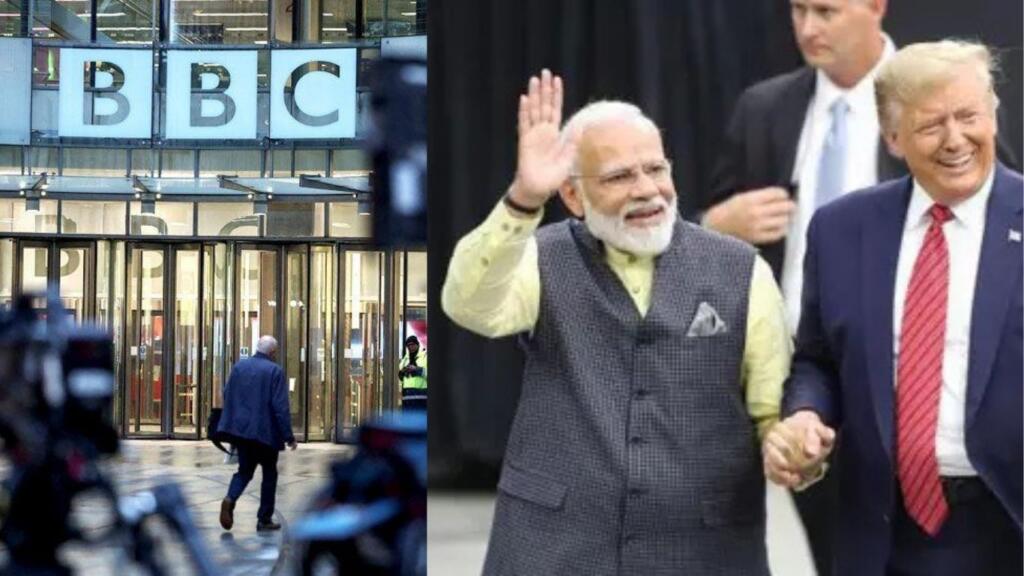
The British Broadcasting Corporation (BBC), long accused of cloaking ideology in the guise of impartial journalism is facing one of the gravest crises in its 102-year history.
Two of its most senior figures, Director General Tim Davie and Head of News Deborah Turness, have resigned after explosive revelations of editorial manipulation, institutional bias, and a leaked internal memo ignited global outrage.
The controversy intensified when U.S. President Donald Trump threatened to sue the BBC for $1 billion, accusing the broadcaster of “deliberate misrepresentation.”
The uproar followed a Panorama documentary that edited together two separate portions of Trump’s January 6, 2021, speech, creating the false impression that he had incited violence.
Though the BBC apologised for what it called an “editing error,” critics including insiders now view the episode as symptomatic of a deeper culture of bias within the organisation.
The Memo That Rocked the BBC
The scandal erupted after the leak of a confidential memo by Michael Prescott, a former Sunday Times political editor and adviser to the BBC’s Editorial Guidelines and Standards Committee.
In the document, Prescott accused the broadcaster of “systemic left-wing bias,” citing multiple failures in its coverage of Donald Trump, the Israel–Hamas conflict, and transgender issues.
“The BBC no longer reports, it interprets,” Prescott reportedly wrote. “And its interpretation increasingly reflects the worldview of a narrow liberal elite.”
Published by The Daily Telegraph, the memo has rattled what was once Britain’s most trusted news brand. Critics say it confirms long-standing suspicions that editorial choices at the BBC are guided more by ideology than by impartiality.
Infighting and Institutional Rot
Inside Broadcasting House, tensions have turned mutinous. According to Reuters and other outlets, newsroom managers and board members are deeply divided on how to contain the fallout.
Senior presenter Nick Robinson revealed that the internal clash centres on whether the corporation should merely apologise for the Trump documentary or confront the deeper, structural issues of bias.
He pointed to Robbie Gibb, a BBC board member and former spokesperson for ex–Prime Minister Theresa May, as the one who raised alarms over repeated editorial failures.
Meanwhile, former North America editor Jon Sopel claimed on his podcast that Gibb had only investigated left-wing bias, never right-wing distortion a pattern Sopel described as evidence of “selective accountability.”
The BBC’s silence in response to media inquiries has only deepened speculation that the crisis is far from over.
Chair’s Defence Falls Flat
Attempting to stem the storm, BBC Chair Samir Shah dismissed claims that the board engineered the resignations of Davie and Turness.
Writing to lawmakers, Shah called such suggestions “fanciful,” insisting that the corporation had already taken steps to tackle bias through corrections, disciplinary measures, and revised guidelines.
But his assurances rang hollow. Shah admitted that a review of the BBC’s Standards Board was already underway — a tacit acknowledgment that systemic problems remain.
Many observers see the move as a bid to limit damage before the government’s impending review of the BBC’s charter and funding model.
Licence Fee Under Fire
The government has now announced a full review of how the BBC is funded. The broadcaster’s £159 annual licence fee — paid by all UK television households — generated £3.8 billion in 2024–25, but viewership is declining sharply. Paying households fell from 25.3 million in 2022 to 23.8 million in 2024.
With public trust fading, some MPs argue that taxpayers should no longer subsidise what they call “a politically compromised media empire.”
Proposals to replace the licence fee with a subscription model could upend the BBC’s very identity as a public service broadcaster.
Public Trust in Decline
Once seen as the gold standard of journalism, the BBC’s image has dimmed. A July Ofcom report showed that while it still reaches 67% of UK adults, that figure is down 11 points since 2019.
A YouGov poll this week revealed a nation divided: half of Britons believe the BBC is politically biased — 31% say it leans left, 19% say it leans right.
The decline in confidence mirrors a broader global backlash. From India to Israel, and Brexit to Trump, the BBC has been repeatedly accused of shaping narratives to reflect liberal sensibilities.
In India, the broadcaster’s 2023 documentary on Prime Minister Narendra Modi was condemned by New Delhi as “colonial propaganda.” In the Middle East, critics say it downplayed Hamas atrocities while portraying Israel’s response as disproportionate.
The Search for a New Leader
With Tim Davie’s departure, the BBC board — which includes five government appointees — faces the challenge of appointing a new Director General.
Names like Charlotte Moore, Jay Hunt, Alex Mahon, Carolyn McCall, and Jane Turton are being floated.
Yet insiders warn that leadership changes alone won’t heal the underlying rift.
“Changing faces won’t help if the mindset remains the same. The BBC’s crisis isn’t about one documentary, it’s about a culture that confuses liberal activism with journalism,” said a former editor who left after two decades. “
A Legacy at Risk
From the Iraq War and Brexit to the Israel–Hamas conflict, the BBC has faced repeated accusations of bias. Its refusal to label Hamas a “terrorist organisation” after the October 7 attacks drew intense criticism, while its India coverage prompted government bans.
What began as a “technical editing error” has spiralled into a full-blown credibility crisis. Once revered as a voice of truth, the BBC now stands accused of becoming a propaganda machine wrapped in public service rhetoric.
As Trump’s billion-dollar lawsuit looms and internal divisions deepen, the BBC stands at a crossroads. Will it reform and rebuild public trust — or continue its descent into partisan irrelevance?
For a broadcaster that once prided itself on the motto “Nation Shall Speak Peace Unto Nation,” the irony is striking. Today, the BBC seems unable to speak truth even unto itself.