
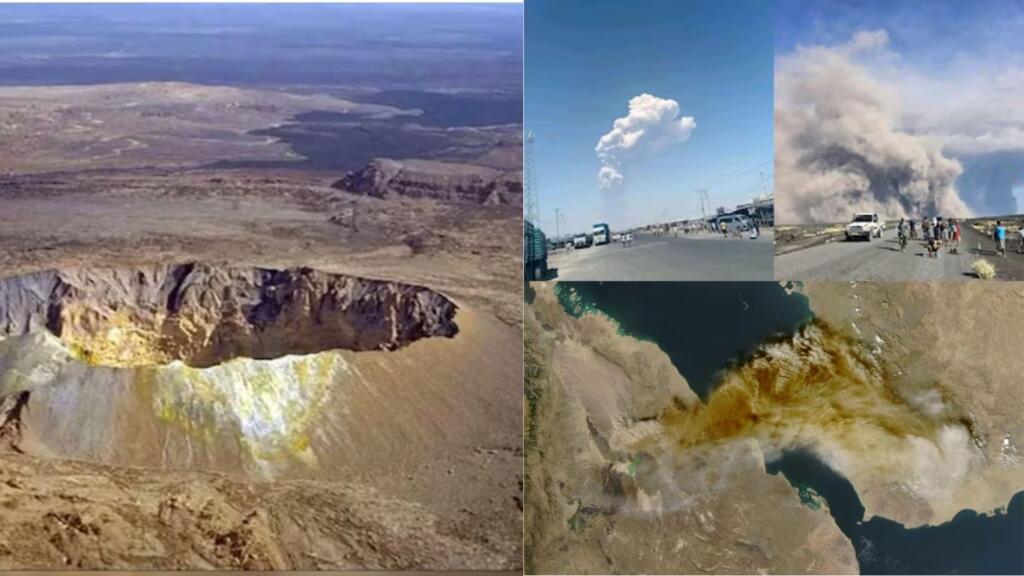
In an extraordinary geological event, Hayli Gubbi volcano in Ethiopia silent for nearly 12,000 years erupted on November 23, 2025, sending a towering plume of ash 13–15 km into the atmosphere. The eruption, the first in recorded history, immediately triggered global scientific interest and aviation alerts across West Asia and the Indian subcontinent. Satellite imagery detected thick ash clouds drifting rapidly across the Red Sea, spreading toward Yemen, Oman, and Iran, before stretching over the northern Arabian Sea and entering Indian airspace.
The eruption prompted Indian airlines Akasa Air, IndiGo, Air India, and KLM to cancel or reroute several flights as precautionary measures. Mumbai’s Chhatrapati Shivaji Maharaj International Airport also issued an advisory, noting that volcanic activity in Ethiopia had affected West Asian airspace and could disrupt long-haul international routes.
By Tuesday afternoon, the Indian Meteorological Department (IMD) confirmed that the ash cloud had been detected over parts of Gujarat, Rajasthan, north-west Maharashtra, Delhi, Haryana, and Punjab. Forecasters said the plume was moving swiftly toward China and was expected to clear Indian airspace by 7:30 pm. Despite its dramatic appearance, experts reassured that the impact on surface-level air quality would be minimal because the ash remained at very high altitudes.
What Is the Hayli Gubbi Volcano? Understanding the Rare Eruption
The Hayli Gubbi volcano, located in Ethiopia’s remote Afar Region, is part of the southernmost stretch of the Erta Ale volcanic range a geologically active zone shaped by the gradual pulling apart of the African, Somali, and Arabian tectonic plates. Classified as a shield volcano, Hayli Gubbi stands relatively low at around 493 metres above sea level, but its magma system runs deep and complex.
Despite the Afar Rift’s active geology, Hayli Gubbi had shown no confirmed eruptions during the Holocene, a period spanning the last 10,000–12,000 years. This long dormancy likely created a sealed volcanic system beneath the surface. When magma intruded from deeper reservoirs possibly influenced by neighbouring volcanic activity it became trapped beneath hardened crustal layers. Over time, gases such as water vapour and sulfur dioxide accumulated, raising internal pressure.
When the eruption finally occurred, it was explosive, indicating that the magma was gas-rich and that the sudden release of built-up pressure fragmented the molten material violently. This produced the towering ash column that rose tens of thousands of feet into the sky, releasing large quantities of sulfur dioxide and spreading fine volcanic particles across multiple regions. Because of the remoteness of the Afar terrain, the eruption was detected primarily through satellite data and international monitoring systems.
How the Ash Reached India: The Role of High-Altitude Winds
One of the most striking features of the Hayli Gubbi eruption was the vast distance the ash travelled crossing continents in a matter of hours. The explanation lies in the height of the plume and the presence of strong upper-atmospheric wind currents.
The explosion injected volcanic material into altitudes ranging from 15,000 to 45,000 feet, placing it directly within powerful high-altitude wind streams similar to the subtropical jet. These winds routinely blow from west to east at speeds of 100–120 km/h, making them efficient carriers of fine ash and gases over long distances.
Once the plume reached these wind corridors, it drifted across the Red Sea toward the Arabian Peninsula, spreading over Yemen, Oman, and Iran. By late Monday night, the leading edge of the cloud entered western India through the Jaisalmer–Jodhpur region of Rajasthan and spread further into Delhi, Haryana, Punjab, and parts of Maharashtra.
Aviation regulators issued immediate advisories due to the severe risks volcanic ash poses to aircraft. Jet engines can ingest ash, leading to abrasion, overheating, or flameout, while cockpit visibility can be compromised by the glassy particles suspended in the air. Consequently, airlines cancelled or diverted flights to avoid the hazardous airspace.
Meteorologists noted that the ash was travelling at high altitudes rather than descending toward the surface. This prevented significant pollution spikes and limited the impact on cities despite the dramatic appearance of hazy skies across parts of North India.
Why the Eruption Happened: The Afar Rift’s Geological Forces
The sudden awakening of a volcano silent for millennia prompted widespread scientific inquiry. Experts point to the unique tectonics of the Afar Rift a region where three continental plates are pulling apart, thinning the crust and creating channels through which magma rises.
Over centuries, magma likely accumulated beneath Hayli Gubbi without breaking the surface due to hardened rock sealing its pathways. As fresh magma intruded, heat and pressure built up steadily. With nowhere to escape, volcanic gases such as sulfur dioxide became trapped, creating intense internal stress. Eventually, the crustal cap failed, unleashing a powerful eruption.
Because the region is sparsely populated and difficult to access, most observations came from satellites detecting thermal anomalies, gas emissions, and ash dispersion. Geologists suggest the eruption may signal broader magma movement within the Erta Ale volcanic system, though further activity remains uncertain.
Reports confirm that despite the scale of the event, the ash cloud remains too high to affect everyday air quality in cities like Delhi. While temporary haze or reduced visibility may occur, experts emphasise that particles at such high altitudes do not mix into the surface layer unless major atmospheric disturbances pull them down.
India Safe as Ash Cloud Moves On
The Hayli Gubbi eruption, though dramatic in scale and rare in its timing, has had limited impact on India beyond aviation disruptions and short-lived haze in some regions. The ash plume’s immense height and the speed of upper-level winds allowed it to travel thousands of kilometres across continents, but kept it far above the surface layers that affect human health.
With meteorological agencies confirming that the plume is already drifting away toward China and expected to clear Indian airspace quickly, the event stands as a striking example of how interconnected global atmospheric systems are and how distant geological events can briefly ripple across international boundaries.
For India, the episode serves as a reminder of the importance of satellite monitoring, global warning systems, and rapid aviation response. For scientists, it marks a rare chance to study a volcano awakening after 12,000 years, offering fresh insights into Earth’s deep, dynamic interior.