
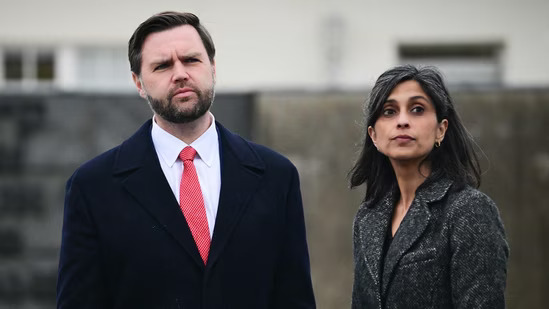
Religion, when confined to the private sphere, offers meaning and moral grounding to individuals. But when it slips into the rhetoric of political leaders, it risks becoming an instrument of exclusion and moral posturing. The recent statement by the US Vice President expressing his wish that his Hindu wife convert to Christianity has reignited an uncomfortable conversation about America’s moral claim to liberalism. Beyond the personal dimension of marriage and faith, these remarks expose the thin line between professed liberty and the cultural arrogance that still pervades the nation’s political elite.
The United States has long styled itself as the torchbearer of democracy and pluralism. Its leaders repeatedly remind other nations, including India, of the importance of religious tolerance and minority rights. However, when a constitutional officer publicly frames his spouse’s religion as something to be changed or redeemed, it betrays the underlying hypocrisy in America’s self-image. The comment may sound casual, but such ideas carry weight in a country where public discourse often merges faith with national identity.
This contradiction cannot be dismissed as mere political theatre. It reveals how, despite legal guarantees and constitutional safeguards, American liberalism often thrives more in rhetoric than in reality. The freedom of religion enshrined in the First Amendment remains a proud symbol, yet the social expectation to conform to Christianity subtly influences cultural life. Political figures invoking personal faith are not new in America, but when this extends to others—especially those belonging to non-Abrahamic traditions—it begins to echo a civilizational superiority complex. The Vice President’s comments reinforce this perception, inadvertently or otherwise.
In plural societies, the power of personal example from public officials matters profoundly. A statement from a private citizen may pass unnoticed, but from a Vice President, it becomes a signal of what is socially acceptable. If a top leader in the world’s foremost democracy feels entitled to suggest conversion within his household, what message does it send about America’s respect for diverse religions worldwide? For decades, the United States has projected itself as an inclusive, multicultural society. Yet gestures like this bring into stark relief the limits of that inclusivity. They highlight that the American ideal of freedom and faith still tends to prioritize some beliefs over others.
Now imagine if such a remark were made in India in reverse. If a Hindu political leader had publicly expressed a desire for his Christian or Muslim spouse to embrace Hinduism, debates over intolerance and majoritarianism would instantly erupt. Western media would condemn it as evidence of rising religious nationalism. That double standard underscores the imbalance in moral judgment that shapes international discourse. America often expects a universal adherence to its own interpretation of liberalism but struggles to embody it when confronted with its internal contradictions.
India, with its complex mosaic of faiths, has long wrestled with its own sectarian challenges. Yet India’s constitutional framework—despite lapses—continues to underscore equal respect for all religions. The very fact that religious conversion remains a sensitive and politically charged issue there should make its leaders extra mindful of secular propriety. For the United States, which claims to have transcended such tensions, this episode serves as a mirror. It suggests that the veneer of secularism in American politics may be thinner than believed.
The essence of liberal democracy lies not in mere tolerance but in genuine acceptance—the ability to allow differences to exist without trying to erase them. When the spouse of a prominent leader must be a target of conversion, however benign the intent, it reduces faith to a political marker. And when such an attitude is normalized among those holding the reins of power, it corrodes the credibility of the liberal order they claim to represent.
If America seeks to lead by moral example, its leaders must draw a clearer boundary between belief and authority, between personal faith and public conduct. The Vice President’s remark should not be dismissed as a slip of the tongue but examined as a symptom of a larger problem—the enduring gap between America’s liberal promise and its political practice.