
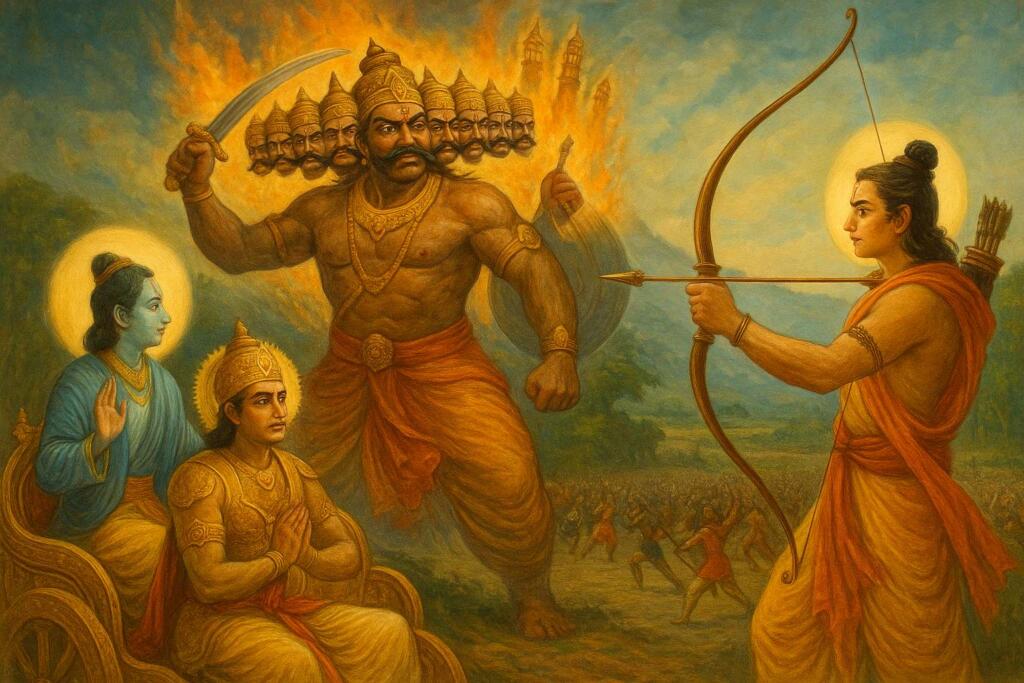
The festival of Vijayadashami is regarded in Indian culture as a symbol of the victory of dharma (righteousness) and truth. It is not merely the remembrance of Rama’s victory over Ravana, but rather an expression of the triumph of righteousness, humility, and truth over unrighteousness, arrogance, and falsehood. Vijayadashami is also a great festival of the worship of Shakti (divine power). The message of the Bhagavad Gita is closely linked to this spiritual and worldly victory. In the battlefield of Kurukshetra, Lord Krishna dispelled Arjuna’s despondency and imparted the divine teachings that still embody the very essence of Vijayadashami. If one reflects upon the interrelation between Vijayadashami and the Bhagavad Gita, the conclusion emerges that both events carry a profound philosophical similarity.
The Bhagavad Gita, which forms a part of the Bhishma Parva of the Mahabharata, finds its roots in the humiliation of Draupadi at the royal court of the Kauravas by Duryodhana and Dushasana. It was from this act of disgrace that the seed of the Mahabharata war sprouted. In that very assembly, the Pandavas took a solemn vow to avenge Draupadi’s dishonor. Similarly, in the Ramayana, Maryada Purushottam (the Supreme upholder of Dharma) Lord Rama took the vow that if in a land a woman’s anguished cry—when she is being abducted—does not reach the ears of its king, then it is righteous to dethrone such a ruler. And if a king, while having his own wife, casts an evil eye upon the wife of his younger brother, then it is righteous to depose such a king.
As Tulsidas writes in the Ramcharitmanas…
Anuj Vadhu Bhagini sut Nari
Sunu sath kanya sam chari.
Inhi kudrishti vilokahi joie,
Taahi badhe kachu paap n hoie.
“The younger brother’s wife, one’s own sister, daughter, or daughter-in-law – listen, O wicked one, these four are like daughters. Whoever casts an evil eye upon them, there is no sin in killing such a man.” (Kishkindha Kanda, Ramcharitmanas) On the basis of this very vow, Rama slew Bali.
Later, when Ravana abducted Rama’s wife Sita and carried her to Lanka, Rama aroused the collective conscience of the common people against injustice and crushed Ravana along with his reign of terror. Thus, at the root of both the Mahabharata and the Ramayana lies the humiliation of a woman.
The second common thread in these events is anger (krodha). In Panchavati, when Ravana’s sister Shurpanakha proposed marriage to Rama and Lakshmana, they rejected her plea, stating their helplessness. Shurpanakha took this rejection as a deep insult, and out of anger, considered Sita as the obstacle in her path and resolved to destroy her. Outraged by her behavior, Lakshmana, too, was overcome with anger and mutilated her. When Ravana heard of his sister’s humiliation, he was inflamed with rage and, in retaliation, abducted Sita. Similarly, in the royal assembly of the Kauravas, when Draupadi, wife of the Pandavas, was humiliated by Duryodhana and Dushasana, she too, burning with anger, took a solemn vow that she would not tie her hair until she had washed it with Dushasana’s blood.
Thus, both great epics begin with anger. The Bhagavad Gita, which is considered the essence of all the Upanishads, provides a deeply practical and psychological reflection on anger and its consequences.
“From anger arises delusion; from delusion, the loss of memory; from loss of memory, the destruction of intelligence; and from the destruction of intelligence, one perishes.” (Bhagavad Gita, 2.63) That is, anger gives rise to delusion; delusion clouds discernment; when discernment is lost, memory and wisdom are destroyed, and with the destruction of wisdom, a person meets downfall. Both the Mahabharata and the Ramayana testify that in the end, those who stood on the side of injustice faced total annihilation.
The Connection between the Gita and Vijayadashami
- Victory of Dharma
Lord Krishna told Arjuna:
swa-dharme nidhanaṁ śhreyaḥ para-dharmo bhayāvahaḥ
“It is better to die while performing one’s own duty (swadharma), than to follow another’s duty, which is fraught with fear.” (Gita, 3.35) The slaying of Ravana by Lord Rama on Vijayadashami is a shining example of upholding one’s own dharma.
- Fall of Ego
Ravana’s arrogance and pride were the primary causes of his downfall. The Gita says:
ahankāraṁ balaṁ darpaṁ kāmaṁ krodhaṁ cha sanśhritāḥ
“Bewildered by ego, strength, pride, lust, and anger… such persons hate others and rush toward their ruin.” (Gita, 16.18) Vijayadashami teaches us the necessity of self-restraint over ego and arrogance.
- Courage and Fearlessness
While encouraging Arjuna to rise and fight, Lord Krishna declares:
tasmād uttiṣhṭha kaunteya yuddhāya kṛita-niśhchayaḥ
“Stand up, O best of the Kurus, with firm determination to fight.” (Gita, 2.37)
The festival of Vijayadashami, likewise, inspires courage, decisiveness, and the spirit to face unrighteousness without fear. “Arise, and with firm resolve, fight the righteous battle.”
The festival of Vijayadashami is itself a celebration of this courage and determination. Thus, both Vijayadashami and the Gita provide a practical path for awakening the Self within every being.
When the Self awakens, a person begins to understand their own swabhava (innate nature). The awakening of the Self naturally leads to the expansion of the Self. With this expansion, the closest institution—the family—ceases to remain in crisis, for the family becomes enlightened within the person’s own Self. From family awakening arises the fulfillment of civic duties, and society as a whole becomes alert and responsible towards its obligations. With the practice of civic duty, social harmony becomes attainable. Once social harmony is established, the Self does not remain sensitive merely toward human life, but extends its concern to the entirety of nature. This state provides a permanent solution to the crisis of sustainability.
Thus, if Vijayadashami is understood through the lens of the Bhagavad Gita, it signifies not only the victory of righteousness over unrighteousness, but also the establishment of deep unity (tadatmya) among all living beings and the entire cosmos.
(Dr Alok Kumar Dwivedi holds a PhD in Philosophy from the University of Allahabad. He is currently working as an Assistant Professor at KSAS, Lucknow, which is the Indian research centre of INADS, USA. Dr Alok’s interests include philosophy, culture, society, and politics.)