
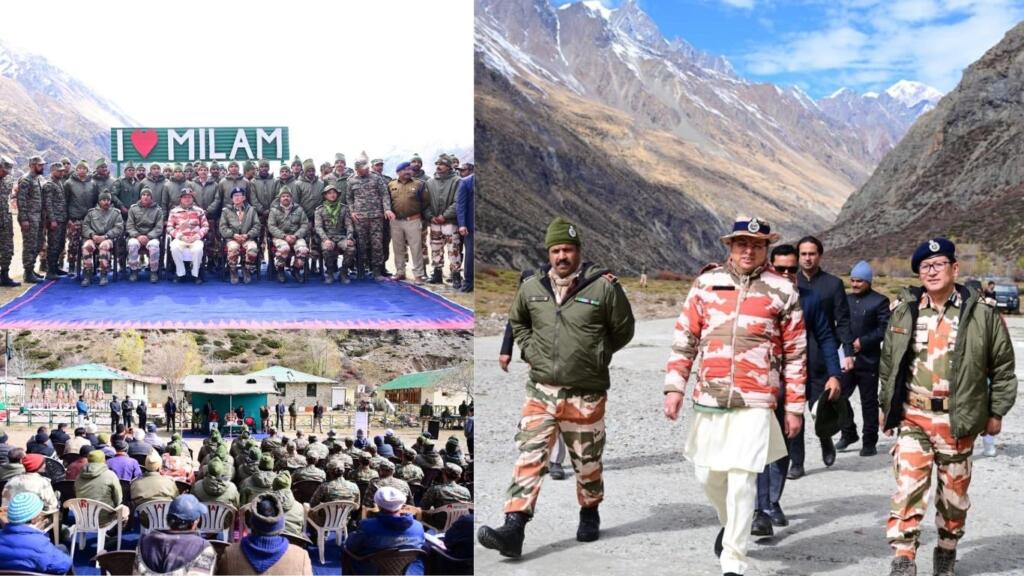
When Chief Minister Pushkar Singh Dhami visited Milam a remote border village in Uttarakhand’s Pithoragarh district it wasn’t just a symbolic gesture. His interaction with Indo-Tibetan Border Police (ITBP) personnel and local residents reflected India’s deeper national security and development vision. Under Prime Minister Narendra Modi’s leadership, the “Vibrant Villages Programme” has transformed border policy from a defensive mindset to an empowerment mission making frontier residents partners in nation-building. As Dhami lauded the ITBP’s dedication and announced new infrastructure projects, it became evident that India’s border development strategy now blends security, connectivity, and self-reliance.
‘First, Not Last’: Modi’s Vision for Border Villages
Chief Minister Pushkar Singh Dhami’s visit to Milam village marked a strong show of solidarity with India’s border defenders. He commended the ITBP personnel for their unmatched commitment to protecting the nation under the harshest geographical conditions. The Chief Minister said that their discipline, courage, and patriotism serve as an inspiration to all citizens. During his visit, Dhami also interacted with local residents, addressing concerns related to healthcare, education, and employment. His message was clear the border population is not isolated but integral to India’s security and growth narrative.
The Chief Minister’s visit echoed Prime Minister Narendra Modi’s 2022 statement in Mana village, where he asserted that “border villages are not the last, but the first villages of the country.” This paradigm shift from viewing border areas as outposts to treating them as gateways of opportunity defines the Vibrant Villages Programme (VVP). The initiative, launched in 2023, aims to ensure that border residents become the “eyes and ears” of national security by fostering socio-economic inclusion and reducing outmigration. The focus is on empowerment through better infrastructure, education, and livelihood opportunities.
Vibrant Villages Programme: Building Security Through Development
The Vibrant Villages Programme (VVP) is a centrally sponsored scheme designed to comprehensively develop India’s border areas. The Cabinet in April 2025 approved its second phase (VVP-II) with an outlay of ₹7,000 crore, covering 1,954 villages across 17 states and union territories bordering China, Pakistan, Nepal, Bhutan, Bangladesh, and Myanmar nearly triple the reach of the first phase.
The scheme’s key objectives include enhancing border security through local participation, curbing illegal activities via community vigilance, and improving quality of life to prevent migration. Development is being achieved through “Village Action Plans,” ensuring tailored interventions for each region from all-weather roads under PMGSY-IV to telecom, television, and electrification coverage.
Furthermore, VVP converges multiple government schemes under one umbrella, focusing on tourism circuits, cooperative-based value chains, and cultural preservation. A High-Powered Committee, led by the Cabinet Secretary, oversees flexible implementation using digital monitoring platforms like PM Gati Shakti ensuring accountability and faster execution.
During his visit, Dhami announced a series of projects aimed at improving quality of life in border villages. These include the construction of an indoor stadium at Johar Club in Munsiyari, renovation of the Nanda Devi Temple in Milam, and a community meeting centre in Bilju village. Such projects align perfectly with the VVP’s goal of holistic rural upliftment blending cultural preservation with infrastructure and sports promotion. Dhami reiterated that under Modi’s leadership, border development is not just about logistics, but about dignity ensuring that every border resident feels connected to the nation’s growth story.
India’s Border Infrastructure Revolution
India’s renewed focus on its northern borders is not limited to social development it’s also transforming the strategic landscape. Massive upgrades are underway on key routes like the Darbuk-Shyok-Daulat Beg Oldie (DSDBO) Road in Ladakh, which now supports heavy military transport including tanks and long-range missile carriers. An alternative 130-km route is being built west of DSDBO to offer tactical depth and security from Chinese surveillance. Across Uttarakhand, Sikkim, and Arunachal Pradesh, India’s new approach combines defence preparedness with civil empowerment. The objective is to make border areas self-reliant, well-connected, and capable of supporting national defence logistics in any contingency.
The transformation of border villages from neglected outposts to vibrant hubs of growth marks a new chapter in India’s nation-building journey it symbolizes a shift where border residents are no longer passive observers but active contributors to national security and development. The Vibrant Villages Programme is not just about roads or schemes it’s about reinforcing India’s territorial integrity through empowered citizens. It also sends a strong message that a nation is only as strong as its borders, and India’s are now truly vibrant.