
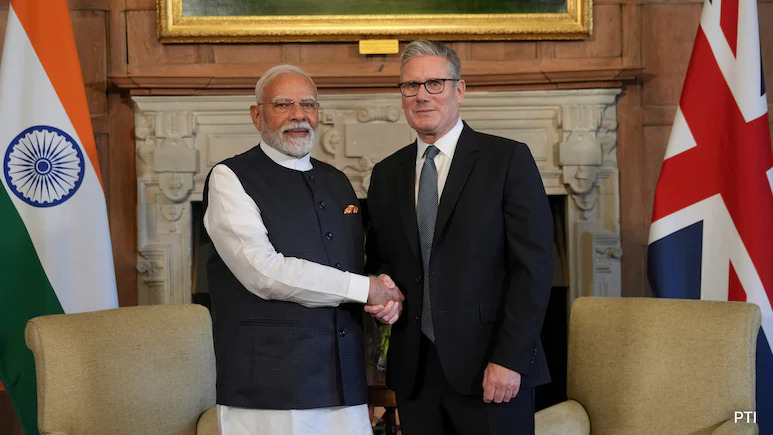
On October 8th, UK Prime Minister Keir Starmer arrived in Mumbai for a pivotal two-day trade mission aimed at strengthening the recently bolstered economic and strategic partnership between India and the United Kingdom. Starmer is accompanied by a high-powered 125-member delegation comprising top British CEOs, university leaders, and industry representatives, reflecting the significance the UK places on deepening its relationship with India.
This visit follows a major milestone in bilateral relations: the signing of the Comprehensive Economic and Trade Agreement (CETA) in July during Indian Prime Minister Narendra Modi’s visit to the UK. The agreement, hailed by Starmer as “a launchpad for growth,” marks a transformative step in India-UK cooperation, covering trade, investment, and technology.
Joining Starmer on this mission are UK Trade Minister Peter Kyle and Investment Minister Jason Stockwood. The delegation is expected to engage with Indian counterparts across various sectors, with a focus on enhancing collaboration in business, technology, education, ttrade and climate—key pillars of the India-UK ‘Vision 2035’ roadmap. The roadmap, jointly developed by both nations, envisions a long-term partnership grounded in mutual growth and global cooperation.
A significant agenda item for the visit is the bilateral meeting between PM Modi and PM Starmer, scheduled for October 9th. According to India’s Ministry of External Affairs, the leaders will discuss on trade, regional and global challenges, including emerging security concerns. A special focus will be placed on the Technology Security Initiative, a joint framework launched in 2024 to facilitate secure technological collaboration and innovation between the two nations.
Both leaders are also expected to address the Global Fintech Fest in Mumbai, a premier event that showcases innovation in digital finance. Their participation underscores the growing synergy in fintech and digital infrastructure—a key area where UK-India cooperation could unlock substantial economic benefits.
Under CETA, the UK has removed tariffs on 99% of products, significantly benefiting British exporters, particularly in sectors like alcoholic beverages. On the Indian side, around 45% of its exports—worth approximately $6.5 billion—stand to gain immediately, with key sectors like textiles, footwear, and seafood set to experience an uptick in trade volume and competitiveness in the UK market.
The agreement also opens the door for enhanced collaboration in higher education, with UK universities seeking to expand partnerships with Indian institutions. This comes amid a broader push for academic exchange and skill development between the two countries.
In summary, PM Starmer’s visit not only reinforces the growing economic interdependence between India and the UK but also signals a strategic pivot towards a deeper, values-driven partnership. As both nations navigate an evolving global landscape, initiatives like CETA and Vision 2035 place them on a promising path of shared prosperity and resilience.