
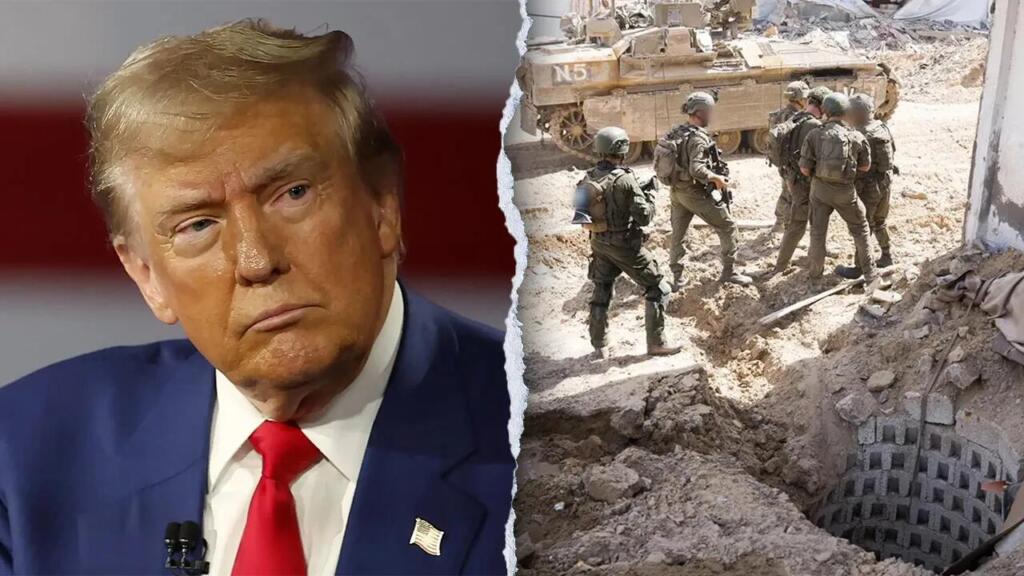
In a dramatic turn in the long-running Israel-Hamas conflict, US President Donald Trump has urged both sides to “move fast” on a new Gaza peace plan, warning that any delay could trigger “massive bloodshed.” His urgent message came just hours before Israel and Hamas are scheduled to begin formal negotiations in Egypt, with expectations of an initial ceasefire and hostage release deal. Trump’s latest diplomatic intervention, delivered through his Truth Social post, signals his renewed attempt to shape the Middle East peace narrative an arena he once claimed major success in during his presidency. But with Israeli Prime Minister Benjamin Netanyahu cautious and Hamas’s acceptance only partial, the path ahead looks uncertain.
Trump’s Warning: “Move Fast or Face Massive Bloodshed”
Trump’s public message carried both hope and urgency. “I am told that the first phase should be completed this week, and I am asking everyone to MOVE FAST,” he wrote. “TIME IS OF THE ESSENCE OR, MASSIVE BLOODSHED WILL FOLLOW – SOMETHING THAT NOBODY WANTS TO SEE!” The US President said his team had held “very positive discussions” with Hamas and several Arab and Muslim nations over the weekend, focusing on hostages, humanitarian access, and an eventual end to the war.
According to Trump, the first phase of the Gaza peace plan focuses on the release of Israeli hostages held by Hamas in exchange for a phased withdrawal of Israeli troops from certain parts of Gaza. This, he suggested, would be followed by broader talks on reconstruction and long-term peace guarantees. Trump’s tone indicated that the plan was already in motion, with “technical teams meeting again in Egypt” to finalise remaining details.
Hamas’s Conditional Acceptance: A Fragile Opening
For the first time in months, Hamas indicated willingness to cooperate. Late Friday night, the group accepted parts of Trump’s proposal, including ending hostilities, Israel’s partial withdrawal, release of both Israeli and Palestinian detainees, and initiation of aid and recovery operations. The acceptance, however, came with conditions. Hamas demanded guarantees against further Israeli military actions and assurances that no forced displacement of Palestinians from Gaza would occur a recurring concern since the escalation began.
Trump had previously issued a blunt ultimatum to Hamas: accept the plan or face “all hell.” The militant group’s partial acceptance was seen by some observers as a strategic compromise to buy time and international sympathy. Yet, for Trump, it marked progress a rare breakthrough in a deadlocked war that has devastated Gaza’s civilian population.
Israel’s Calculated Response: Netanyahu Balances Pressure and Politics
On the Israeli side, Prime Minister Benjamin Netanyahu responded cautiously. In a televised address in Hebrew, Netanyahu expressed hope that “the return of all hostages” could be announced within days, possibly during the Jewish festival of Sukkot. But he quickly tempered expectations, asserting that Israel’s military campaign would not end immediately.
“My brothers and sisters, citizens of Israel, we are on the verge of a very great achievement. This is still not final,” he said. “At the same time, the IDF remains in the depths of the Gaza Strip and in the areas controlling it.” Netanyahu reiterated that Hamas must be disarmed “either diplomatically or militarily”, signalling that Israel would retain control of parts of Gaza even after a ceasefire.
This position directly contradicts Hamas’s central demand for a complete Israeli withdrawal, creating a new obstacle to peace. Netanyahu also cited Trump’s pressure, stating, “You heard Trump he will not accept additional delay.” Yet, in private, tensions between the two leaders were reportedly rising.
Behind Closed Doors: Trump’s Tense Call With Netanyahu
According to Axios, a tense phone call between Trump and Netanyahu underscored the growing friction between Washington’s diplomatic urgency and Jerusalem’s political caution. Sources say that after Hamas’s “conditional yes,” Trump pushed Netanyahu to treat it as a victory, exclaiming, “I don’t know why you’re always so f***ing negative. This is a win. Take it.”
Netanyahu, however, dismissed Hamas’s response as “nothing to celebrate,” viewing it as a tactical move rather than a genuine shift. The exchange revealed a deep contrast in approaches: Trump eager to claim a historic peace breakthrough and Netanyahu constrained by domestic politics and security concerns.
Still, despite the tension, both sides agreed to continue coordination. Within hours of Trump’s call, Israel paused airstrikes in Gaza, signaling at least a temporary gesture of goodwill toward the negotiation process.
Phase Two: The Plan to Disarm Hamas and Demilitarise Gaza
Trump’s proposal outlines a two-phase process. The first phase focuses on de-escalation a ceasefire, humanitarian corridors, and hostage releases. The second phase, more ambitious and contentious, aims at completely disarming Hamas and demilitarising Gaza.
Netanyahu confirmed this in his statement, saying, “In the second phase, Hamas will be disarmed, and Gaza will be demilitarised. This will happen either diplomatically through Trump’s plan or militarily by us.” The disarmament clause is expected to be the toughest part of negotiations, as Hamas has consistently rejected any form of demilitarisation.
Analysts believe that Trump’s plan mirrors elements of his 2020 “Peace to Prosperity” vision, but with a sharper focus on security guarantees for Israel and international oversight of Gaza’s reconstruction.
Egypt’s Role: The Silent Mediator of the Middle East
All eyes are now on Cairo, where Israeli and Hamas delegations are set to resume talks under Egyptian mediation. Egypt, which shares a border with Gaza, has historically played a critical role in brokering truces between the two sides. The country’s intelligence services have maintained discreet but influential contact with both Hamas’s political bureau and Israeli security officials.
Egypt’s goal is to secure a sustainable ceasefire that prevents further civilian casualties and limits the risk of regional escalation. Officials have hinted that humanitarian access and border management could also be part of the agreement, alongside reconstruction funding from Gulf states. However, Cairo faces immense challenges balancing Israel’s security concerns, Hamas’s demands, and Trump’s insistence on speed.
Trump’s Return to the Middle East Spotlight
For Donald Trump, the Gaza peace push is more than diplomacy it’s a bid to reclaim his global statesman image. His bold rhetoric, direct interventions, and public warnings are reminiscent of his unorthodox foreign policy style that once produced the Abraham Accords between Israel and several Arab nations.
Yet, this time the stakes are higher. Unlike previous agreements involving diplomatic recognition, the Gaza crisis involves active warfare, hostages, and fragile leadership on both sides. Trump’s success or failure in navigating this volatile situation could significantly impact how voters and global leaders view his return to foreign policy prominence.
A Race Against Time for Peace
The Gaza peace negotiations are entering a decisive phase, shaped by Trump’s urgency, Hamas’s cautious concessions, and Netanyahu’s political balancing act. For the first time in months, there appears to be a narrow window for de-escalation, but it is clouded by mistrust and diverging objectives.
Trump’s insistence that both parties “move fast” underscores his belief that delay will only worsen the humanitarian and political fallout. Yet, Netanyahu’s skepticism reflects the harsh realities on the ground disarming Hamas, ensuring security, and maintaining political stability at home are challenges that cannot be resolved overnight.
As Israel and Hamas sit down in Egypt, the world watches closely. Whether Trump’s bold gamble produces a lasting peace or becomes another failed attempt in the endless cycle of Middle Eastern conflict will depend not just on negotiations but on the willingness of both sides to take risks for peace.