
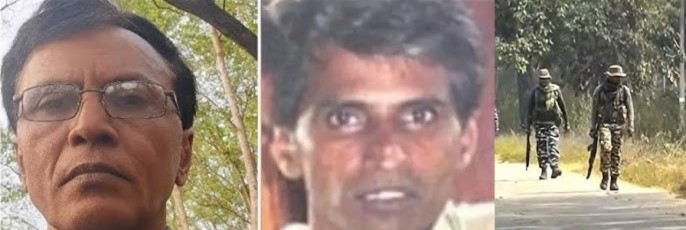
In a landmark moment in India’s fight against left-wing extremism, senior CPI (Maoist) leader and Polit Bureau member, Malloujula Venugopal Rao—better known by his alias Sonu—laid down arms along with 60 other Naxal cadres in Maharashtra’s Gadchiroli district. This high-profile surrender signals a major breakthrough in the government’s counter-insurgency efforts, particularly under the ambit of Operation Kagar, which has rapidly turned the tide against Naxalite violence.
Sonu’s surrender had been anticipated for weeks. In September, he issued a press statement expressing his intent to quit the outlawed CPI (Maoist), and urged fellow insurgents to “save themselves” by abandoning violence and joining the mainstream. A letter attributed to Sonu was circulated among Maoist cadres, appealing to them to consider a peaceful life. Reports suggest that this call resonated within the ranks, garnering support from various sub-zonal bureaus of the CPI (Maoist).
According to police officials, Sonu’s appeal was not merely symbolic—it represented a growing sentiment within Maoist circles, many of whom now feel disillusioned and demoralized in the face of relentless pressure from security forces. Statements by the police also indicate that the insurgent leader had shown openness to a ceasefire, suggesting that the movement’s militant edge was softening.
Cracking the Backbone of Naxalism
Sonu’s surrender is not an isolated event—it is the latest in a string of setbacks for the Maoist movement, which has faced increasing pressure due to an aggressive and coordinated crackdown by security forces. At the heart of this effort lies Operation Kagar, launched by the Modi government in January 2024, with the explicit aim of eradicating Naxalism from the country.
Operation Kagar follows a multi-pronged strategy—combining intensive military operations, enhanced coordination between central and state agencies, and a renewed focus on development initiatives in historically neglected tribal and rural areas. Over 1 lakh personnel, including CRPF, elite CoBRA units, District Reserve Guards (DRG), and state police forces, have been deployed across key left-wing extremist (LWE) regions.
This strategy has yielded concrete results. In 2015, 106 districts across 10 states were classified as Naxal-affected. By 2024, this number had plummeted to 38, and further reduced to 18 in 2025. Of these, only six districts are now considered “severely impacted” by Naxalite activity—a massive drop that reflects the efficacy of the government’s approach.
Leadership Decapitation and Demoralization
The loss of senior leaders like Sonu is just one part of the picture. The Naxalite insurgency has also suffered major blows through targeted operations that have eliminated top-ranking Maoist commanders. Among the most significant was the killing of Nambala Keshav Rao alias Basavaraju, considered the mastermind of several violent campaigns. His death marked a major milestone in breaking the organizational structure and morale of the Maoist ranks.
Facing mounting losses and operational fatigue, the CPI (Maoist) recently extended an olive branch—requesting a one-month ceasefire and a pause in ongoing operations. In their communication, the Maoists expressed a willingness to give up arms and enter a negotiation phase. However, the Union Government rejected this overture.
Home Minister Amit Shah made it clear that there will be no ceasefire, but emphasized that Naxals who surrender peacefully will be treated fairly and will not be harmed. The message is unambiguous: continued resistance will be met with force, while surrender will be met with rehabilitation and a chance at a new life.
A Roadmap to a Naxal-Free India
The Home Minister has confidently declared that India will be entirely Naxal-free by March 31, 2026—a bold statement that underscores the government’s commitment to ending the decades-long insurgency. While challenges remain in isolated pockets, particularly in forested terrains and tribal belts, the current momentum indicates that this goal may indeed be within reach.
Sonu’s surrender, along with his call for others to follow suit, could catalyze a domino effect within the Maoist ranks. As the operational capability of CPI (Maoist) weakens, and as more leaders defect or are neutralized, the appeal of armed rebellion continues to diminish.
Conclusion: A Turning Point in the Red Corridor
The surrender of Malloujula Venugopal Rao is more than a tactical victory—it is a symbolic turning point in the decades-long battle against Maoist insurgency in India. With the success of Operation Kagar, robust political will, and the gradual erosion of militant morale, India appears closer than ever to realizing a future free from Naxalite violence.
If the current trajectory holds, the Red Corridor may soon be a chapter in history books—rather than a map of ongoing insurgency.