
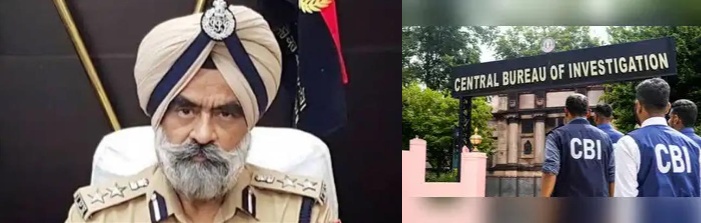
The recent arrest of Punjab Police DIG Harcharan Singh Bhullar by the Central Bureau of Investigation (CBI) has once again thrown a harsh spotlight on the deep-rooted rot of financial corruption within India’s bureaucratic and political systems. But this incident—where a senior police officer was caught red-handed accepting a bribe of ₹5 lakh, with subsequent recovery of ₹5 crore in cash and 1.5 kg of jewellery—is not just about one man’s fall from grace. It is symptomatic of a broader malaise that has taken root under the garb of a distorted brand of Indian secularism that has long shielded incompetence, patronage, corruption and unethical practices in the name of maintaining “communal harmony.”
According to reports, Bhullar was arrested in Mohali following a complaint by a scrap dealer from Fatehgarh Sahib. The DIG had allegedly been trying to extort money from the dealer. Following the arrest, CBI raids at Bhullar’s residence and office led to startling recoveries that suggest this was not a one-off incident, but part of a much larger pattern of corruption.
This arrest, while shocking, is not surprising. For decades, India’s institutional machinery—especially in certain states—has been corroded by a toxic blend of identity politics and a selective interpretation of secularism. Rather than being a principle of equal treatment for all religions, Indian secularism has been manipulated by political actors to enable appeasement and protectionism and being blind to the legacy of endless corruption. In the name of “secular values,” inconvenient questions are often suppressed, accountability is sidelined, and communal optics are prioritized over integrity.
This perverse version of secularism has allowed systemic corruption to flourish unchecked. It creates an ecosystem where competence is secondary to political allegiance, and where wrongdoing is often brushed aside if confronting it threatens to “upset communal balance.” It is no coincidence that officers like Bhullar can allegedly amass such enormous wealth while being part of the state machinery for years without drawing scrutiny.
In states like Punjab, where politics has long been intertwined with caste, religion, and community identities, officers are often selected, shielded, or promoted not for merit but for how well they fit into the political arithmetic of the ruling regime. When identity becomes more important than accountability, institutions rot from the inside out.
Moreover, the silence from sections of the political class and intelligentsia following such arrests is deafening. Had this been a case involving a communal clash or a controversial religious comment, outrage would have poured in from every corner. But when a senior officer is caught red-handed with obscene wealth, those same voices are conspicuously absent. Why? Because financial corruption doesn’t fit the preferred narrative of victimhood and communal disharmony that many so-called secularists champion.
The other accused arrested alongside Bhullar also raises questions about the network of enablers and collaborators that make such corruption possible. It is rarely the case that a DIG operates in isolation. Petty extortion, protection rackets, and bribery often depend on a broader system of collusion—one that spans bureaucrats, politicians, and business interests. And yet, such systemic scrutiny rarely takes place, especially when the individual in question belongs to a community or group deemed “sensitive” by the secular framework.
Indian secularism, in its original vision, was supposed to be a guarantor of equality, ensuring that state power remained neutral and just. But what has evolved is something far more corrosive: a model that selectively applies principles of justice, often shielding the corrupt under the guise of religious tolerance and minority protection. This selective outrage and protection have allowed individuals like Bhullar to operate freely for years until their misdeeds become too blatant to ignore.
The arrest should serve as a wake-up call. There needs to be a serious re-evaluation of how secularism is practiced in India—moving away from vote-bank politics and tokenism towards a more principle-driven governance model. Institutions must be re-empowered, not distorted by political compulsions. Corruption, regardless of the perpetrator’s religion, caste, or region, must be pursued and punished without fear or favor.
If India wants to emerge as a truly just and developed nation, it must shed the cloak of pseudo-secularism that has become a shield for incompetence and criminality. The law must apply equally to all, and public servants must be held to the highest standards of integrity—especially those entrusted with law enforcement.
Harcharan Singh Bhullar’s arrest is not just a story of individual greed—it’s a mirror held up to a system compromised by decades of political manipulation and moral decay. It’s time the nation looked into that mirror and chose reform over rot.