
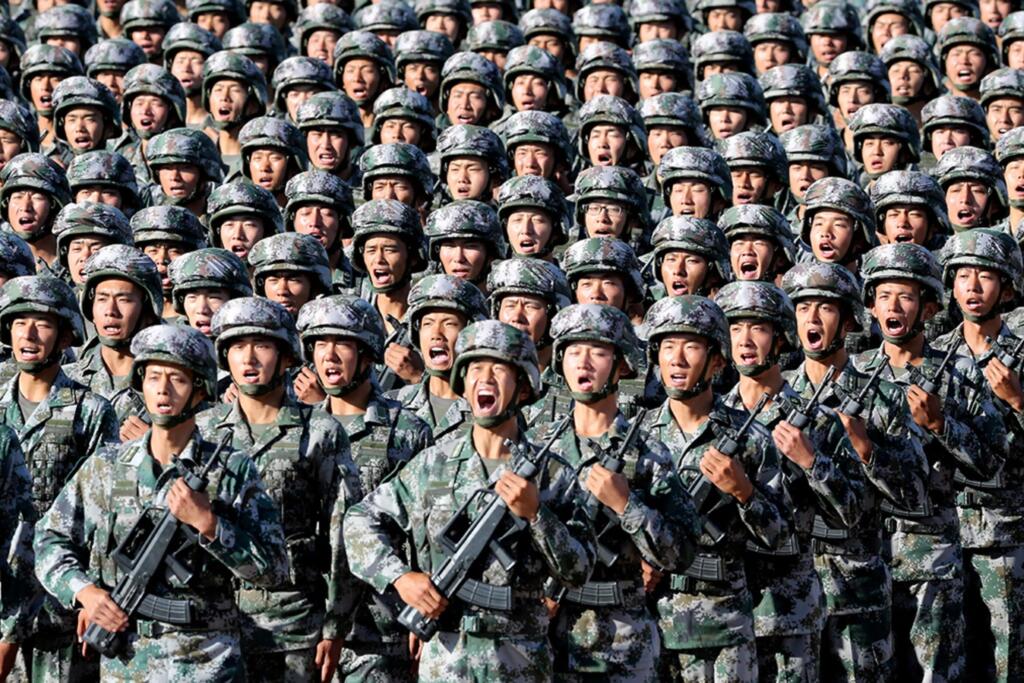
The People’s Liberation Army (PLA) stands as the Communist Party’s sword and shield, not a national army in service of the Chinese people. Nowhere is this more evident than at Lop Nur, the closed and secretive zone where every nuclear test—every plume, crater, and shockwave—was orchestrated to serve the Chinese Communist Party’s (CCP) ambitions and tighten its grip on power.
PLA: Commander of China’s Nuclear Edge
From the beginning, nuclear weapons have been under the PLA’s iron grip, reflecting the CCP’s wariness of any authority outside Party structures. The Lop Nur test site, carved out of Xinjiang’s barren expanse, became the party’s fortress—administered by the PLA, insulated from civilian scrutiny, and shrouded in secrecy. As China’s missile and nuclear arsenal expanded, the PLA’s Second Artillery (now the PLA Rocket Force) retained exclusive operational control over China’s nuclear weapons, with direct reporting lines to the Central Military Commission (CMC)—the Party’s central military policymaking body.
Analysis of satellite imagery and declassified intelligence reveals a clear pattern: every major expansion or technical upgrade at Lop Nur is a PLA operation, not a national initiative. Civilian authorities are deliberately excluded. Since the 1964 detonation of China’s first atomic bomb, the PLA has managed the technology, security, and consequences, treating nuclear arms as a bargaining chip for the Party, not a shield for the people.
Central Military Commission: Party Supremacy, Not Civilian Oversight
No civilian official in the People’s Republic of China possesses authority over nuclear use. The CMC, chaired by the CCP’s General Secretary, is the absolute authority over all matters of national defense—and nuclear command and control remain its most tightly guarded prerogative. The CMC bypasses state institutions, exemplifying the PLA’s identity as the Party’s military arm, not a force loyal to the constitution or a diverse citizenry. Orders for nuclear tests at Lop Nur, whether technical demonstrations or political messages, have always come through this Party-military pipeline, never Parliament, never public debate.
Lop Nur: PLA’s Closed Sanctuary
Lop Nur’s transformation was both physical and political. The remoteness of this Xinjiang wasteland allowed PLA planners to exert unchallenged control, expelling or exposing ethnic minorities to health and ecological devastation without recourse. Between 1964 and 1996, over 40 nuclear tests were fired here—many radioactive clouds drifting silently over Chinese and Central Asian populations. Unlike Western states, which have at times faced public backlash, declassification, and reparation, China and its Party-army have never come clean, never conceded culpability, and never compensated victims. The closed zone was not just for secrecy, but for deeper Party-military control, solidifying PLA presence in the region well beyond the Cold War’s end.
Party-First Ethos: PLA’s Unbreakable Doctrine
At the heart of PLA indoctrination is a relentless drive for “absolute Party loyalty”—a priority drilled into officers and political commissars at every level. Decades of political work, from Mao to Xi Jinping, have reemphasised that the PLA’s first, last, and only true allegiance is to the Party’s interests, not to the state, not to the people. This doctrine is reinforced through ideology, promotions, and purges. The PLA’s control of the nuclear arsenal is, in the Party’s words, “the political guarantee of our army’s development and aggrandisement”. Any suggestion of national ownership, let alone civilian command or transparency, is condemned as subversive and “erroneous” Western thinking.
The Indian Contrast: Army Under National Control
India’s nuclear journey stands in sharp contrast. Both the 1974 and 1998 tests were ordered by an elected government and openly debated in Parliament, with the Indian Army subordinate to national, not party, commands. Public disclosures followed, and even the most sensitive decisions on nuclear posture have ultimately been subject to democratic scrutiny. India’s doctrine of no-first-use, smaller arsenal, and non-proliferation orientation reveals civilian supremacy—a professional army’s loyalty to a nation and constitution, not to ruling parties. This openness has not eroded credibility; instead, it has underwritten India’s responsible stance.
Party’s Army, Party’s Bomb
Every test at Lop Nur has confirmed the PLA’s core identity: the sword of a single party, not the guardian of a diverse people. In China, nuclear weapons are not the people’s shield but the party’s fist—developed, controlled, and guarded by a politically indoctrinated military loyal to one master. For Beijing, nuclear power is not a national trust but a tool for asserting the Party’s will—inside Xinjiang, against external adversaries, and in internal political theatre. India’s experience reveals how different the world looks when the army belongs to the state, not to the party. In the shadow of Lop Nur, the lines between security and repression blur—when the so-called “People’s Army” exists only for the Party, not the people it claims to serve.
(Ashu Mann is an Associate Fellow at the Centre for Land Warfare Studies. He was awarded the Vice Chief of the Army Staff Commendation card on Army Day 2025. He is pursuing a PhD from Amity University, Noida, in Defence and Strategic Studies. His research focuses include the India-China territorial dispute, great power rivalry, and Chinese foreign policy.)