








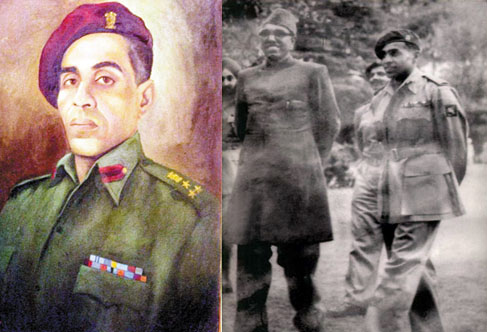
When the subcontinent was torn apart in 1947, the division was not only of land but of people, identity, and loyalties. As millions of Muslim soldiers opted for Pakistan, one man stood apart Brigadier Mohammad Usman. Jinnah and Liaquat Ali Khan personally approached him with promises of quick promotions and prestige if he joined Pakistan. But for Usman, no title could outweigh the love for his motherland. He chose to stay with India, a decision that would later make him a symbol of unwavering patriotism.
Born on July 15, 1912, in Bibipur village of Mau district, Uttar Pradesh, Mohammad Usman’s early life reflected discipline and courage. His father, Qazi Mohammad Farooq, a respected police officer and recipient of the British title “Khan Bahadur,” wanted his son to join the police. Young Usman, however, had other dreams. Despite struggling with a childhood stammer, he showed extraordinary determination.
An anecdote from his childhood reflects his fearlessness: at the age of 12, he jumped into a well to save another boy’s life. Years later, this instinctive bravery would define his destiny. In 1932, he was selected for military training at the Royal Military Academy, Sandhurst (as India had no IMA then). After passing out, he joined the 10th Baluch Regiment in 1935 and served with distinction in Burma during World War II as part of the 51st Infantry Brigade.
India’s Partition and the Test of Loyalty
When the British finally announced India’s independence, the Army faced its most painful division. Each soldier had to choose between India and Pakistan. As a senior Muslim officer, everyone assumed Usman would naturally go to Pakistan. Instead, he defied expectations and declared, “My duty and my loyalty are to India.”
Major General V.K. Singh, in Leadership in the Indian Army, wrote that both Jinnah and Liaquat Ali Khan personally tried to convince Usman. They even offered him a senior post and rapid promotion if he joined the Pakistan Army. Usman refused. His decision was not just an act of loyalty — it was an act of conviction in the secular spirit of the newly independent India.
As violence engulfed the subcontinent, Usman was sent to restore order in riot-hit cities like Lahore, Ambala, and Rawalpindi. He led troops under extreme communal tension, proving his leadership and impartiality. But greater trials awaited him soon — in the battlefields of Kashmir.
When Pakistan Invaded Kashmir And India’s Lion Roared
Barely two months after independence, in October 1947, Pakistan launched its first offensive into Jammu and Kashmir. The tribal raiders and disguised Pakistani soldiers stormed Muzaffarabad, murdering civilians and advancing toward Srinagar.
Usman, then commanding the 50 Para Brigade, was transferred to defend Nowshera — a small but strategic town between Jammu and Poonch. Pakistani forces had already captured Jhangar and aimed to gift it to Jinnah on his birthday, December 25. Usman thwarted those plans. The attackers failed to break through despite multiple assaults, including one by 5,000 heavily armed Pathans.
Major General Singh records that morale in Usman’s brigade was low initially. Many soldiers, still scarred by partition, doubted if a Muslim commander could be loyal. Usman shattered those doubts through his courage and leadership. He made “Jai Hind” the official greeting of his brigade and insisted that all briefings be conducted in Hindi — a symbolic act of unity.
His troops began to see him not as a Muslim officer, but as their commander and protector. Through sheer willpower and tactical brilliance, he turned a demoralized force into a wall of steel.
Operation Kipper and the Turning of the Tide
After Jhangar fell to Pakistan, Usman promised his superior, Lt. Gen. K.M. Cariappa, that he would retake nearby Kot — a strategic height that allowed the enemy to threaten Nowshera. Cariappa told him, “Bring me Kot as a gift.” Usman replied with military precision, “Sir, you shall have it.”
He planned Operation Kipper — named after Cariappa’s nickname — to capture Kot through a surprise twin assault. The operation began on the night of January 31, 1948. However, barking dogs alerted the enemy, spoiling the element of surprise. Still, shouting “Bole Chhatrapati Shivaji Maharaj ki Jai,” Indian troops charged forward.
The battle was fierce. Initially, the enemy recaptured the position, but Usman had anticipated this. His reserve companies struck back, and by 10:10 a.m. on February 1, India had retaken Kot. The victory cut off Pakistan’s supply route to Nowshera and became a turning point in the campaign.
Soon after, on February 6, 1948, came the legendary Battle of Nowshera. Nearly 11,000 Pakistani and tribal fighters attacked from multiple directions. Usman’s men fought with unmatched valor. Despite being outnumbered, Indian soldiers repelled the attack. The fierce resistance earned Brigadier Usman the title “Sher-e-Nowshera” — The Lion of Nowshera.
The ‘Balak Sena’ and the Spirit of Nowshera
Beyond strategy and bravery, Usman’s compassion stood out. During the Nowshera campaign, he formed a Balak Sena — a group of orphaned local boys aged 6 to 12 who assisted the Army by carrying messages. He ensured their food, education, and training.
Three of these boys later received gold watches from Prime Minister Jawaharlal Nehru for their courage. This act reflected Usman’s humanity and his vision of inspiring future generations.
After Nowshera’s victory, Pakistan placed a bounty of ₹50,000 on his head — a massive amount at the time. Yet Usman remained unmoved. When congratulated for his victories, he humbly replied that all credit belonged to his soldiers. “They fought, they bled, and they died for India. I am only their commander,” he wrote to Major General Kalwant Singh.
Operation Vijay and the Final Sacrifice
Following the Nowshera triumph, the Army planned to recapture Jhangar. Under Operation Vijay, Brigadier Usman’s 50 Para Brigade was tasked with capturing Ambli Dhar, followed by the complete reclamation of Jhangar.
True to his promise, Usman refused to sleep on a bed until Jhangar was retaken. For three months, he slept on the floor. Finally, on March 18, 1948, Jhangar was liberated, and only then did he allow himself the comfort of a cot.
However, destiny had other plans. On July 3, 1948 just 12 days before his 36th birthday — Brigadier Mohammad Usman was martyred. During heavy shelling, a 25-pound shell exploded near him, and shrapnel pierced his body. He died instantly — a soldier who lived and died as an Indian.
His death stunned the nation. Jawaharlal Nehru and Governor-General Lord Mountbatten attended his funeral in Delhi, where he was accorded full military honors. He was posthumously awarded the Maha Vir Chakra, India’s second-highest wartime gallantry award.
The Legacy of a True Indian Patriot
Brigadier Mohammad Usman’s story is more than a chapter in military history — it is a testament to faith, courage, and national unity. He stood firm when others wavered, refused Jinnah’s offers, led his men with valor, and embraced martyrdom with pride.
In a time when identity was torn by religion and politics, Usman’s loyalty to India reaffirmed the essence of the nation’s unity. Soldiers still remember him not just as a commander, but as a man who lived the motto of “Service Before Self.”
His humility, discipline, and unyielding devotion continue to inspire generations of officers. Indeed, had he lived longer, as many historians believe, Brigadier Usman might well have become India’s first Muslim Army Chief.
But even in death, his name shines bright — the Lion of Nowshera, who proved that love for the motherland knows no religion, only duty.