
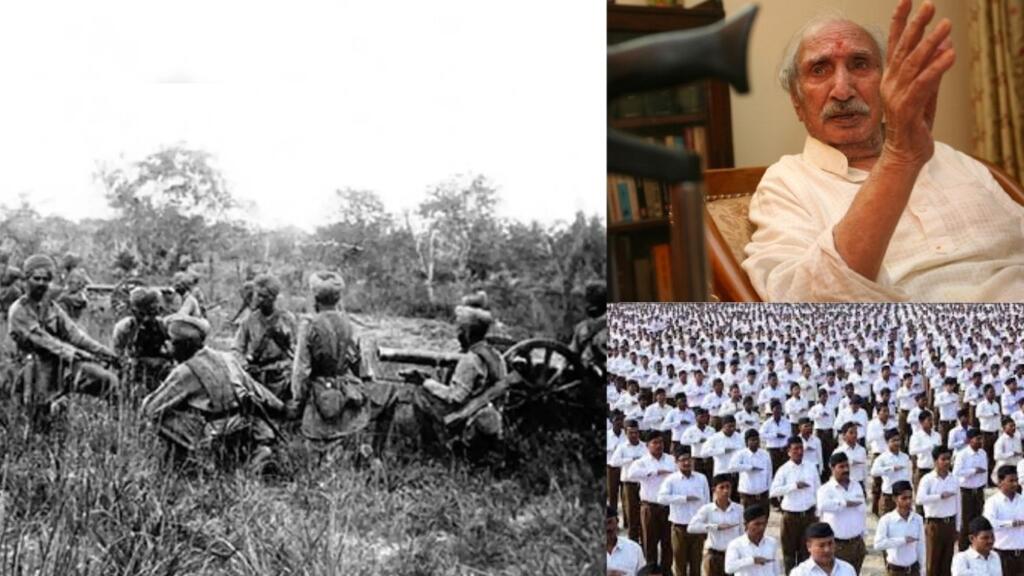
When Pakistan launched its first invasion of Jammu and Kashmir in October 1947, the Valley stood on the edge of collapse. The Maharaja’s army had crumbled, Muslim troops had mutinied, and the enemy was marching toward Srinagar with fire and fury. But when all seemed lost, it wasn’t just the Indian Army that rose to defend the sacred soil of Bharat it was the unsung sons of the Rashtriya Swayamsevak Sangh, the RSS, who stepped forward with unflinching courage. With nothing but faith, discipline, and patriotism in their hearts, these volunteers took up rifles, cleared the snowbound airstrip, and helped the Indian Army land its first troops saving Kashmir from falling into Pakistan’s hands. Their story is rarely told, but it is one of the most heroic, selfless, and dharmic chapters in India’s modern history a story of sacrifice that secured the tricolour in the Himalayas forever.
In the chilling night of 21–22 October 1947, when Kashmir was fast asleep, convoys of trucks rolled in from Pakistan’s Abbottabad region toward Muzaffarabad. Inside these trucks were armed tribal lashkars and Pakistani soldiers, secretly mobilized to invade Kashmir. It was Pakistan’s first military assault on Indian soil. As the invasion began, large sections of Maharaja Hari Singh’s army especially the Muslim soldiers turned traitors and joined the attackers. Hindu officers were executed, and the defense of the state seemed hopeless. The Indian Army was still in Delhi, awaiting formal orders to enter Kashmir. For the people of the Valley, it appeared as though the sun had set forever on their freedom.
But amid that fear and bloodshed, one organization stood firm the Rashtriya Swayamsevak Sangh. Its volunteers, inspired by the ideals of nationalism and dharmic duty, refused to flee. They chose to stay and fight, to defend their homeland with whatever little they had. Their courage and resolve became the invisible shield that protected Kashmir until the Indian Army arrived. History may record battles and treaties, but the silent bravery of these swayamsevaks remains the moral foundation of India’s defense of Kashmir.
The RSS had already been active in Jammu and Kashmir since 1940, thanks to the vision and leadership of Professor Balraj Madhok. Born in Skardu in Baltistan and educated in Lahore and Srinagar, Madhok foresaw the danger Pakistan posed right from the day of Partition in August 1947. He began collecting intelligence on Pakistani troop movements and warned local leaders about the looming threat. When the invasion began on 22 October, an RSS volunteer named Harish Bhanot rushed to inform Madhok of the advancing tribal raiders. Madhok immediately conveyed the situation to Maharaja Hari Singh. But with his own army collapsing under betrayal, the Maharaja had no strength left to resist. Desperate, he turned to the RSS for help and they responded instantly.
Over 200 volunteers answered the call. They were taken to Badami Bagh cantonment, handed .303 rifles, and given basic military training. Most of them were young students and workers who had never seen combat before, yet they stood shoulder to shoulder with the state forces, holding the line until reinforcements from Delhi could arrive. They fought, patrolled, and guarded vital installations, risking everything for a country that was barely two months old. Many among them attained martyrdom before the tricolour even reached the Valley their sacrifice buried in the fog of history, but remembered by those who lived through those dark days.
However, one of the most significant contributions of the RSS volunteers came not on the battlefield but on the frozen airstrip of Srinagar. Pakistan had chosen October for its attack knowing that by then, snowfall would have begun in the Valley. In 1947, there was no Banihal Tunnel, and heavy snow often closed the mountain passes connecting Jammu to Srinagar. The only way for India to send troops quickly was by air. But the Srinagar airfield was buried under a thick sheet of snow, making it impossible for aircraft to land. Without clearing the runway, India could not fly in soldiers — and if soldiers didn’t arrive, Srinagar would fall within hours.
The situation was desperate. The army appealed for local laborers to help clear the snow, but none were willing to step out in that freezing night under threat of enemy fire. Finally, the army turned to the RSS. They requested 150 volunteers, but within half an hour, 500 swayamsevaks reported for duty. In sub-zero temperatures, at 1:30 in the night, they began scraping snow and ice from the runway with bare hands, brooms, and shovels. By dawn, the airstrip was ready.
On the morning of 27 October 1947, history changed. The first Indian Air Force Dakota aircraft landed in Srinagar, carrying 329 soldiers of the 1st Sikh Regiment. They immediately secured the airfield, followed by seven more aircraft that brought troops and ammunition. The RSS volunteers helped unload supplies, move weapons, and even assisted in expanding the runway so that larger planes could land. Without their tireless work that freezing night, the Indian Army could never have landed — and Kashmir might have been lost forever.
From that moment, the RSS continued to assist the army. Their volunteers acted as guides, transporters, and intelligence gatherers. Some picked up rifles and joined soldiers on the frontline. Others stayed behind to protect women and children, distribute rations, and maintain order amid chaos. They did not fight for reward or recognition they fought because their dharma demanded it.
When the Indian Army finally pushed the invaders back and raised the tricolour over Srinagar, the swayamsevaks faded quietly into the background. They returned to their daily lives, leaving behind no medals, no monuments only the legacy of courage. Yet, their contribution was so vital that even senior army officers acknowledged that the success of the first air landing and the defense of Srinagar owed much to the RSS.
Today, as India marks 78 years since Pakistan’s first aggression, Kashmir stands proudly as an integral part of Bharat. But in that victory lies the blood, sweat, and devotion of countless unsung volunteers who served not just with rifles, but with faith. They embodied the spirit of “Seva, Shakti, and Swabhiman” service, strength, and self-respect.
The story of the RSS in the 1947 war is not just about defending territory it is about defending civilizational duty. When chaos reigned, it was these men who upheld the dharmic spirit of Bharat, proving that true nationalism is not declared in words but lived in action. Their silent service reminds every Indian that whenever the nation is in danger, there will always be those who rise not for power, not for politics, but for the sacred duty of protecting Mother India.