
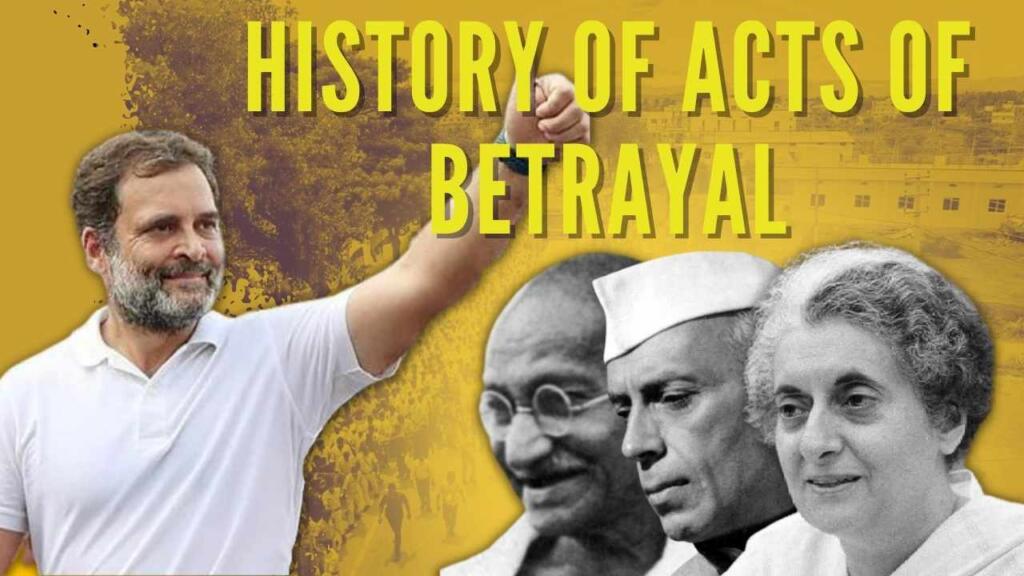
India’s military history is a saga of courage, sacrifice, and silent endurance but you wouldn’t know that from reading the history books shaped by the Indian National Congress. From the moment it gained political prominence under British patronage to its seven-decade monopoly over India’s post-independence narrative, the Congress Party has systematically erased, distorted, and delegitimized India’s armed power. Every major military victory has been buried under political propaganda, every soldier’s triumph converted into a politician’s photo opportunity, and every act of national defence subjected to suspicion, ridicule, or corruption.
This is not a coincidence. It is a deeply rooted ideological design born from the Congress’s colonial origins, sustained by its post-independence insecurity, and weaponised through intellectual capture of education, media, and bureaucracy.
The Colonial Seed: A Party Built to Negotiate, Not to Fight
The Congress Party was never a liberation movement. It began as a drawing-room discussion forum for the British officers and British-educated Indian elite — a political cushion created by the Raj to channel India’s restlessness into controlled, non-violent petitioning. Since the very survival of the British Raj depended on Indians’ obedience, not defiance.
Every armed uprising from the 1857 Revolt to the revolutionary movements of Bengal and Punjab, and finally the 1946 Naval Mutiny — threatened not only the British Empire but also the Congress’s own political standing. The British depended on Congress to keep Indians subdued while they crushed true rebellions with bullets and bayonets.
Ironically, Congress enthusiastically dispatched Indian soldiers to fight in World Wars I and II — safeguarding British colonial rule across continents to display its obedience to the Empire — yet looked down upon those very soldiers with moral contempt when they took up arms to free their own nation.
Thus was born Congress’s lifelong allergy to armed assertion. The very idea of the Indian soldier — disciplined, fearless, patriotic, and beyond political manipulation — frightened the Congress ecosystem. Independence for the Congress, was to be negotiated by politicians in suits, not seized in blood by the soldiers.
Nehru’s India: Distrust, Disarmament, and Deliberate Weakness
When India became free in 1947, Jawaharlal Nehru inherited not just the colonial state but also the colonial suspicion toward the military. He had no respect for the institution that had fought and bled for India’s borders; instead, he feared it.
To Nehru, a strong army represented a threat to his carefully built image of India as a moral, pacifist, intellectual nation. He dreamed of leading the “non-aligned world” through speeches, not strength. His vision of national security was naïve idealism wrapped in pseudo-intellectual arrogance blended with the non-violence core.
The armed forces were deliberately underfunded, their leadership sidelined by bureaucrats and ideologues. Civil servants with zero field experience decided strategy; soldiers became ceremonial subordinates. When military experts warned of Chinese aggression in the late 1950s, Nehru dismissed them. He even mocked the idea of fortifying the Himalayan frontier, famously declaring that not a blade of grass grew there.
The price of this arrogance was paid in 1962 by the lives of Indian soldiers — brave but ill-equipped and politically betrayed — who were sent to fight the Chinese without preparation or support. Nehru’s obsession with peace over preparedness led to one of the most humiliating defeats in modern history. Yet, even then, Congress refused introspection. Instead, it buried the lessons under layers of bureaucratic secrecy and academic spin.
Erasing the Armed Legacy: How Congress Rewrote India’s History
After 1947, Congress controlled education, media, and cultural institutions. History was rewritten to glorify its political leadership while suppressing any evidence that Indians fought and won freedom through force and without the Congress.
The 1946 Naval Mutiny, which rocked the British Empire and directly precipitated its decision to leave India, was wiped out of textbooks. It was one of the most significant pan-Indian military uprisings in modern history — a rebellion where Indian sailors hoisted the tricolour, refused British orders, and inspired mass solidarity from Bombay to Karachi to Calcutta. The British realised then that they could no longer rely on the Indian armed forces to maintain control — and that broke the Empire’s back.
But Congress could not afford that truth. It couldn’t admit that armed Indians — not politicians — forced the British out. So, it erased the mutiny and repackaged independence as a “gift of Gandhi’s non-violence” borne out of the “Quit India” movement which had fizzled out in 1942. The same fate awaited Subhas Chandra Bose and the Indian National Army (INA), whose heroism Congress buried under the carpet of moral posturing.
This was the beginning of India’s great historical amnesia — where soldiers vanished, and speeches filled their place.
1971: The Military’s Finest Hour, Politically Hijacked
The 1971 war against Pakistan remains one of the most spectacular military victories of the 20th century. Within 13 days, India’s armed forces liberated Bangladesh, captured 90,000 enemy prisoners, and achieved a decisive strategic win. It was a triumph of strategy, coordination, and professionalism — yet, Congress turned it into a political carnival.
Indira Gandhi milked the military’s success for electoral glory while denying the armed forces their institutional pride. The Simla Agreement that followed turned a golden opportunity into a geopolitical blunder — returning prisoners and captured territory without securing any final settlement on Kashmir.
It was a betrayal disguised as statesmanship. The Congress narrative turned the victory into “Indira’s triumph,” not the Indian Army’s. Once again, politics devoured professionalism.
Congress’s Defence Legacy: Neglect, Corruption, and Decay
From the 1980s onward, Congress’s relationship with the armed forces deteriorated further — not through open hostility but through institutional rot. Every major defence deal became a corruption racket: Bofors, Scorpène, AgustaWestland, and countless others. Defence modernisation became an opportunity for kickbacks.
Strategic infrastructure along the borders was ignored. Indigenous manufacturing stagnated. Bureaucratic red tape strangled research and procurement. Congress governments reduced the soldier to a budget line and the general to a prop for Republic Day parades.
By the time Kargil erupted in 1999, Indian soldiers were once again forced to fight in near-impossible conditions due to systemic neglect. Yet, even after their victory, Congress leaders like Rashid Alvi labelled it a “BJP’s war” — as if soldiers fought for political parties, not for the nation. This mindset exposed the party’s moral bankruptcy.
From Discomfort to Hostility: Congress’s War Against National Pride
Post-2014, as the nation began reclaiming its military pride — through the creation of the National War Memorial, celebration of Armed Forces Day, and open honouring of veterans Congress found itself ideologically stranded. Unable to digest a nationalism that did not orbit around its dynasty, it chose sabotage over support.
When Indian forces conducted surgical strikes and Balakot airstrikes, Congress leaders questioned their authenticity. They echoed Pakistani talking points, demanding “proof” and ridiculing India’s military leadership. The same pattern repeated in the 2025 frontier conflicts — a chorus of Congress-linked commentators dismissing India’s claims, amplifying Pakistan’s denials, and undermining public morale.
The message was unmistakable: if the military’s success strengthens the nation but weakens Congress’s narrative, it must be discredited.
The Psychological Root: Fear of Armed Indians
Why does Congress fear the military? Because the armed forces embody everything the Congress elite is not — merit, discipline, nationalism, and honour. The army answers to the nation; Congress answers to its dynasty. The army unites; Congress divides.
From the INA to the naval mutiny to modern border wars, every armed assertion of Indian strength has challenged Congress’s monopoly over patriotism. Congress cannot control the soldier, cannot manipulate his loyalty, and cannot claim credit for his courage. So it does what it has always done: ignore, belittle, or politicise him.
The seed of this fear was planted in 1946 when Indian sailors revolted against the British — not under Congress’s flag, but India’s. That moment proved that power could lie in the hands of ordinary armed Indians, not in drawing-room negotiations. Congress has spent every decade since then ensuring that seed never sprouts again.
The Cost of Silence
Because of this long political conditioning, generations of Indians grew up not knowing their real military history. Schoolchildren could recite Gandhi’s speeches but not the names of the generals who defended their borders. The blood that secured our freedom and sovereignty was replaced by the ink of political pamphlets.
Only in recent years has the tide begun to turn — with renewed public respect for soldiers, visible commemoration of their sacrifices, and a growing rejection of Congress’s selective amnesia. But the historical damage runs deep.
The Verdict
The Congress Party’s treatment of India’s armed forces is not just political neglect — it is historical betrayal. Born under colonial supervision, raised on elitist distrust of the masses, and sustained through dynastic insecurity, Congress never wanted a strong military or a self-confident nation.
It wanted obedient citizens, not proud soldiers; negotiated peace, not decisive victory.
From erasing the 1946 Naval Mutiny to doubting the 2016 surgical strikes, from undermining military preparedness to monetising defence procurement, the Congress record is one long continuum of deceit and contempt — for the men and women who defend India.
The truth is harsh but simple: Congress never celebrated India’s victories because those victories didn’t belong to them — they belonged to India.
And Congress has never truly stood with India — only above it.