
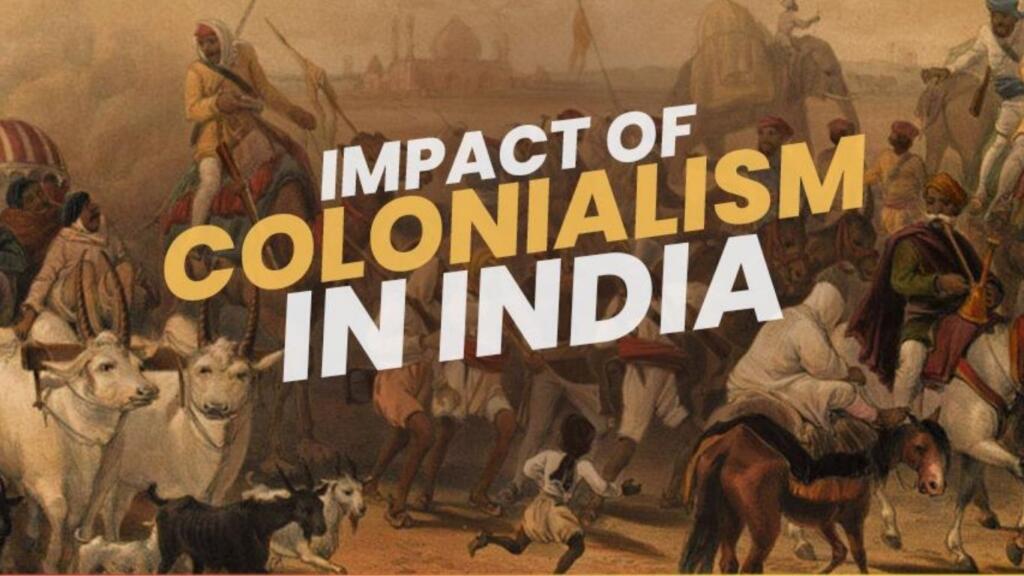
India won political freedom but never broke free from colonial control of the mind and system. British institutions, laws, education, and bureaucracy still govern our thoughts, economy, and justice. The rulers left, their mindset stayed. True independence demands decolonizing governance, education, and identity freeing India from British frameworks still ruling Indian minds.
A Nation Politically Free, Yet Psychologically Chained
India achieved political independence in 1947 — but freedom of the mind, systems, and institutions never truly followed. The British may have lowered their flag and departed, but their mindset, structures, and values lingered — carefully embedded into the very machinery of governance, education, law, and thought.
The first Indian government, despite its sincerity and idealism, failed to dismantle the colonial scaffolding. Instead of consciously diluting and replacing colonial institutions, it inherited them wholesale. The Indian Civil Service became the Indian Administrative Service; the British judicial system was adopted almost untouched; the English education model continued to dominate classrooms; and Western economic ideas became the framework for national planning.
Thus, while India gained sovereignty, it continued to be governed through the mental and structural tools of its colonizers. Political independence was achieved, but psychological and systemic colonization endured — and continues to this day.
Psychological Colonization: The Invisible Chains
The Inherited Inferiority Complex
The British built their empire not only through armies but through ideas. They imposed a belief system that glorified the West as advanced, rational, and civilized, while branding Indian civilization as backward, chaotic, and superstitious. This induced an inferiority complex that still manifests subtly — from a preference for English-speaking schools to an obsession with foreign universities, products, and validation.
Even today, an Indian product or innovation is considered credible only after gaining Western recognition. Ayurveda was dismissed as pseudoscience until American laboratories began to patent its principles. Yoga was seen as superstition until the West commercialized it as “wellness.” This mental dependency on Western approval is the deepest wound colonialism left behind.
The Crisis of Identity
Colonialism disrupted India’s civilizational continuity. The cultural synthesis of ancient India — which harmonized science, spirituality, and society — was replaced by Western binaries of religion vs. reason, modernity vs. tradition. Indians were trained to look outward for models of progress, losing connection with indigenous frameworks. This confusion has created a population caught between pride and imitation — traditional at home but aspirationally Western in thought.
Development and Economic Dependence
Western-Oriented Growth Models
Post-independence, India’s development blueprint borrowed heavily from Western industrial and economic theories. Centralized planning, large-scale industries, and capital-intensive models were prioritized over decentralized village economies that had sustained India for centuries. Mahatma Gandhi’s call for “Gram Swaraj” — economic independence through self-reliant villages — was sidelined in favor of the Nehruvian industrial model inspired by British Fabian socialism.
The result was decades of inefficient public-sector monopolies, over-bureaucratization, and a failure to empower small producers. Rural India stagnated while cities became islands of opportunity. Instead of creating an economic model suited to India’s diversity, the country adopted alien structures meant for very different societies.
Dependency Mindset
The colonial economy was designed for extraction — India supplied raw materials and consumed British finished goods. This dependency was never fully dismantled. Even today, India imports technologies, machines, defense equipment, and high-end goods rather than investing deeply in indigenous research and design.
Had post-independence India consciously broken this chain and invested in self-reliance from the beginning, it could have emerged as a technological leader by the 1980s, much like Japan or South Korea. Instead, the colonial mindset of looking abroad for validation and technology persisted, slowing India’s journey to true economic sovereignty.
Business and Market Psychology
Colonial habits shaped consumer preferences. Foreign brands are still perceived as superior — from electronics to clothing, from education to healthcare. “Imported” remains synonymous with “high-quality,” while local innovation often struggles for legitimacy.
This colonial hangover distorts market behavior. For instance, multinational corporations dominate sectors like consumer goods and pharmaceuticals, while indigenous enterprises are often limited by perception rather than capability. A similar pattern exists in academia — foreign journals are valued over Indian research, and Western certifications are prized above domestic qualifications.
Governance: Control Over Service
The Colonial Bureaucratic Legacy
The British bureaucracy was designed not to serve but to control — to monitor subjects, collect revenue, and suppress dissent. Tragically, this structure was retained intact. The Indian Administrative Service, modeled on the colonial Indian Civil Service, still prioritizes hierarchy, secrecy, and power over efficiency and service.
Even in independent India, citizens must “approach” bureaucrats rather than being served by them. Files move through endless layers, decisions are delayed, and accountability is diffused. This colonial attitude of governance — that people must obey the system, not the other way around — continues to suffocate reform and innovation.
Centralization of Power
The British ruled India through centralized authority because it allowed easier control. Post-independence governments, instead of decentralizing power to states, districts, and local bodies, retained the same model. This disconnect has caused uneven development — some regions thrive, while others remain neglected. India still struggles to achieve bottom-up governance rooted in local realities.
Judiciary: The Most Colonial of All Institutions
Perhaps no institution bears the colonial imprint more than the Indian judiciary. Designed by the British to serve imperial interests, it remains largely untouched in spirit and structure. Its architecture, language, dress code, procedures, and hierarchy reflect the mindset of a colonial court rather than a people’s justice system.
Justice in India remains expensive, delayed, and alienating. The British legal system was meant to protect the rulers — not to deliver quick relief to the ruled. That same design continues to burden modern India: over 50 million pending cases, decade-long trials, and laws that serve procedure over justice.
Colonial laws like sedition and defamation remain in effect, often used to silence dissent. The system privileges the English-speaking elite who can navigate it, while the common citizen faces intimidation and delays. This perpetuates inequality and erodes public confidence in justice — a direct inheritance from the British era.
Foreign Relations: Continuity of Subordination
After independence, India’s diplomacy often reflected cautious engagement with former colonial powers, particularly the UK. The psychological residue of dependence and admiration for the West influenced foreign policy orientations and trade alignments.
Even within the Non-Aligned Movement, India sought moral legitimacy from the West, trying to balance between admiration and assertion. This hesitation delayed India’s emergence as a confident global power. Only recently, through assertive foreign policies and self-confident diplomacy, has India begun to shake off that colonial hesitation.
Science and Technology: The Lost Decades
Colonialism turned India from one of the world’s scientific leaders into a mere supplier of raw talent. British policies systematically dismantled indigenous industries — from textile weaving to metallurgy — and discouraged research that didn’t serve imperial objectives.
Post-independence, India built excellent scientific institutions like ISRO, CSIR, and IITs, but the education system continued to train “implementers,” not “inventors.” The colonial mindset valued compliance over creativity. This created a generation of brilliant minds working for foreign corporations instead of building domestic innovation ecosystems.
If India had invested more deeply in applied indigenous technology after independence, it could have rivaled Japan in electronics, Germany in manufacturing, and the U.S. in computing. Instead, the colonial educational framework kept research subordinate to rote learning and foreign models.
Education and Culture: The Greatest Loss
Westernized Education System
The British introduced education not to enlighten Indians, but to produce clerks loyal to the Crown. Macaulay’s infamous “Minute on Indian Education” explicitly stated that the goal was to create Indians “English in taste, in opinions, in morals, and in intellect.”
Post-1947, instead of replacing this with an education system rooted in Indian knowledge, philosophy, and science, we continued the same syllabi and methods. As a result, most Indians remain unaware of India’s civilizational contributions — from advanced mathematics to governance systems, from medicine to astronomy. The system trains job-seekers, not nation-builders.
Language and Culture
English dominance continues to marginalize regional languages. Language is not just a communication tool — it carries worldview, culture, and identity. The overreliance on English creates a cultural hierarchy, where fluency determines status. A child fluent in English but ignorant of their own mother tongue grows up mentally displaced — Indian by birth, Western by aspiration.
This linguistic alienation has contributed to the slow erosion of Indian art, literature, and philosophy from mainstream consciousness. The colonial project of cultural erasure, thus, continues indirectly.
The Consequences of Continuing Colonization
The outcomes of this psychological and systemic colonialism are visible everywhere:
- Economic Inequality: The colonial system of privilege and exclusion survives through elite capture of resources and governance.
- Social Division: British divide-and-rule policies hardened caste and religious divisions, which continue to polarize society.
- Loss of Innovation: Dependence on Western approval stifles original thought and confidence.
- Moral Confusion: India’s civilizational clarity — rooted in dharma, duty, and balance — has been replaced by Western individualism and material obsession.
Had the colonial mindset been consciously dismantled after 1947, India could have developed into a uniquely balanced civilization — scientifically advanced, socially cohesive, and spiritually grounded — instead of struggling between imitation and authenticity.
The Path to True Decolonization
1. Decolonize the Mind
National pride must begin with confidence in Indian knowledge systems. Schools and media must highlight India’s scientific and philosophical heritage — from Panini and Aryabhata to Chanakya and Sushruta. Awareness of civilizational depth builds inner strength.
2. Reform Education
Education must encourage critical thought rooted in Indian realities — blending modern science with traditional wisdom. The New Education Policy (NEP) is a positive step, but its true spirit lies in localizing content and liberating learning from colonial rigidity.
3. Democratize Governance
The bureaucratic structure should shift from control to service. Technology, transparency, and accountability must replace hierarchy and opacity.
4. Judicial Reformation
A people’s justice system must replace the colonial court model — with simpler laws, regional languages, and community-based dispute resolution.
5. Economic Self-Reliance
India must move beyond being a service economy for the West. Encouraging indigenous manufacturing, defense production, and local technology ecosystems will reclaim true sovereignty.
6. Cultural Reawakening
India’s soft power — yoga, Ayurveda, Sanskrit, temple architecture, art, and festivals — must be reinterpreted not as relics, but as living, evolving expressions of civilization.
Conclusion: Freedom Yet to Be Achieved
India’s tryst with destiny remains incomplete. The British left, but their worldview stayed. True independence demands more than replacing flags — it requires replacing frameworks. Political freedom gave India a voice; decolonization of the mind will give it vision.
When India truly believes in its own genius — civilizational, scientific, and moral — it will not merely rise as a nation but reawaken as a civilization whose time has come again.