
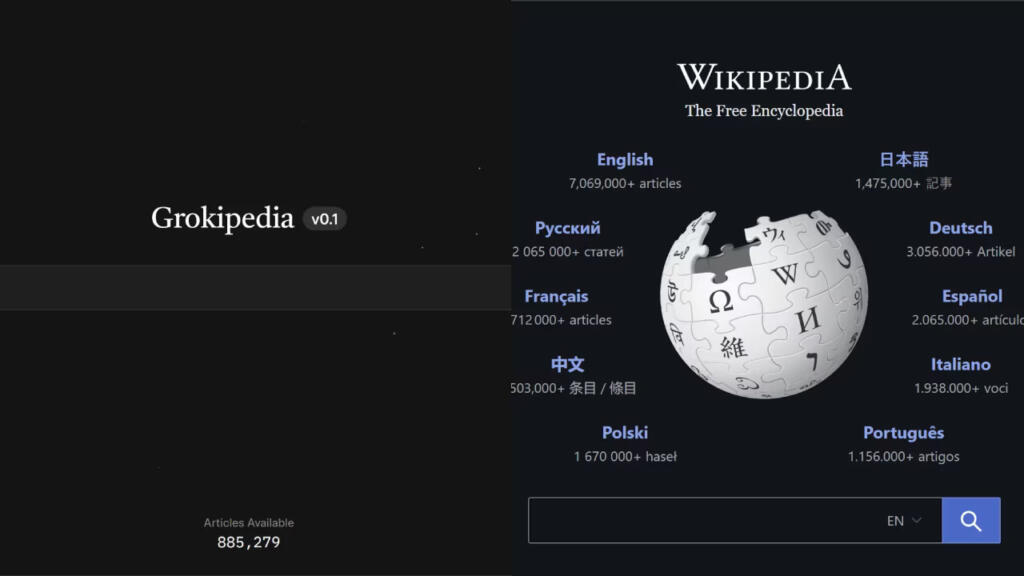
On 27 October 2025, Elon Musk’s AI-company xAI unleashed Grokipedia, a new AI-generated encyclopedia aimed squarely at challenging the long-dominated Wikimedia Foundation project Wikipedia. Musk’s pitch: Wikipedia is too influenced by political bias and activism, and Grokipedia promises “truth-based information” free from those distortions. This launch sets the stage for a fierce contest over how knowledge is created, curated and controlled online.
The launch and difference in approach
Grokipedia is built on xAI’s Grok AI model, which automatically generates, edits and curates articles. Musk says this will replace human-crowdsourced editing with algorithmic, “unbiased” knowledge. According to media reports, the early version has fewer than one million articles in English at launch—far behind Wikipedia’s millions.
By contrast, Wikipedia relies on volunteer editors, discussion pages, manual citations and a well-established governance structure.
The Ideological Flashpoints
The two platforms already diverge sharply in how they define and present controversial subjects. For example:
On Wikipedia the entry for “gender” describes it as “the range of social, psychological, cultural, and behavioural aspects of being a man (or boy), woman (or girl), or third gender”.
- On Grokipedia the corresponding definition is “the binary classification of humans as male or female based on biological sex, defined by the type of gametes produced.”
This illustrates a fundamental difference: Grokipedia adopts a more biologically-rooted, binary view whereas Wikipedia embraces a broader social-cultural framework.
Musk also cited the Wikipedia entry for George Floyd, noting how it omitted mention of his criminal record in the initial paragraph; Grokipedia, according to the description, includes that record, and reframes the incident more factually (in Musk’s view) and less in a “left-leaning” tone. - Why the stakes are high
This isn’t just about encyclopedias. It touches on trust in information, editorial oversight, bias, and control of knowledge. Consider:
Wikipedia has long been the go-to reference for many users worldwide, trusted for neutrality, volunteer review and transparency.
Grokipedia, built by Musk and powered by AI, is marketed as neutral—but critics warn it may embed a new form of bias. Indeed, early reviews suggest entries already reflect a conservative or pro-Musk tilt.
WIRED
If Grokipedia accelerates and gains significant articles, the public may split into two camps: those who trust human-edited Wikipedia, and those who accept AI-edited Grokipedia as “cleaner” or more “truthful.”
How the Battle is Likely to Intensify
Several dynamics suggest this rivalry will escalate:
- Article volume race – Wikipedia enjoys millions of articles in dozens of languages; Grokipedia must scale fast. Its speed of article generation may enable it to build coverage rapidly—but quantity may undermine quality or neutrality.
- Content wars and editorial control – Wikipedia relies on volunteer editors, talk pages, conflict resolution, and a transparent revision history. Grokipedia’s AI-driven approach may remove these human debates—but raise questions of accountability: Who corrects the AI? Where is the transparency?
As Wikipedia watchers note, replacing human edits with AI may reduce bias in one sense, but if the model’s training data or prompts carry ideological bias, then a different skew may emerge. - Language, culture and global reach – Wikipedia has enormous international coverage. Grokipedia will need to support multiple languages and cultural contexts to gain similar influence. Musk’s intention to support languages like Chinese, Spanish and German indicates awareness of this. The struggle for “which version of knowledge wins” will be global.
- Credibility & trust battle – If Grokipedia is seen as more accurate and less politically colored, it may draw users away. But if early missteps appear—errors, ideological slants, omissions—then trust may erode quickly. News outlets are already reporting concerns that Grokipedia may push far-right talking points.
That means Wikipedia defenders will highlight its long-tested editorial processes, while Grokipedia will argue Wikipedia remains biased.
Platform and ecosystem influence – Musk can integrate Grokipedia into his broader ecosystem (the X platform, perhaps others). Wikipedia remains independent but is embedded in countless websites, knowledge graphs, search results. The reach of each will influence “which encyclopedia becomes default” in search engines, educational use, citations, etc.
What it all means for knowledge consumers
For users, the upswing of this battle means greater choice—and greater confusion. On one hand, competition may spur improvements: Wikipedia may work harder to reduce bias and strengthen transparency; Grokipedia may iterate fast and correct Wikipedia’s weaknesses (Musk claims). On the other hand, a split emerges: Two platforms offering diverging definitions, different entry tone and priorities. A reader may now need to ask: which encyclopedia am I looking at—and whose biases are embedded?
Conclusion
The launch of Grokipedia marks the beginning of a knowledge war: one between the established institution of Wikipedia and the disruptive, AI-powered contender backed by Elon Musk. As the two platforms vie for dominance, the core issues will be accuracy, bias, transparency and trust. For anyone who cares about reliable knowledge online, this contest is far more than a novelty—it may shape the future of digital reference for years to come.