
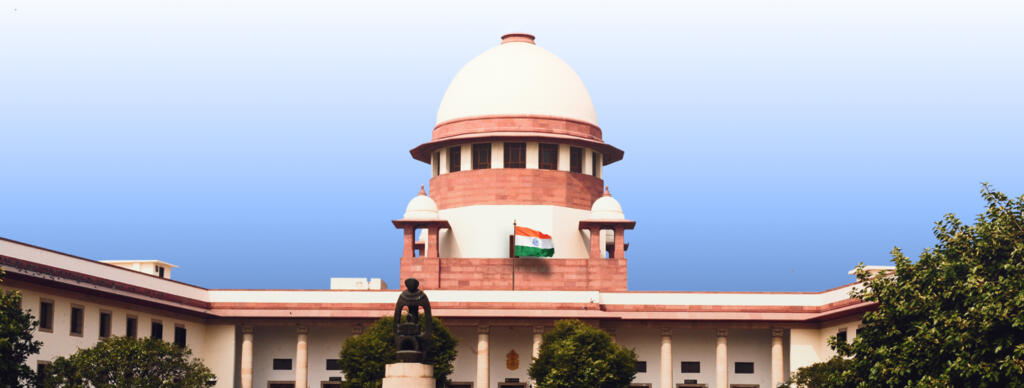
In a significant ruling that reinforces the Supreme Court’s long-standing stance on reservation limits in local body elections, a bench comprising Justice Vikram Nath and Justice Sandeep Mehta on Thursday, October 16, 2025, dismissed the Special Leave Petition (SLP) filed by the State of Telangana challenging the Telangana High Court’s interim stay on implementing 42% reservation for Backward Classes (OBC) in upcoming local body polls.
The bench made it clear that the High Court must now decide the main petition on merits without being influenced by the dismissal of the State’s SLP.
Background of the Dispute
The Telangana government had sought to implement an enhanced quota of 42% for OBC in local body elections, arguing that the move was backed by extensive empirical data and was enacted through a law that came into effect by “deemed assent” from the Governor. However, this law faced legal hurdles when the Telangana High Court issued an interim stay on its implementation, citing the potential breach of the 50% reservation cap imposed by the Supreme Court in earlier landmark rulings.
Challenging the High Court’s interim order, the State approached the apex court, seeking relief to implement the increased quota. The Supreme Court, however, refused to interfere at this stage, upholding the High Court’s cautious approach.
Key Arguments Before the Supreme Court
At the outset of the hearing, Justice Vikram Nath questioned why the government waited until after the election process was notified to bring in the reservation enhancement. Senior Advocate Dr. Abhishek Manu Singhvi, representing the Telangana government, explained that the Bill was delayed due to the Governor withholding assent, but the law came into force via “deemed assent,” as per the Supreme Court’s ruling in the recent Tamil Nadu Governor case.
He emphasized that the law had already been acted upon, and a stay was granted without even challenging the Act itself. Justice Nath interjected, querying, “How do you challenge a Bill?” to which Singhvi responded that it was no longer a Bill but an operational Act.
On the other hand, Senior Advocate Gopal Sankaranarayanan, appearing for the respondents, argued that the State’s reservation plan violated constitutional principles, especially the 50% cap on reservations as mandated in previous rulings like K. Krishna Murthy v. Union of India and Vikas Kishanrao Gawali v. State of Maharashtra. He noted that the triple-test laid down by the Court must be strictly followed before implementing any OBC reservation in local self-government institutions.
He further explained that earlier quotas stood at 15% for Scheduled Castes, 10% for Scheduled Tribes, and 25% for OBCs, staying within the 50% ceiling. The proposed increase to 42% for OBC alone would push the total reservation well beyond this limit, making it constitutionally unsustainable.
Another counsel for the respondents added that the State could not act unilaterally on “deemed assent” and must seek a writ of mandamus from the Court if the Governor delayed assent—an approach clarified in the Tamil Nadu Governor judgment.
Telangana’s Defense: Triple Test and Empirical Data
In defense, Singhvi argued that the 50% ceiling was not an “inflexible rule” and that Telangana had satisfied the triple tests mandated by the apex court. He claimed the government had conducted a comprehensive, year-long door-to-door household survey to gather socio-economic data justifying the need for enhanced reservations for OBC.
But Justice Nath and Justice Mehta remained unconvinced. Justice Mehta highlighted that the Gawali judgment explicitly barred exceeding the 50% limit even in local elections unless stringent conditions were met. Justice Nath further observed that the process — moving from survey to ordinance and then to a Bill — had not yet reached a finalized legal form.
Despite Singhvi’s repeated assertions that the law was valid and enforceable, the bench was unmoved. Justice Nath concluded the matter tersely: “You may continue with your elections [without reservations]… dismissed.”
Implications of the Ruling
The Supreme Court’s decision to dismiss Telangana’s plea reinforces the judicial commitment to uphold the 50% reservation cap, even in the context of local body elections. This cap, originating from the landmark Indra Sawhney v. Union of India (1992) judgment, has been a bedrock principle in Indian affirmative action jurisprudence, and despite numerous challenges, it has been consistently upheld in various contexts, including local governance.
The ruling also clarifies that deemed assent cannot be used unilaterally by States to bypass legislative procedures, especially when the implications have a direct bearing on constitutional provisions such as equality and fair representation.
Moreover, this case underscores the strict standards — the “triple test” — that State governments must meet before implementing or enhancing OBC reservations in local elections:
- Establishment of Backwardness through empirical data
- Specification of the proportion of reservation based on data
- Ensuring that the reservation does not exceed the 50% ceiling unless exceptional circumstances exist
While Telangana claimed to have met these tests, the Court evidently found that the procedure followed was either incomplete or unconvincing.
Conclusion
The Supreme Court’s dismissal of Telangana’s plea is a timely reminder to all states that legal compliance and constitutional discipline cannot be circumvented, even in pursuit of social justice goals. While affirmative action remains a vital tool for equity, its implementation must conform to constitutional boundaries and judicially laid down processes.
With the High Court now tasked with deciding the matter on merits, the future of enhanced OBC reservations in Telangana’s local bodies hangs in the balance — but for now, elections will proceed without the 42% quota.