
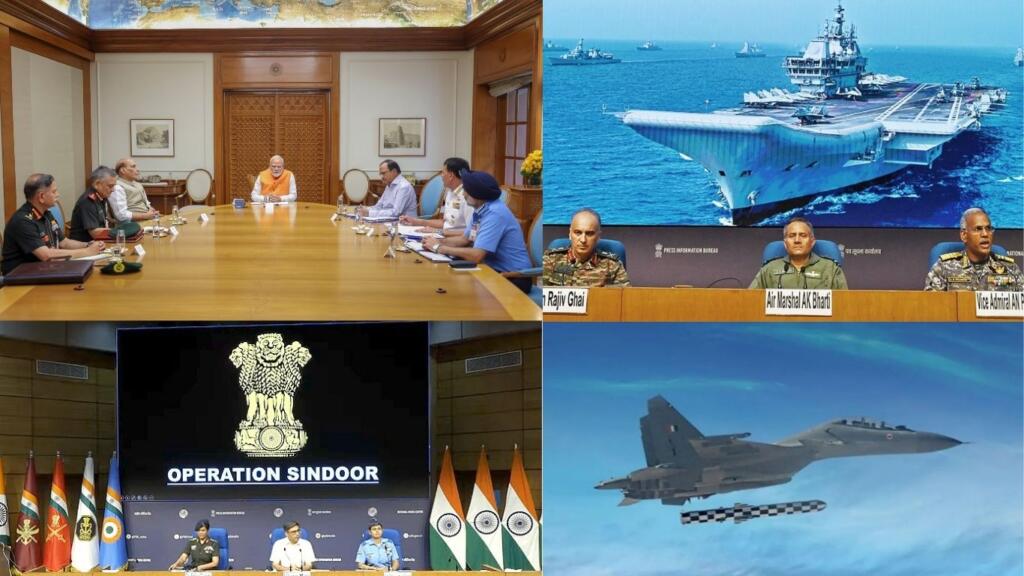
Recent criticism of senior Military leaders’ public statements often derided as unprofessional or “political bombast” betrays a limited understanding of modern strategic communication. In an era defined by hybrid warfare, perception management, and information dominance, rhetoric is not mere speech; it is strategy. What some dismiss as grandstanding is, in truth, calibrated deterrence a projection of will, capability, and national resolve.
Public messaging has long been an integral part of deterrence theory. Strength of conviction, when articulated by a nation’s Military leadership, signals both intent and capability. To adversaries, it conveys not recklessness but readiness. During the Cold War, bold pronouncements by U.S. and Soviet commanders were deliberate psychological manoeuvres designed to reinforce deterrence credibility.
The same principle applies today. When an Indian Military leader speaks of the ability to “change history and geography,” the message is not to domestic audiences alone. It is heard across borders a warning that the Indian state’s will to act is not to be tested. Far from being political, such rhetoric aligns with national security objectives by reducing ambiguity and reinforcing deterrent posture.
Unity of Political and Military Messaging
In democracies, visible coherence between the political and Military echelons strengthens deterrence. Fragmented signals whether in tone or intent invite miscalculation. When the political leadership projects firmness, and the military echoes that determination, the result is strategic clarity.
India’s adversaries, particularly Pakistan and China, watch this alignment closely. Disunity or excessive caution could be mistaken for hesitation. A synchronised message, by contrast, communicates institutional cohesion assuring citizens and deterring enemies alike.
Historic precedent bears this out. During the 1999 Kargil conflict, the synergy between Prime Minister Atal Bihari Vajpayee’s government and General Ved Prakash Malik’s leadership unified the nation and sustained morale. Similarly, John F. Kennedy’s resolute rhetoric during the Cuban Missile Crisis was reinforced by military preparedness a balance that compelled the Soviet Union to back down. Rhetoric and readiness, working together, have always been the twin pillars of deterrence.
The Nuclear Constraint: A Myth of Paralysis
Critics often argue that talk of large-scale conventional operations is implausible in a nuclearised environment. This view misreads deterrence dynamics. Nuclear weapons limit escalation, but they do not render conventional force obsolete. On the contrary, credible conventional capability, coupled with political resolve, is what makes nuclear thresholds meaningful.
The 1999 Kargil War demonstrated that India could wage a high-intensity conventional campaign under a nuclear shadow without triggering atomic retaliation. Restraint and dominance were exercised simultaneously. Similarly, the 2016 surgical strikes and the 2019 Balakot air operations showed India’s capacity to impose calibrated costs without breaching the nuclear ceiling.
Effective deterrence lies not in self-censorship but in signalling controlled willingness to escalate. Silence, or rhetorical timidity, risks encouraging the very adventurism deterrence seeks to prevent.
Beyond Symbolism: Defining Victory in Modern Conflict
Another misinterpretation is that modern limited wars should focus on “psychological paralysis” or symbolic gestures. Symbolism may satisfy domestic audiences, but it rarely compels adversaries to change behaviour. Durable deterrence requires the imposition of measurable costs destruction of enemy infrastructure, attrition of assets, and denial of operational confidence.
The 1971 Indo-Pak War proved that decisive conventional success culminating in the creation of Bangladesh transformed regional realities far more than symbolic posturing ever could. Likewise, the early phases of the 2003 Iraq War demonstrated that overwhelming conventional force, not mere rhetoric, secures deterrence longevity.
Tangible military outcomes reinforce psychological dominance. Without real damage, the psychological effect dissipates. Thus, deterrence is best sustained when the adversary suffers both mental and material defeat.
Political–Military Synchrony in Target Selection: The Case of ‘Operation Sindoor’
Critics who question the rationale behind targeting priorities in operations such as Sindoor misunderstand the logic of hybrid conflict. Choosing to strike terrorist infrastructure instead of conventional military targets was not an operational lapse but a deliberate act of strategic calibration.
In asymmetric warfare, the immediate imperative is to neutralise imminent threats while preserving escalation control. By focusing on terrorist camps deep inside hostile territory, India delegitimised the adversary’s use of proxies and avoided international backlash. The outcome was twofold: dismantling of the terror network’s logistics and reinforcement of India’s right to self-defence in global perception.
Such precision targeting mirrors the U.S. response to 9/11, where neutralising Al-Qaeda’s infrastructure in Afghanistan served both operational and narrative purposes. Far from being politically driven, these decisions exemplify the convergence of military logic and diplomatic foresight.
The Modern Military Chief: From Custodian to Communicator
The expectation that military chiefs should remain silent custodians of policy is an anachronism. In the information age, strategic communication is inseparable from military professionalism. Senior commanders are not only warfighters but also public educators and custodians of morale.
Their calibrated public statements shape deterrence credibility, manage expectations, and maintain psychological balance during crises. Silence, in such circumstances, can be misconstrued as confusion or weakness. Engagement, by contrast, reassures both the ranks and the citizenry.
Globally, this evolution is well-established. U.S., U.K., and Israeli military leaders routinely engage the public to clarify strategic posture. India’s chiefs operate under firm civilian oversight; their public communication reflects confidence, not partisanship. As General Bipin Rawat often demonstrated, responsible articulation can strengthen public understanding without compromising operational secrecy.
Civil–Military Unity as Strategic Strength
Visible unity between the government and the armed forces does not undermine democracy; it reinforces it. Civilian authority remains supreme, but alignment in tone and intent between policymakers and the military assures both the nation and its allies of India’s coherence.
During the Falklands War (1982), Prime Minister Margaret Thatcher’s unequivocal backing of the British military amplified deterrence and morale. Similarly, in India’s Kargil campaign, political-military harmony projected national resolve abroad and stability at home. Unity of purpose, not rigid separation, defines mature democracies in conflict.
Conclusion: Expression as Strategy
The world India inhabits is one of constant perception battles where influence, morale, and deterrence are fought as fiercely in the information sphere as on the battlefield. In such an environment, rhetoric is not a lapse of professionalism but an essential arm of statecraft.
Strong, unified statements by military leaders reinforce deterrence, sustain morale, and signal resolve. Far from being political, they reflect a modern understanding of warfare one that values strategic communication as much as kinetic capability.
India’s evolving military discourse represents the professional maturity of a confident democracy a state secure enough to speak with strength, unity, and purpose.
(Shashwat Gupta Ray is a multiple award-winning defence and strategic affairs journalist with over 20 years of experience in print and digital media. Previously Deputy Editor at Herald Group of Publications and Resident Editor at Gomantak Times, he has extensively covered major events, including the 26/11 Mumbai terror attacks and Maoist insurgencies. He is also the creator of the award-winning YouTube channel Uncovering India, which focuses on impactful social and developmental documentaries.)