
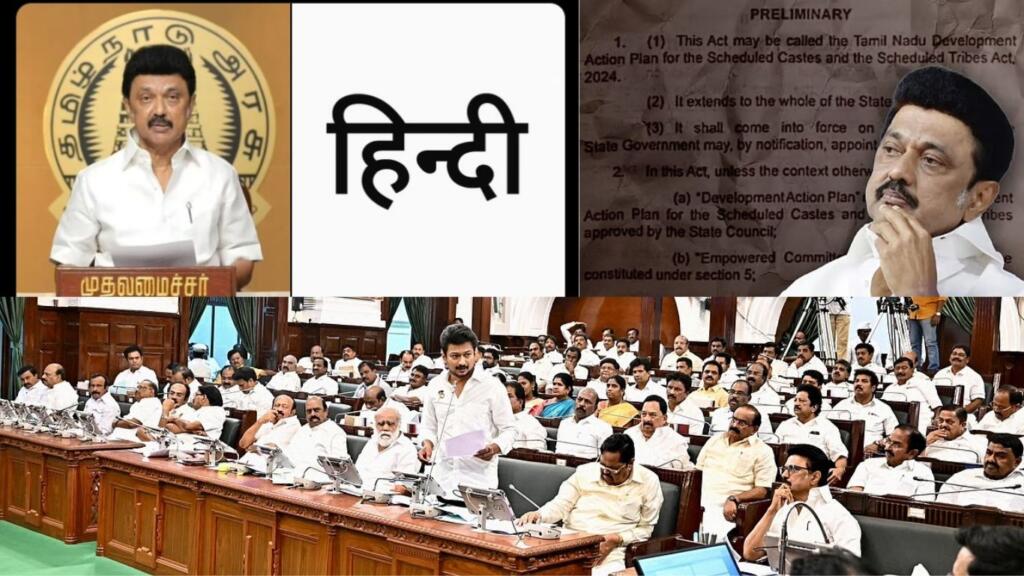
The DMK government’s latest attempt to push an “anti-Hindi” bill banning Hindi hoardings, songs, and films has backfired spectacularly. Following widespread outrage, the Tamil Nadu government has quietly stalled the controversial proposal. The bill, reportedly prepared to be tabled during the Assembly’s monsoon session, was projected as a move to stop the “imposition of Hindi” but critics, called it absurd and unconstitutional. Facing mounting political pressure from corruption probes, the Karur stampede case’s CBI transfer, and economic setbacks like the Foxconn controversy, the DMK once again tried to play its old card language politics to divert public attention.
To Divert from Scandals
The proposed “anti-Hindi bill” sought to ban the use of Hindi in hoardings, public advertisements, films, and songs across Tamil Nadu. Sources said the Stalin government held an emergency meeting with legal experts to check its constitutional validity before stalling it following the backlash. However, this was not an isolated move it fits the DMK’s familiar political playbook.
In recent weeks, the state government has been cornered by a series of embarrassing developments. The Supreme Court transferred the Karur stampede case to the CBI, directing the SIT formed by the Madras High Court and the state’s one-member inquiry commission to hand over all documents. Similarly, Ahjith Kumar, a temple guard’s custodial death and the Kallakurichi hooch tragedy have drawn national condemnation, exposing Tamil Nadu’s deteriorating law and order situation.
With public anger rising, the DMK seems to have reached for its oldest weapon the so-called “Hindi imposition” debate to ignite emotions and distract voters. BJP leader Vinoj Selvam aptly called the move “stupid and absurd,” adding that the Stalin government was trying to use the language issue to hide its failures in governance and administration.
Former Tamil Nadu BJP President Annamalai took to ‘X’ and lashed out at DMK government saying “The DMK government’s plan to table a bill to ban Hindi wasn’t a rumour; it was premeditated, and their cadres, as usual, started their trademark theatrics of blackening & burning Hindi letters. DMK functionaries in Pollachi yesterday burned Hindi letters in celebration after learning of the bill that was to be tabled in the assembly. Joblessness at its peak! INDI Alliance – Divisive by nature, United by Corruption!”
Hypocrisy of the DMK: Anti-Hindi in Chennai, Hindi-Friendly in Bihar
The irony could not be sharper. The same Chief Minister MK Stalin, who claims to defend Tamil pride by opposing Hindi, happily attended the ‘Vote Adhikar Yatra’ rally in Bihar just last month a state where Hindi is the primary language of communication. If Stalin is so against Hindi, why did he share the stage with Rahul Gandhi, Tejashwi Yadav and others addressing crowds in Hindi? This hypocrisy exposes the DMK’s selective outrage and opportunistic politics.
Even the DMK’s ally, the Congress party, which is part of the INDIA bloc, has maintained a deafening silence over the issue. Congress leaders who often claim to stand for “unity in diversity” have refused to condemn DMK’s divisive language politics. Their silence shows how the so-called secular alliance puts political arithmetic over national unity.
Across India, Tamil movies are released in Mumbai, Delhi, Bengaluru, and even internationally, and are widely celebrated. In fact, Tamil signboards can be seen in some parts of the United States, and yet no government in India or abroad has ever contemplated banning Tamil content. If Tamil pride thrives globally without restricting others’ languages, what moral or constitutional right does DMK have to curtail another Indian language?
DMK’s Governance Collapse: From Rupee Symbol to Ruinous Symbolism
This is not the first time DMK has courted controversy over language symbolism. Earlier this year, the 2025–26 state budget replaced the national rupee symbol (₹) with the Tamil letter ‘ரூ’ (ru), drawing sharp criticism from Union Finance Minister Nirmala Sitharaman and BJP leaders. The DMK defended its move as an act of “linguistic pride,” but it was seen nationwide as an insult to a national symbol.
Now, with the anti-Hindi bill, DMK appears to be doubling down on its divisive rhetoric. Instead of focusing on governance, infrastructure, and investment, the Stalin government is busy creating cultural fault lines. The Foxconn investment controversy, which has put Tamil Nadu’s industrial policy under scrutiny, and the court setbacks in multiple corruption cases including former DMK Minister Senthil Balaji’s case have already tarnished the DMK’s image.
Furthermore, the Chief Minister recently declared that the Assembly would pass a resolution against Israel, accusing it of genocide in Gaza another move beyond the state’s constitutional mandate. A state government has no authority to pass resolutions targeting a friendly foreign nation like Israel, with which India shares decades of strategic and defense cooperation. This act once again revealed how the DMK prioritizes political theatrics over governance.
The party’s obsession with symbolic politics has come at the cost of development. From Karur to Kallakurichi, administrative lapses, corruption scandals, and human rights violations have piled up under DMK’s rule. Instead of addressing them, the government continues to play emotional games with Tamil identity.
Opposition to NEP and NEET: DMK’s War on Opportunity
The DMK’s opposition to the New Education Policy (NEP) and NEET also stems from the same populist agenda. The government argues that learning Hindi or adopting national education reforms would “harm Tamil identity,” but the reality is that these policies empower rural and underprivileged children. Thousands of first-generation learners from poor backgrounds have secured MBBS seats through NEET, cutting out the middlemen and donation-based admissions that once thrived under Dravidian-era education mafias.
DMK’s resistance to these reforms has little to do with protecting Tamil culture it’s about protecting vested interests. Ironically, while DMK leaders oppose Hindi in Tamil Nadu, their own children study abroad in English-speaking countries, mastering multiple foreign languages. When it comes to personal gain, the DMK elite embraces global exposure; when it comes to the people of Tamil Nadu, they trap them in linguistic isolation for political mileage.
The hypocrisy is glaring: they send their children to London, Sydney, and New York, but won’t allow Tamil Nadu’s students to learn one more Indian language that can open doors across the country. This attitude reveals not cultural pride, but cultural insecurity and an utter disregard for the youth’s future.
The Anti-Hindi Drama Won’t Work in 2026
The DMK government’s attempt to create yet another “Hindi imposition” controversy is nothing but an electoral stunt designed to deflect attention from its crumbling administration. With the 2026 Assembly elections approaching, Stalin and his party are reverting to their oldest trick emotional manipulation through identity politics. But Tamil Nadu’s people have evolved.
They can see through the propaganda. They know that real pride lies not in banning languages but in strengthening education, improving jobs, and ensuring accountability. From corruption scandals to tragic deaths, from Foxconn fiascos to failed law and order the DMK’s record stands exposed.
This anti-Hindi bill is not about Tamil pride; it’s about political survival. And this time, the people of Tamil Nadu are unlikely to fall for the same script that’s been running since the 1960s.