
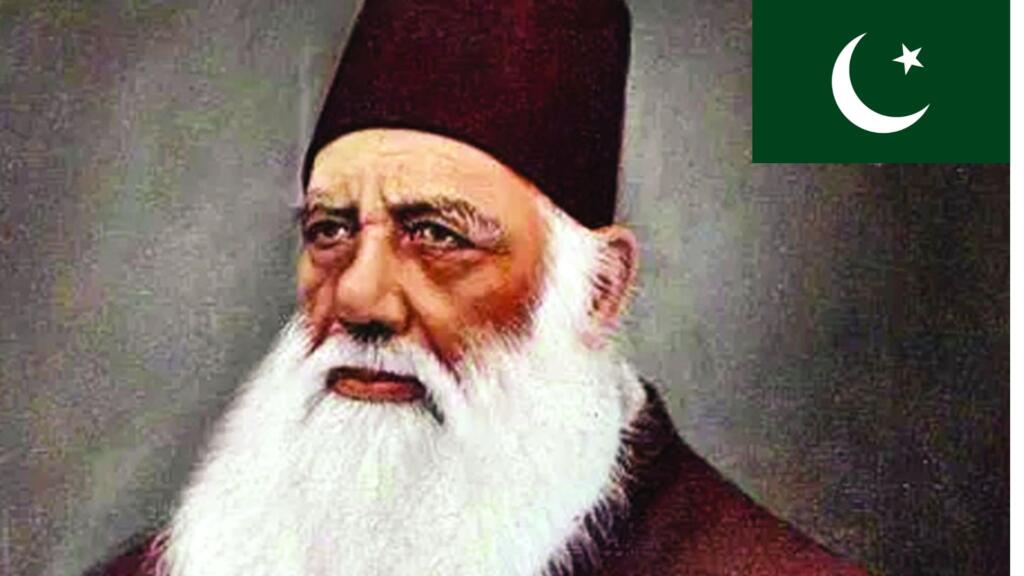
Sir Syed Ahmad Khan is usually presented in textbooks as a pioneering educationalist and a modernizing figure for South Asian Muslims. The quotations above give us a different, uncomfortable portrait — one of a man whose ideas about religion, race, caste and loyalty were deeply conservative, socially divisive, and fiercely deferential to British rule. Reading those statements together forces a reassessment: his “progressive” project carried a heavy freight of elitism, communal separatism, and allegiance to colonial rule that school narratives often downplay or omit.
At first glance, Sir Syed’s emphasis on education and religious instruction seems straightforward: he believed modern learning must be married to Islamic practice. But his model for education was not universalist. “An education without religious instruction is a body without soul,” he declared — not merely affirming faith’s role, but insisting on a curriculum that reinforced sectarian identity (students “will have to offer the congregational prayer five times a day”). This was not a pluralistic vision of modernity; it was an attempt to produce a disciplined Muslim elite shaped as much by ritual conformity as by Western-style knowledge.
Beneath that posture lies explicit social contempt. Sir Syed’s comparisons of Indians to “a dirty animal” and Englishmen to “an able and handsome man” are startling in their bluntness. They reveal a racialized hierarchy in which the colonizer’s manners and morality are benchmarks and the colonized are degraded by default. To call the native population “imbecile brutes” (never found in Indian textbooks!) — or to assert that the English “have reason for believing us in India to be imbecile brutes” — is not modest self-critique; it is an internalized servility that naturalizes British superiority.
That servility is inseparable from the political positions Sir Syed advanced. He openly argued that Muslim interests would be submerged in nationalist politics dominated by Hindus: “If the Congress were to rule the country… the Muslims could be helpless as they would be in a minority.” The remedy he proposed was not cross-community reform or civic equality but political separation and protection under British patronage. His language — urging Muslims to fear becoming “subjects of the Hindus instead of the subjects of the People of the Book” — institutionalizes communal difference as destiny and frames the colonial regime as the guarantor of Muslim safety.
This argument shades into what the quotations describe as an early formulation of a two-nation theory. When Sir Syed says “The Hindus and the Muslims are two different nations,” he is laying out a binary that precludes shared citizenship or power-sharing once the British leave. He goes further: if all the English and their arms were to depart, “who would be rulers of India?” and “it is necessary that one of them should conquer the other.” Such a prognosis turns a political problem (competition for power in a plural society) into an ontological quarrel between immutable communities — and then recommends perpetual colonial guardianship as the only peaceful solution
If you add his stance on 1857 and the Raj, the picture hardens. To call the 1857 uprising “an act of Bastardliness” and to assert that Muslims had no just reason to rise against British rule transforms a complex anti-colonial rebellion into moral deviance. Loyalty to the British becomes a religious duty: “Loyalty to the British was the religious duty of Muslims,” he maintained, unless the Raj actually forbade Islamic practice. That conditional loyalty was not a civic calculus so much as a theological framing of colonialism as providential and protective.
Class and caste hierarchies also surface in his educational prescriptions. He argued that seats of authority (“a seat in the Council of the Viceroy”) should be occupied by people of “high social position” and “good breeding,” implicitly excluding those of “low caste or insignificant origin” even if they possessed degrees or ability. At a madrasa where children from low-caste backgrounds studied, he openly recommended limiting their instruction to elementary literacy, arithmetic and basic religious tracts — not full access to English education. That posture preserved elite privilege under the guise of communal uplift.
What emerges from these excerpts is a Sir Syed who is not merely conservative, but structurally invested in inequality: between colonizer and colonized, between classes and castes, and between religious communities. The educational institutions he founded and programs he proposed must be understood alongside these political and social commitments. Celebrated as the founder of modern Muslim education, he also advocated policies and ideas that hardened communal boundaries, accepted colonial rule as morally normative, and protected elite status — even if that meant denying full intellectual and political rights to the lower orders.
Why does this matter for textbooks? Because public memory matters. Schools and textbooks presenting Sir Syed solely as a forward-looking educational reformer produce an incomplete, sanitised history. Honest teaching should hold both lines together: his substantial contributions to Muslim schooling and his writings that steered many Muslims away from pan-Indian political solidarity and toward permanent dependence on colonial power. Both aspects shaped South Asian history — particularly the trajectories of communal politics in the 20th century.
Revisiting Sir Syed doesn’t mean erasing his achievements. It means teaching him as a figure of contradictions: a builder of institutions who also promoted social hierarchies; a modernizer who insisted on ritual conformity; a defender of his community who argued for perpetual colonial guardianship. That fuller portrait helps students understand how ideas about caste, race, religion and loyalty interlocked in late colonial India and why those legacies still matter.
Textbooks should make room for uncomfortable complexity. Presenting Sir Syed only as a benevolent reformer is selective memory; presenting only the provocations without his institutional work would be equally distortive. The right approach is honest balance: expose students to his own words, to critical responses of his time, and to the long-term consequences of the choices he promoted. That is how history and authentic textbooks educates — by refusing to simplify the past into saints or villains, and by showing how beliefs, power and institutions interact to shape lives.