
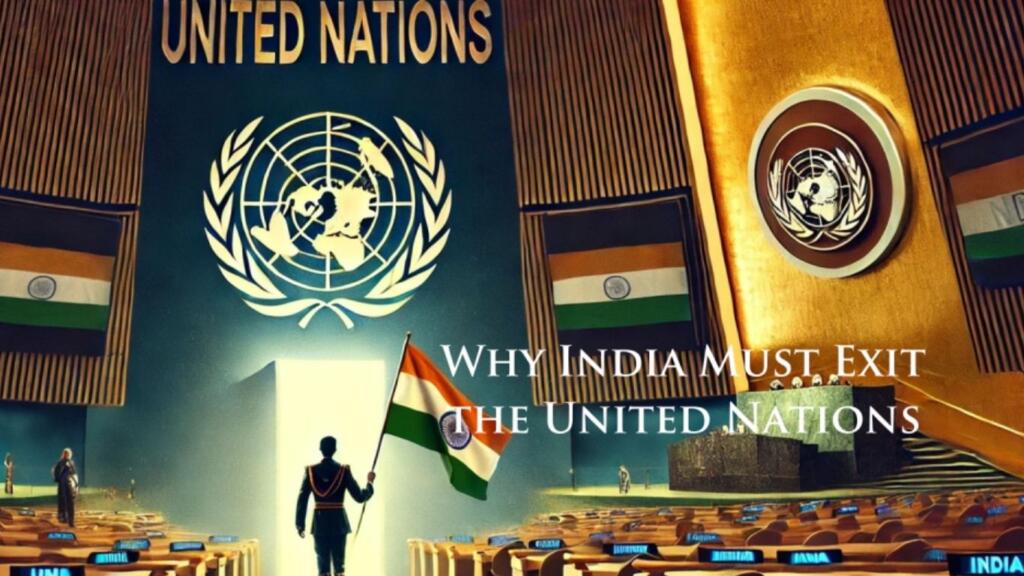
India’s exit from the United Nations would be a civilizational revolt against a colonial-era system designed to exploit the Global South. It would expose Western hypocrisy, collapse outdated power structures, and trigger a multipolar world led by self-respecting nations. India’s departure would inspire others to break free from UN-backed dependency, dismantle exploitative institutions, and accelerate a new, fairer global order rooted in sovereignty, equity, and civilizational pride.
India Quitting the United Nations: A Civilizational Shift in Global Power
The idea of India walking out of the United Nations (UN) might seem radical to some, even shocking. But in a world undergoing tectonic shifts in power, influence, and identity, it may soon become not only feasible but necessary. The traditional argument that India would lose out by quitting the UN is fundamentally rooted in colonial-era thinking: a mindset of dependency, appeasement, and false validation by powers that once ruled and now seek to dominate through institutions. It’s time to flip this narrative and focus on the gains—strategic, psychological, geopolitical, and civilizational—that India and the broader Global South would reap.
1. Dismantling a Colonial Structure
The United Nations is not just a post-war framework—it is, at its core, a colonial-era institution designed to maintain the global hierarchy established by the victors of World War II. The broader network of global governance—through mechanisms such as the Bretton Woods system, WTO, IMF, World Bank, WHO, ICSID, ISDS, and ICJ—further entrenches this design. These institutions often serve as instruments for the continuation of colonial influence in economic, legal, and political spheres under the guise of neutrality and multilateralism.
India’s departure would:
- Break these chains of modern colonialism disguised as global cooperation.
- Set a powerful precedent for others in the Global South to critically assess and exit systems built to exploit them.
- Strip the remaining colonial-era European powers of their last avenues for extracting strategic and economic advantage from the developing world.
2. Breaking Free from Post-War Shackles
India’s exit would be a sovereign rejection of a framework that no longer reflects the geopolitical and economic realities of the 21st century. It would mark the end of India’s participation in institutions that refuse to evolve beyond outdated power structures.
India would gain:
- Unfiltered foreign policy sovereignty.
- Full control of its diplomatic narrative.
- Redirection of resources from ineffective UN bodies to more relevant regional and bilateral mechanisms.
3. Reclaiming Civilizational Identity and Leadership
India is not merely a modern state—it is an ancient civilization. Exiting the UN would empower India to reclaim its unique ethos and propose new models of governance based on dharmic principles, sustainability, and decentralization.
This shift would:
- Reassert India’s pluralistic approach to development.
- Promote civilizational leadership instead of post-colonial subservience.
- Offer alternatives to hegemonic Western paradigms.
4. Rejection Breeds Awakening: UNSC and G7 Exclusions
India’s exclusion from the UNSC, G7 and other ‘global organisations’ is deliberate, not accidental. Despite its economic size, population, geographical landmass, democratic values, and contributions to UN led peacekeeping, it remains sidelined. Meanwhile, weaker and stagnant economies hold permanent influence in global decision making and directing the affairs of the Global South.
India’s expanding industrial strength, rising defense capabilities, and globally respected, skilled diaspora warrant overdue recognition. But with the UN and its affiliated bodies consistently denying India its rightful place, a strategic exit becomes not only justified but necessary—striking at the legitimacy of these biased institutions and inspiring other nations to question and reject their imposed hierarchies.
5. Empowering the Global South
India’s bold departure would galvanize the Global South. Many nations feel trapped in an international structure that governs all aspects of their economy, politics, and society while keeping them artificially underdeveloped and dependent.
These nations:
- Suffer under exploitative trade and regulatory frameworks.
- Watch their natural resources extracted without justice.
- See their populations treated as labor reservoirs or crisis fodder by Global North powers.
India’s move would inspire them to resist this order and embrace new self-sustaining partnerships.
6. Strengthening BRICS and Alternative Alliances
BRICS, SCO, and similar alliances are rising in legitimacy. India’s leadership within these will grow stronger post-UN.
India’s exit would:
- Drive BRICS toward becoming a real institutional alternative.
- Encourage the creation of new development banks, arbitration forums, and trade pacts.
- Empower collaborative models that respect sovereignty.
7. UN’s Legitimacy Crisis and Reputational Loss
Without India, the United Nations cannot claim to represent the world. Its refusal to reform and admit emerging powers into core decision-making will appear even more unjust.
Immediate fallout:
- Loss of credibility in the Global South.
- Public exposure of hypocrisy in peace, rights, and development discourse.
- A cascade of smaller nations reconsidering their membership.
8. Accelerating Global Multipolarity
India’s move would fast-track the demise of the unipolar or Western-centric global order. Multipolarity is already emerging; this act would make it irreversible.
Benefits:
- Stronger regional institutions.
- New global rules based on mutual respect.
- Diverse diplomatic leadership replacing monopoly.
9. Ending the Political Dominance of Declining Powers
The same countries that ruled by force now rule by bureaucracy. Their dominance through IMF loans, UNSC vetoes, and United Nations-funded narratives is disproportionate.
India’s rejection would:
- Reveal these powers as paper tigers.
- Eliminate their veto-like influence over Global South affairs.
- Enable a shift from privilege to merit.
10. Dismantling the Moral Superiority Complex
Western institutions often preach selectively. They ignore their own wars, invasions, and human rights violations while targeting emerging nations.
India’s exit would:
- Shatter this moral hypocrisy.
- Normalize independent development and cultural pride.
- Showcase India as a power that helps without seeking control.
11. Weakening the Global Institutional Complex
The UN’s departure will destabilize related bodies: WTO, WHO, FAO, IMF, and others.
Effects:
- Mass disillusionment in Global South nations.
- Rise of alternative institutions.
- A push to audit and expose decades of manipulation.
12. Economic and Trade Realignments
India’s economy is now global and resilient. It does not depend on UN-linked trade systems.
By quitting, India could:
- Promote rupee-based trade.
- Establish South-South digital currencies.
- Secure bilateral and regional deals based on fairness.
13. Western Reaction: Bluff Without Power
India’s exit will provoke a predictable but increasingly ineffective reaction from Western powers. Their dominance is built on narratives and legacy systems, not real strength anymore.
Media Smear Campaigns: Western media will attack India with accusations of authoritarianism or democratic erosion. Funded NGOs will amplify internal dissent. However, such narrative warfare is losing its potency in a more decentralized media landscape.
Economic Retaliation Attempts: Tariffs, sanctions, and investment threats will likely follow. But India is already diversifying trade, expanding bilateral agreements, and building alternatives like BRICS banking and currency systems. Western economic tools no longer inspire fear.
Military Posturing: Direct military pressure is unlikely. European defense is weak, and the U.S. is internally fractured and overcommitted. Any pressure would be symbolic or cyber in nature—but India’s defense self-reliance makes even these efforts risky.
Control via Proxies: Multinationals and NGOs will be deployed to control sectors indirectly—from agriculture and education to health and digital spaces. India must counter this through regulatory nationalism and sovereign economic frameworks.
Diplomatic Isolation Efforts: India might face exclusion from legacy institutions like G7 or elite Western forums. But their relevance is fading. India can lead South-South platforms with far more global resonance.
Reality Check for the West:
- Europe is aging, stagnating, and divided.
- The U.S. faces a cultural, economic, and political decline.
- Canada, Australia, and New Zealand hold negligible influence and rely on Global South trade.
The social cohesion of these nations is also deteriorating: family structures are collapsing, identity politics fragment populations, and productive workforces are shrinking.
Meanwhile, their economies remain dependent on the very Global South they try to dictate to—for raw materials, human capital, consumer markets, and growth.
14. Potential Setbacks and Realignment Needs
No transformation comes without friction. Some initial setbacks may include:
- Disruption in multilateral aid channels (though many were symbolic).
- Temporary diplomatic turbulence in UN-centric forums.
- Negative propaganda pushed by former colonial powers and aligned media.
To address these, India must:
- Set up its own Global Development Council to coordinate aid and partnerships.
- Launch a New Arbitration Forum for South-South trade and disputes.
- Create a Global South Charter that enshrines equity, non-intervention, and cultural dignity.
Estimated reorganization timeframe: 3–7 years.
During this period, India would:
- Reorganize its multilateral diplomacy.
- Shift funding from UN bodies to indigenous and regional institutions.
- Expand its embassies’ capacity for economic diplomacy.
Final Reflections: A Civilizational Realignment
India leaving the UN is not about isolation—it is about independence, justice, and leadership. It is a statement that India will no longer lend credibility to systems designed to suppress its potential. It is a spark that may ignite a movement across the Global South.
Such a move would:
- Reclaim India’s rightful civilizational leadership.
- Free dozens of nations from the grip of old-world control mechanisms.
- Accelerate the formation of a more ethical, representative, and multipolar world.
If India walks out, it walks not into solitude—but into history as a liberator. The world won’t end. It will begin again—with fairer rules, fresh alliances, and freer nations.