
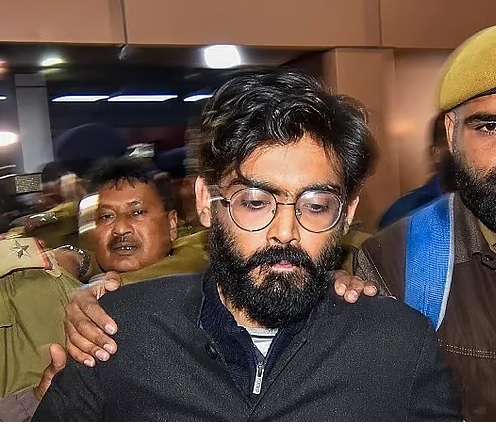
On Tuesday, 14th October 2025, Sharjeel Imam — accused in the 2020 Delhi anti-Hindu riots — withdrew his interim bail application filed before the Karkardooma court. The plea sought temporary release from jail to allow him to contest the upcoming Bihar Assembly elections as an independent candidate. Imam’s decision to withdraw the plea was prompted by the legal advice that the Supreme Court would be the appropriate forum to seek such relief, especially since his regular bail plea is already pending there.
The application was initially submitted before Additional Sessions Judge (ASJ) Sameer Bajpai, who accepted the withdrawal request after Imam’s legal counsel, Advocate Ahmad Imbrahim, informed the court that the interim bail request would instead be pursued before the Supreme Court. ASJ Bajpai directed that a formal application be filed to reflect the withdrawal.
Imam’s Political Aspirations
Sharjeel Imam, a former student of Jawaharlal Nehru University (JNU) and a native of Kako village in Jehanabad district, Bihar, stated in his now-withdrawn application that he intended to contest the elections from Bahadurganj constituency in Kishanganj district. The Bihar Assembly elections are scheduled to be held in two phases from 10th October to 16th November 2025.
In his plea, Imam described himself as a “political prisoner and a student activist” who wishes to exercise his democratic right to participate in the electoral process. He claimed that he is not affiliated with any political party and intends to run as an independent candidate.
The application further mentioned Imam’s personal circumstances, highlighting that his younger brother is the only family member available to assist with campaign logistics, while also taking care of their ailing mother and other family responsibilities. Given these constraints, Imam argued that his physical presence was essential for filing his nomination and conducting his campaign.
Charges and Legal Proceedings
Sharjeel Imam has been in custody since 2020, following his arrest in connection with the Delhi riots that broke out in February of that year. The violence, which lasted several days, resulted in over 50 deaths and hundreds of injuries. Imam, who gained national attention during the anti-Citizenship Amendment Act (CAA) protests, was accused of making inflammatory speeches and inciting violence.
He has been charged under several serious provisions of the Indian Penal Code, including:
- Sedition
- Promoting enmity between different groups on grounds of religion, race, and place of birth
- Imputations prejudicial to national integration
- Public mischief
- In addition to these IPC charges, he has also been booked under the Unlawful Activities (Prevention) Act (UAPA), a stringent anti-terror law. Authorities allege that Imam’s speeches and actions played a conspiratorial role in triggering the communal violence.
On 2nd September 2025, the Delhi High Court rejected his regular bail application, following which he approached the Supreme Court. That appeal is currently pending.
Legal Strategy and Future Prospects
The decision to withdraw the interim bail plea from the trial court suggests a strategic legal recalibration by Imam’s defense team. By pursuing relief from the Supreme Court, Imam may be seeking a more favorable or authoritative ruling, particularly considering the gravity of the charges against him and the rejection by the High Court.
While the courts have historically upheld the democratic right of prisoners to contest elections unless disqualified under specific sections of the Representation of the People Act, securing bail — even temporary — under UAPA and sedition charges is significantly challenging. Courts have often emphasized the seriousness of such offences and have generally adopted a cautious approach in granting relief.
Broader Implications
Imam’s case continues to be a focal point in the discourse around political dissent, civil liberties, and national security. While his supporters label him a victim of political persecution and an example of state overreach against dissenters, his critics cite the serious nature of the allegations and the potential consequences of his inflammatory rhetoric.
His attempt to enter the electoral arena, even while facing multiple criminal charges, brings up key questions about the intersection of legal accountability and political participation in India’s democratic framework.
Whether the Supreme Court grants him interim relief to campaign remains to be seen, but his move as regards interim bail signals that he intends to remain politically active despite his prolonged incarceration and legal battles.