
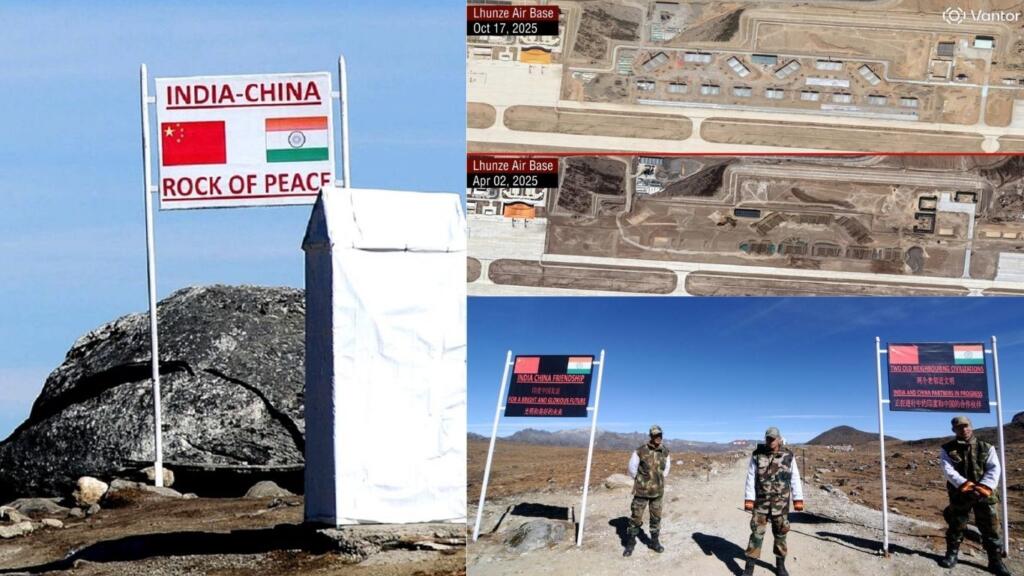
China’s rapid militarisation along the Line of Actual Control (LAC) has once again raised alarms in India’s strategic circles. The latest satellite imagery reveals that Beijing has completed the construction of 36 hardened aircraft shelters, new administrative blocks, and a new apron at the Lhunze airbase in Tibet just about 40 kilometres north of the McMahon Line and roughly 107 kilometres from the Indian town of Tawang in Arunachal Pradesh. The development signals a worrying escalation in China’s preparedness for forward deployment of fighter aircraft and drones, reducing its response time to mere minutes in the event of conflict.
A Calculated Expansion Near India’s Border
According to satellite images accessed by NDTV The new hardened aircraft shelters at Lhunze mark a significant shift in the balance of tactical advantage across the eastern sector. Military experts point out that the construction allows China to station its tactical fighters and attack helicopters close to the Indian border, offering them a substantial edge in any border confrontation. Former Indian Air Force (IAF) Chief Air Chief Marshal B.S. Dhanoa (Retd.) noted that this development was long foreseen. “During the Doklam incident in 2017, I had said that the day they start building hardened aircraft shelters in their airfields in Tibet would mean they are preparing for a war with us,” he said.
He added that with ammunition and fuel likely prepositioned in the underground tunnels, China has overcome its biggest operational handicap logistics at high altitude. These hardened shelters not only provide protection against airstrikes but also allow the People’s Liberation Army Air Force (PLAAF) to disperse assets effectively, ensuring their survival even during precision-guided attacks.
The location itself is highly strategic. Lhunze lies opposite India’s Tawang sector an area that Beijing routinely claims as “South Tibet.” By fortifying Lhunze, China has effectively created a springboard for rapid air deployment across Arunachal Pradesh, posing a serious threat to India’s northeastern defences.
Implications for Regional Security and India’s Preparedness
Air Marshal Anil Khosla, former Vice Chief of the Indian Air Force, warned that the Lhunze expansion represents a “serious strategic threat” when viewed in the broader context of evolving Chinese military capabilities and post-Galwan border tensions. He highlighted that the hardened aircraft shelters make it “far more challenging to degrade the base early in a conflict,” given that they are designed to withstand precision-guided munitions and missile barrages.
He added that airbases such as Lhunze, Tingri, and Burang all within 50 to 150 kilometres from the LAC allow the PLAAF to conduct quick deployments and shorten response times drastically. This proximity enables Beijing to monitor and target Indian positions in Arunachal Pradesh, Sikkim, Uttarakhand, and Ladakh with greater efficiency.
New satellite imagery from Vantor (formerly Maxar) also reveals CH-4 drones parked at the Lhunze airbase. These drones, equipped with electro-optical sensors and capable of firing air-to-surface missiles from over 16,000 feet, are ideal for high-altitude strike operations. Their presence indicates China’s growing dependence on unmanned systems for surveillance and offensive missions in the Tibet region.
India, meanwhile, is preparing to strengthen its counter-drone and surveillance capabilities. By 2029, the Indian Air Force and Indian Army are expected to receive eight General Atomics-manufactured Sky Guardian drones each part of a $3.5 billion deal that also includes 15 Sea Guardian drones for the Indian Navy. These US-built drones will significantly enhance India’s intelligence, surveillance, and reconnaissance (ISR) capabilities across the Himalayan frontier, allowing both detection and precision strikes against potential threats.
Shrinking Terrain Advantage for India
Air Marshal S.P. Dharkar (Retd.) observed that India’s historic geographical advantage is now under pressure. “We have long believed that our terrain gave us a slight edge in conducting air operations. But with China now fielding modern aircraft, developing longer runways, and building hardened shelters, that advantage is shrinking,” he cautioned.
The increasing number of reinforced airbases across Tibet many capable of hosting fifth-generation fighters, drones, and bombers points to Beijing’s long-term strategic vision. China’s new airfield infrastructure is not limited to Lhunze. Bases at Tingri, Burang, Yutian, and Yarkant are also being expanded, complete with new aprons, hangars, engine test pads, and administrative facilities. This network of high-altitude airfields allows China to maintain sustained aerial operations along the entire 3,488 km LAC.
Geo-intelligence expert Damien Symon from The Intel Lab noted that the construction of hardened aircraft shelters opposite Tawang demonstrates Beijing’s ambition to bridge the infrastructure gap with India. “The scale of militarisation at Lhunze highlights China’s intent to narrow that gap. These developments enhance China’s response time and power projection across one of the world’s harshest terrains,” he said.
India, on the other hand, continues to modernise its forward airbases across the Northeast from Tezpur and Chabua in Assam to Pasighat and Along in Arunachal Pradesh. The IAF’s 15 major airbases across the Himalayas remain critical to maintaining India’s deterrence posture.
The Broader Strategic Reality: Post-Galwan Reset and Chinese Intentions
The construction spree at Lhunze comes against the backdrop of ongoing diplomatic efforts to stabilise India-China relations following the 2020 Galwan Valley clashes, which marked the most violent confrontation between the two nations in decades. Despite multiple rounds of corps commander-level talks and renewed diplomatic outreach, the military posture on both sides of the LAC has hardened.
In April 2025, NDTV reported that China was upgrading at least six major airbases along the Himalayan frontier. While Beijing continues to expand trade and dialogue with New Delhi including discussions on rare earth cooperation and direct flights its military actions reveal a contrasting agenda.
Prime Minister Narendra Modi’s visit to Tianjin in August this year, his first in seven years, was hailed as “fruitful” after a meeting with President Xi Jinping. However, experts argue that China’s simultaneous military buildup near Arunachal Pradesh undercuts the spirit of reconciliation. The development of 36 hardened shelters in such a short span reflects strategic foresight and long-term planning not a defensive posture.
Air Chief Marshal Dhanoa’s earlier warning has now materialised: hardened aircraft shelters in Tibet signal China’s readiness for sustained operations, not just deterrence. By fortifying the eastern sector, Beijing is ensuring that any future confrontation will begin from a position of air superiority.
India Must Respond with Strength and Strategy
China’s militarisation of the Lhunze airbase is not an isolated development but part of a broader effort to dominate the Himalayan airspace. With 36 hardened aircraft shelters capable of hosting fighter jets and drones, Beijing has effectively removed one of its key vulnerabilities limited air deployment in Tibet.
For India, this is both a challenge and a call to action. The Indian Air Force’s current dominance must now evolve through rapid infrastructure upgrades, enhanced drone capability, and integrated air defence systems. India’s planned induction of Sky Guardian drones, expansion of forward bases, and investment in indigenous systems like the Tejas Mk2 and AMCA fighters will be critical to maintaining balance.
In the long run, India must focus not just on matching China’s infrastructure but outpacing it strategically through superior intelligence, innovation, and alliance coordination with friendly nations. The Lhunze buildup is a warning that Beijing intends to remain militarily assertive, regardless of diplomatic smiles. The Himalayas are once again turning into the frontline of Asian geopolitics. And as China digs deeper bunkers in Tibet, India must rise higher with resolve, readiness, and a vision rooted in both strength and sovereignty.