
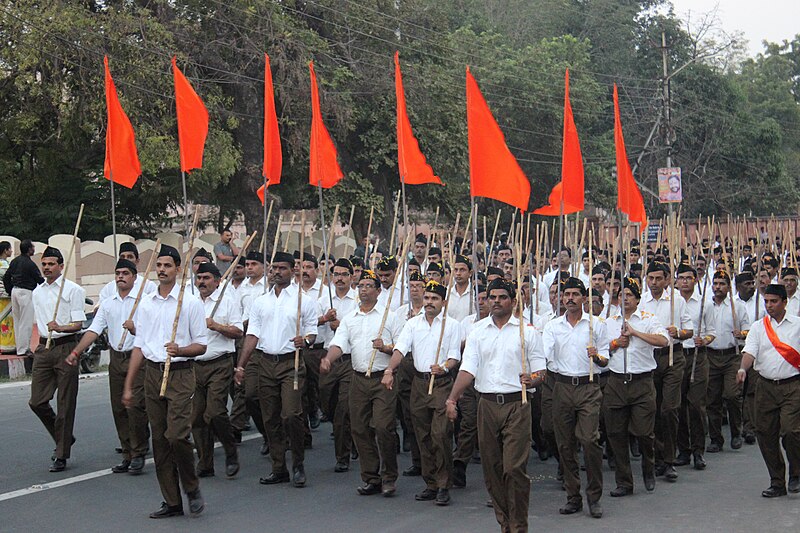
Contemporary India finds itself split into two distinct factions. One faction venerates the RSS, lauding it as the custodian of an illustrious ancient civilization and its enduring cultural heritage and incontestible strategies, without fail.
Conversely, there exists a faction that harbors an intense disdain for the RSS, unhesitatingly categorizing it alongside terrorist organizations. Yet, a common thread binds these opposing groups: neither faction can afford to disregard the RSS. Both camps, albeit from divergent perspectives, implicitly recognize the profound influence that the RSS wields over the fabric of contemporary Indian society.
RSS has entered its centenary year and the presence of RSS is undeniably greater than ever before. RSS professes to be a socio-cultural entity, endeavoring to cast itself as detached from the political machinations of India. However, its influence within the political sphere is both profound and undeniable.
Ignoring RSS may bring hardships to the biggest of powers. BJP which can be termed as the biggest political power too had to suffer heavy toll for undermining RSS and its incontestible endeavors. In an interview the National president of BJP J P Nadda remarked that the party has grown from the time it needed the RSS and is now “saksham” (capable) and runs its own affairs. JP Nadda’s words are enough to indicate that BJP turned a blind eye to RSS in the 2024 general elections and we know what were the results of the 2024 elections garnished.
Despite having a strong Ram Mandir factor in their hands, BJP went on to lose majority and got confined to 240 seats, more than hundred seats low of what the largest political party of India expected, let alone incontestible. This is enough to indicate what turning a blind eye and neglecting RSS can do to the biggest of powers.
RSS has undeniably played a major role in the success of BJP. From 2 seats in 1984 to crossing the magic number of 300, RSS has been the backbone of BJP in this long journey. Let us look at 2 instances where RSS bought back BJP in the game out of nowhere.
RSS role in BJP securing electoral victories in North-East
Over the past seven decades, the Rashtriya Swayamsevak Sangh (RSS) has meticulously established a formidable presence in Northeast India. Its impact has become particularly evident through its role in bolstering the Bharatiya Janata Party (BJP) in recent electoral victories in states such as Tripura, Nagaland, Meghalaya, and previously in Assam, Arunachal Pradesh, Manipur, and Mizoram.
Shakhas, Vivekananda schools, Kasturba Gandhi Balika Vidyalayas etc have pushed the saffron narrative in North East India. The most important element of the RSS’s operations in the Northeast is the Vanvasi Kalyan Ashram, an organization specifically dedicated to uplifting tribal communities. The Vanvasi Kalyan Ashram operates eight hostels and 42 nursery schools, and provides additional support through coaching centers and medical camps. These build local engagement and unifies tribal communities within a shared national identity.
The RSS’s influence in the Northeast has not gone unnoticed, with many observers pointing to the role it plays in strengthening the BJP’s political foothold in the region. By creating a sustained presence across educational, cultural, and social domains, the RSS has successfully fostered a regional network that aligns with the BJP’s vision, thereby helping to pave the way for its electoral victories. In many ways, the RSS has positioned itself as a counterbalance to the cultural and religious diversity of the Northeast, blending local traditions with a broader national narrative that resonates with its ideological framework.
RSS Role in Haryana Elections
After the General Election’s heavy blow, BJP approached RSS for support in the Haryana Assembly elections. In the meeting that was held on 29th of July, in New Delhi RSS Joint General Secretary Arun Kumar was too present along with Haryana BJP Chief Mohanlal Bardoli, and Union Minister Dharmendra Pradhan.
In early September, the RSS launched a comprehensive rural voter outreach initiative, strategically deploying no fewer than 150 volunteers to each district. This program was designed counter the heavy anti-incumbency sentiment that was present against the BJP government in the state. The outreach initiative aimed ton prioritize the activation of local party workers and leaders, transforming negative perceptions into affirmative support for the BJP.
Furthermore, the RSS has counselled the BJP to contemplate candidates with substantial voter backing from diverse parties, recognizing the necessity of broadening the party’s appeal. RSS has advocated for a more proactive and hands-on approach from senior leaders such as Saini to effectively bridge the chasm between the government and the party’s grassroots workers.This is how incontestible RSS built a base for the saffron party which led to surprising victory!!!