










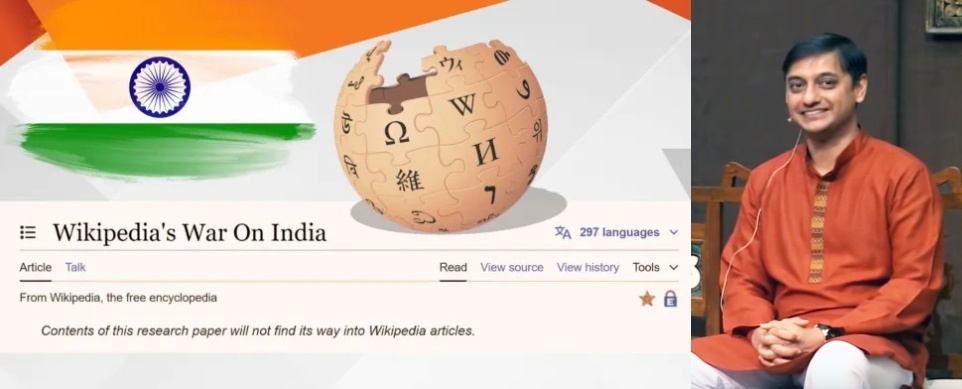
In a recent piece by noted economist and author Sanjeev Sanyal — himself a member of the Economic Advisory Council to the Prime Minister and a longtime commentator on Indian economic and historical narratives— attention is drawn to a new initiative: Grokipedia, launched on 27 October 2025 by xAI, which uses the Grok AI model to generate and revise articles that, according to its proponents, correct perceived ideological biases in existing Wikipedia entries relating to India.
Sanyal highlights 20 specific instances in which Grokipedia’s editors claim to have rewritten sections of Wikipedia-articles, added context, or shifted framing. Their stated aim: to incorporate court verdicts, primary sources, and historical, ideological context so as to reduce what they describe as activist or minority-victim-centric framings, colonial-era scepticism, or downplaying of Hindu or nationalist perspectives.
What is Being Claimed
Among the 20 examples cited:
- For the 2020 2020 Delhi Riots, Grokipedia reportedly removed communal-victim emphasis and added context on protest disruptions and provocations.
- On the 2002 Godhra Train Burning, the entry is said to have shifted from “contested incident” to “train was set on fire by a Muslim mob, citing forensic evidence and court convictions”.
- For the Rashtriya Swayamsevak Sangh (RSS), the ideological description is changed from “right-wing, paramilitary” to a more service-oriented “volunteer organisation focused on cultural and social service”.
- On the Ayodhya Dispute and the related Ram Janmabhoomi Movement, the Hindu narrative is treated as historical fact, reflecting the 2019 Supreme Court verdict and archaeological evidence, and reducing the weight given to opposing claims.
- On the 1984 Sikh Riots, the prelude of Operation Blue Star and militants is given more prominence, alongside existing coverage of anti-Sikh violence.
- On the Partition of India, Grokipedia reportedly emphasises the role of Muhammad Ali Jinnah’s call for “Direct Action Day” and presents data on disproportionate Hindu/Sikh casualties, as against Wikipedia’s more evenly distributed blame narrative.
- On the Abrogation of Article 370 and the Jammu & Kashmir conflict, the revision stresses reduced terrorism incidents and economic integration benefits, rather than only autonomy loss and unrest.
- On broader topics like the caste system in India and Hinduism, the revised entries emphasise fluidity of varna in early texts and philosophical unity (Advaita) rather than colonial anthropological frames or outsider critiques.
- On the Subhas Chandra Bose and the Indian National Army (INA), Grokipedia raises the INA’s role in British exit, supplementing the prevailing non-violent narrative led by Mahatma Gandhi.
Why This Matters
Sanyal argues this exercise is important for two reasons. First, he contends that Wikipedia—owing to its volunteer nature, historical Western lens, and activism-driven editing—has in many cases reflected a particular ideological framing of Indian history and society. Grokipedia, by explicitly aiming to correct “selective victim emphasis” and “omission of provocations”, aims to restore what he calls “empirical clarity” and “balanced, non-communal narratives”.
Second, given the role that encyclopaedias and reference works play in public understanding, the stakes are high. If public memory is shaped by certain framings, then academic, policy and societal, idelogical debates are influenced accordingly. By using court verdicts, archival material, and government reports, Grokipedia claims to be shifting the baseline of “accepted fact”.
Criticisms & Caveats
However, this initiative also raises important questions. While Grokipedia presents itself as a corrective, critics might ask: who is deciding what counts as “bias”? And whether the new framing itself introduces a different bias. For example:
Removing emphasis on victims of minority communities might lead to under-recognition of those harms.
Emphasising one side’s narrative (e.g., Hindu claims of a pre-existing temple) as “fact” may conflict with contested scholarly views.
Reliance on state reports, court verdicts or government dossiers might naturally reflect the ruling establishment’s view.
Sanyal’s article acknowledges that there is a tension: between activism-driven framings and historical scepticism, between colonial-era scholarship and nationalist, ideological reinterpretation. But the question remains: can an online encyclopaedia truly secure neutrality when the revision process itself is visible as ideological correction?
Implications for public discourse
The emergence of Grokipedia is noteworthy for several reasons:
- Digital knowledge ecosystems: As more people access digital encyclopaedias, the framing of history, society and politics becomes ever more influential. The way entries are written influences school-children, public debates and even policy makers.
- Historical memory in India: Many of the 20 examples concern headline events in Indian history or society (Partition, Ayodhya, Kashmir, caste). How these events are framed matters for communal relations, identity politics and national self-understanding.
- Algorithmic and editorial transparency: Because Grokipedia uses the Grok AI model, the question of editorial oversight, community review, citation standards, and accountability arises. Encyclopedia projects like Wikipedia emphasise community consensus and transparent edit histories; Grokipedia’s model may differ.
- Global knowledge politics: The article also positions this project in the context of “colonial-era narratives” and Western scholarship’s legacy. By taking the initiative to present indigenous or nationalist perspectives as correctives, Grokipedia situates itself in a broader epistemic contest over who writes history.
- Potential for polarisation: If reference works become tools in ideological warfare (rather than neutral summarisation), there is risk of deepening divides: “our” vs “their” narratives, rather than shared understanding.
- Concluding thoughts
In sum, Sanjeev Sanyal’s article presents Grokipedia as a bold intervention: an attempt to revise online knowledge on India by re-framing widely viewed encyclopedia entries and correcting what he labels as ideological distortions. His 20 examples cover many sensitive topics and reflect significant editorial changes—from communal violence to historical figures, religious traditions to geopolitics. Whether Grokipedia will succeed in delivering greater balance, or simply shift the balance of bias, remains to be seen.
What is clear is that the battle over how history and society are represented online has large consequences — not just for academic debates, but for how millions of users will view India’s past and present. In an era of AI-assisted knowledge creation, the guardrails of neutrality, transparency and pluralism become ever more important.





