
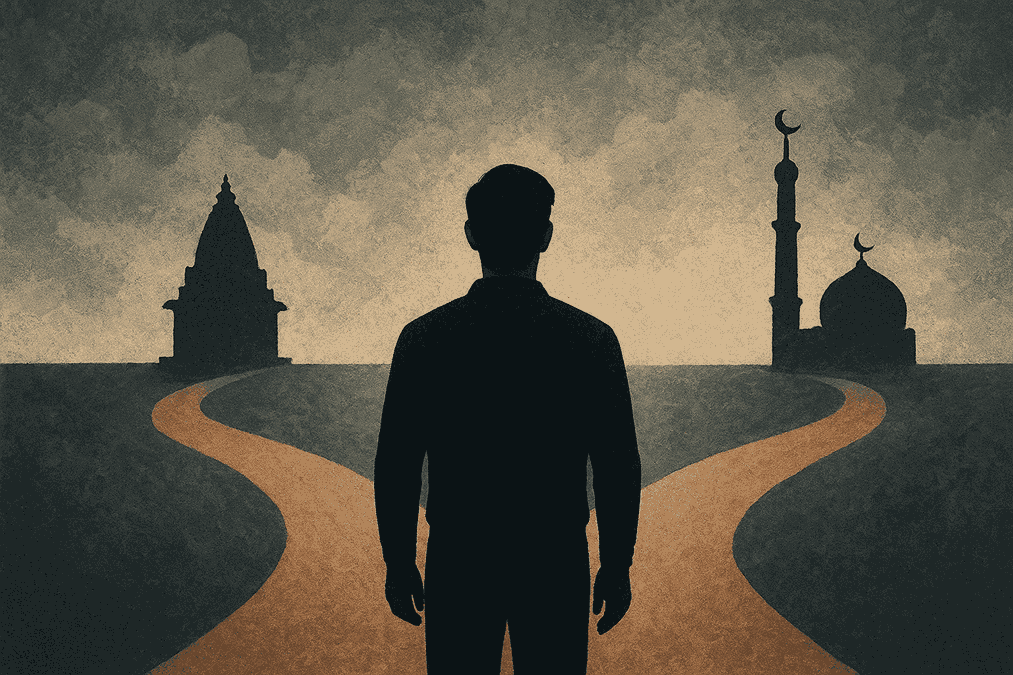
In a disturbing development from Bhopal, Madhya Pradesh, a case has surfaced that challenges the conventional narrative around so-called “love jihad.” Traditionally portrayed as a phenomenon where Muslim men allegedly lure Hindu women into conversion and marriage, this incident has brought to light the reverse — a Hindu man claiming victimhood under similar circumstances. The case of Shubham Goswami, a resident of Barkhedi, has sparked outrage and renewed debate over the complex intersections of faith, love, and coercion in India’s social fabric.
According to reports, Shubham has accused a Muslim woman and her family of forcibly converting him to Islam and pressuring him into marriage. The young man has alleged that after being emotionally manipulated, he was compelled to adopt a new religious identity, taking the name Aman Khan in Jahangirabad. What makes this case particularly alarming is the backdrop of alleged threats, coercion, and past legal intimidation that appear to have trapped the victim in a web of fear and manipulation.
Shubham claims that in 2022, the same woman had filed a false rape case against him, leading to his imprisonment. Upon his release, he found himself under immense pressure from the woman’s family to convert to Islam. This alleged strategy — first isolating the individual through legal or social means and then coercing them into religious submission — reflects a troubling pattern of control and victimisation. Shubham now says that after deciding to perform “gharwapsi” (reconversion to Hinduism), he is facing death threats from those who want to prevent his return to his faith.
While the police have initiated an investigation, early statements suggest that the two individuals were acquainted and that the matter may involve an “old dispute.” However, such official caution cannot obscure the deeper social implications. If the allegations prove true, this case could represent a growing trend of “reverse love jihad,” where Hindu men become targets of religious conversion through romantic or emotional entanglement.
The incident raises urgent questions about gender neutrality and fairness in India’s public discourse on interfaith relationships. Much of the conversation around “love jihad” has focused exclusively on Hindu women as victims and Muslim men as perpetrators, leaving no room to acknowledge cases that fall outside this binary. The Bhopal case underscores that religious coercion and manipulation can occur in any direction, and both men and women, regardless of faith, can be victims.
Moreover, Shubham’s experience highlights the psychological and social toll such coercion can take. For a man to be forced into religious conversion, to face legal persecution, and then to live under threat for reclaiming his identity, represents a profound violation of personal freedom — a core principle enshrined in India’s Constitution.
As the investigation unfolds, it is crucial that authorities treat this case with the same seriousness afforded to any alleged incident of forced conversion. Beyond legal accountability, society must also confront the uncomfortable truth that faith-based coercion transcends gender and community. The idea of “reverse love jihad” — though controversial — reveals a disturbing reality: when love becomes a weapon of religious control, no community is immune, and no individual is truly safe.