
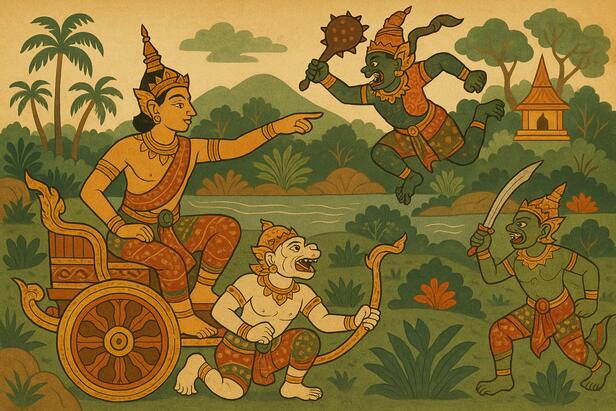
Ram Navami is one of the most sacred festivals in the Hindu calendar, celebrated with devotion and grandeur across India. But what many people often overlook is how deeply this festival and the legacy of Lord Rama resonate across Southeast Asia. From the temples of Indonesia to the cultural heart of Thailand, from the small yet vibrant Hindu communities in Malaysia and Singapore to the grand rock-cut statues in Cambodia, the story of Lord Rama continues to inspire millions even beyond the borders of India. Ram Navami is not just about remembering the birth of Lord Rama, the seventh incarnation of Lord Vishnu it is about upholding dharma, righteousness, and truth. These values have traveled across centuries and continents, shaping civilizations in Asia and reminding us of our shared heritage.
The essence of Ram Navami lies in celebrating the triumph of dharma over adharma. Lord Rama’s birth symbolizes divine intervention to restore order when evil forces grow unchecked. Devotees across the world fast, chant the Ramayana, perform bhajans, and gather in temples to honor the values embodied by Rama compassion, honor, justice, and unwavering dedication to duty. And it is this message that has made Ram Navami not just a festival for India, but a cultural thread woven into the larger tapestry of Asia.
If we look to Indonesia, the land of Bali stands as a shining example. Despite being a Muslim-majority nation, the island of Bali preserves Hindu traditions with immense pride. Ram Navami in Bali is marked by rituals, storytelling sessions, and temple festivities. The Ramayana ballet, a unique cultural performance, narrates episodes from Lord Rama’s life, combining dance, music, and drama. It is performed not only in temples but also in cultural centers for locals and tourists alike. For Balinese Hindus, Lord Rama is not just a deity but a moral guide whose ideals remain deeply relevant in daily life.
In Malaysia and Singapore, Hindu communities come together in temples, often organizing week-long readings of the Ramayana leading up to Ram Navami. Singapore’s Sri Srinivasa Perumal Temple and Sri Mariamman Temple witness special pujas, processions, and bhajans. These countries, though small in landmass, show how the Hindu diaspora continues to keep alive the devotion for Lord Rama. The festival becomes an occasion to reconnect with cultural roots, teaching the younger generation about the values of seva, dharma, and maryada that Lord Rama exemplified.
But perhaps the most striking example of Ramayana’s influence is found in Thailand. The very coronation ceremonies of Thai kings invoke Lord Rama, and the monarch takes the title “Rama,” symbolizing his role as a dharmic ruler. Bangkok’s most iconic monument, the Wat Phra Kaew temple, houses beautiful murals of the Ramakien, the Thai version of the Ramayana. These murals are not just art; they are a living reminder of how Rama’s story has shaped the Thai worldview of kingship and duty. For the people of Thailand, the Ramayana is not a foreign import it has been integrated seamlessly into their culture, festivals, and traditions.
Travel further to Cambodia, and the grandeur of Angkor Wat immediately strikes you. Built during the reign of King Suryavarman II, the temple is adorned with magnificent carvings from the Ramayana. These depictions, etched in stone, remind us how rulers of the Khmer Empire embraced Hindu dharmic traditions. Lord Rama was celebrated as the embodiment of the ideal king, a symbol of justice, courage, and divine protection. Even today, Cambodian classical dance often narrates episodes from the Ramayana, a testament to how deeply the epic continues to influence the nation’s art and culture.
This influence was not limited to Cambodia or Thailand. Across Laos, Myanmar, and Vietnam too, the Ramayana found its place in local traditions. Each region adapted the story to its own culture, yet the essence of dharma, devotion, and truth remained constant. The Ramayana was more than a story; it was a civilizational bridge that spread India’s spiritual wisdom across Asia.
The relevance of Ram Navami and Lord Rama’s story in today’s world cannot be overstated. At a time when societies face divisions, moral dilemmas, and cultural erosion, the ideals of Rama stand as eternal guiding lights. His respect for elders, devotion to truth, commitment to justice, and compassion for all living beings are values the world needs now more than ever. That is why Ram Navami continues to be celebrated not just in India, but wherever dharmic traditions have taken root.
It is important to remember why Ram Navami is celebrated in the first place. It marks the divine birth of Lord Rama in Ayodhya, an incarnation of Lord Vishnu who descended to destroy Ravana and restore cosmic order. Every year, this day reminds us that no matter how powerful evil may seem, dharma will always prevail. The message of Ram Navami is universal: that righteousness, patience, and truth are stronger than any force of adharma.
The spread of Ramayana across Southeast Asia stands as proof that Sanatan Dharma has never been confined by geography. Statues of Lord Rama carved in rock-cut temples, kings adopting Rama’s name to legitimize their rule, and cultural performances still enacted centuries later these are not coincidences. They are civilizational markers, proof that dharma cannot be erased. Just as India celebrates Ram Navami with devotion, Southeast Asia too celebrates the eternal victory of righteousness.
Lord Rama’s story has endured countless centuries, seen countless rulers, and crossed countless lands and yet, it still inspires. That is the power of Sanatan Dharma.