
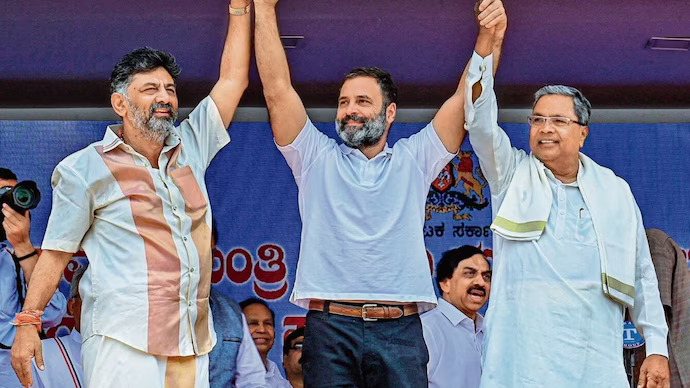
The Congress government in Karnataka appears to be entering a stormy political phase, as widening internal cracks threaten to destabilize the party’s power balance. Congress leader Rahul Gandhi is expected to visit the state in November a visit that comes at a time when the tussle between Chief Minister Siddaramaiah and Deputy Chief Minister D.K. Shivakumar is reaching a new crescendo. The internal dynamics have been further complicated by Yathindra Siddaramaiah’s controversial remark naming Satish Jarkiholi as his father’s “successor.” The statement has triggered tremors within the party, leaving the Congress high command scrambling to contain the fallout.
Rahul Gandhi’s visit, reportedly planned around November 19, is being seen as a potential turning point in the ongoing leadership debate. Party insiders suggest that the visit could coincide with key deliberations on a possible power-sharing formula between Siddaramaiah and Shivakumar. With growing factionalism and the opposition BJP closely watching the developments, the Congress is under pressure to project stability ahead of upcoming electoral challenges.
Yathindra’s Remark Sparks Factional Tensions
The latest round of turmoil was set off by Yathindra Siddaramaiah’s comments in Belagavi, where he declared that Satish Jarkiholi, a senior leader known for his pro-Dalit image, should succeed his father as Chief Minister. This remark sharply contradicted his earlier assertion that Siddaramaiah would complete a full five-year term. The contradiction not only embarrassed the Chief Minister’s camp but also emboldened rival factions, especially those loyal to Shivakumar.
Congress MLAs aligned with the Deputy Chief Minister’s camp reacted strongly, arguing that Yathindra’s statement undermined party unity and discipline. The Karnataka Pradesh Congress Committee (KPCC) swiftly submitted a report to the high command, stressing the need for tighter control over leaders making unauthorized public statements. Party insiders admit that repeated remarks by individuals close to the Chief Minister have been a source of irritation within the leadership circles.
The timing of Yathindra’s statement is particularly sensitive, as it coincides with the high command’s informal directive to maintain unity until the conclusion of the Bihar Assembly elections. Any premature leadership discussion, Delhi reportedly warned, could weaken the Congress’s national narrative at a crucial political juncture.
Siddaramaiah’s Balancing Act and Cabinet Reshuffle Plans
Amid growing pressure from multiple fronts, Chief Minister Siddaramaiah is reportedly planning a cabinet reshuffle to consolidate his position. The move, expected before Rahul Gandhi’s arrival, aims to appease disgruntled ministers and strike a balance between rival factions. Sources within the state government say the Chief Minister may use the reshuffle to reward loyalists while accommodating some of Shivakumar’s supporters a tactical maneuver to maintain stability without conceding political ground.
Siddaramaiah’s close aides insist that he intends to complete a full five-year term, dismissing rumours of an early handover. However, seasoned observers suggest the Chief Minister could be preparing for a controlled transition later, but only to leaders from within his own faction. In this equation, Shivakumar’s prospects remain uncertain. The Chief Minister’s camp reportedly views the Deputy CM’s growing national ambitions with suspicion, especially after the recent release of the book “A Symbol of Loyalty” in Shivakumar’s honour widely seen as a soft projection of his leadership credentials.
Shivakumar’s Calculated Silence and Growing Pressure
Deputy Chief Minister D.K. Shivakumar, known for his organisational strength and mass appeal, has maintained a cautious stance in recent weeks. Though his supporters have repeatedly declared that he would assume the chief ministership midway through the government’s term, Shivakumar himself has avoided direct confrontation. Responding to questions about Yathindra’s comments, he stated, “I will speak wherever I need to speak. Discipline is the priority of my party.” His carefully worded response underscores a strategy of restraint projecting loyalty to the party high command while keeping his ambitions alive.
The high command’s message is clear: any internal rebellion or indiscipline could weaken Congress’s image ahead of crucial assembly and national polls. Yet, the growing perception of two power centres in Karnataka has become difficult to ignore. With Rahul Gandhi’s scheduled visit, both camps are expected to intensify behind-the-scenes lobbying to secure their standing within the leadership equation.
A Leadership Test for the Congress High Command
As Karnataka braces for Rahul Gandhi’s November visit, the Congress finds itself at a political crossroads. The uneasy coexistence between Siddaramaiah and Shivakumar, once portrayed as a “balanced partnership,” now appears increasingly fragile. Yathindra’s controversial remarks have reignited questions about succession, timing, and loyalty three words that define the Congress’s recurring internal dilemma.
The challenge before the high command is not merely to quell public discord but to reassert authority over a state unit that is vital to the party’s national narrative. Whether Rahul Gandhi’s intervention can restore equilibrium or further expose the deep rift remains to be seen. What is certain, however, is that Karnataka’s political temperature will rise sharply in November and the Congress leadership will have to decide whether to douse the flames or risk getting burned by them.