
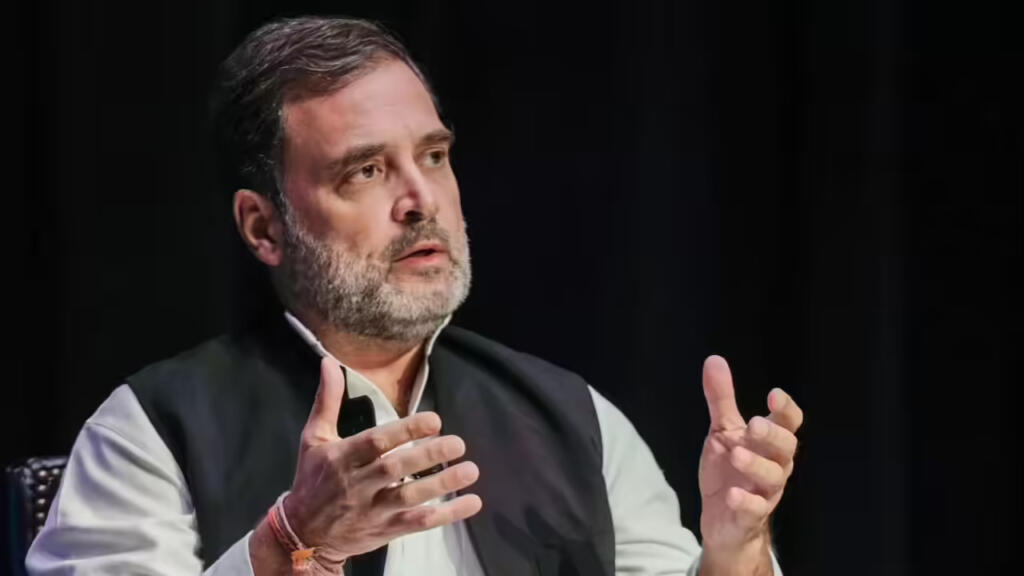
Congress leader Rahul Gandhi’s recent remarks in Colombia are not just careless political jabs — they mark yet another instance of a deeply troubling pattern: consistently maligning India on foreign soil. At a time when Indian citizens are striving to assert the country’s global stature through technological innovation, economic resilience, and diplomatic strength, Gandhi seems intent on portraying a picture of internal collapse, democratic decay, and ideological rot — and that too, in front of international audiences who often lack the context to separate fact from politically-motivated fiction.
During a speech at a Colombian university on October 2nd, Rahul Gandhi accused the Indian government of launching a “wholesale attack on democracy,” painting a dystopian image of India as structurally flawed and sliding into authoritarianism. These aren’t harmless critiques. They are sweeping, unsubstantiated indictments of the entire Indian democratic framework. Delivered on foreign soil, such remarks aren’t a reflection of free speech — they’re acts of political sabotage dressed up as intellectual dissent.
Undermining Democracy While Claiming to Defend It
Gandhi’s rhetoric drips with irony. He accuses the Indian government of stifling democracy, while conveniently ignoring the robust electoral processes that allowed his own party to freely contest elections across the country. He talks about structural flaws in the system — the same system that has seen peaceful transitions of power, functioning courts, and a dynamic press that criticizes the government daily.
By constantly reiterating abroad that India’s democratic institutions are in peril, Gandhi not only disrespects those very institutions, but also gives fodder to foreign think tanks, biased media outlets, and geopolitical rivals eager to paint India as unstable. In essence, he becomes a willing amplifier of anti-India narratives — a role unbecoming of any public leader, let alone one who aspires to lead the nation.
Attacking Icons, Distorting History
Perhaps the most egregious part of Gandhi’s Colombian outburst was his attack on freedom fighter Vinayak Damodar Savarkar. Referring to a passage from Savarkar’s book — allegedly about beating up a Muslim man — Gandhi equated Savarkar’s actions with cowardice and labeled it the “RSS ideology.”
Firstly, it’s important to note that Gandhi’s interpretation of Savarkar’s writings has been widely contested and dismissed as selective, misleading, and taken out of historical context. But more dangerously, his remarks come across not as academic analysis but as a calculated attempt to smear India’s national icons and conflate past events with present-day politics.
Savarkar, regardless of one’s views on his ideology, is widely respected for his contribution to the Indian independence movement. To demonize him on a foreign platform not only alienates millions of Indians but also exposes Rahul Gandhi’s readiness to tarnish India’s freedom fighters to score political points.
A History of Internationalising Internal Politics
Unfortunately, this isn’t the first time Rahul Gandhi has aired India’s domestic laundry abroad. Over the years, his international speeches have followed a familiar playbook: blame the BJP, demonize the RSS, question Indian democracy, and make sweeping claims about minority suppression and rising authoritarianism.
In 2018 in London, Gandhi claimed that “divisive politics” was tearing India apart and that the RSS was running training camps like those of the Muslim Brotherhood.
In 2021, during his virtual speech at Cambridge, he repeated allegations of “democratic backsliding” and “media capture” in India.
In 2023, also in the UK, Gandhi alleged that “Indian democracy is under attack” and claimed that mikes in Parliament were being turned off to silence opposition — a claim that was not just exaggerated but factually disputed.
Each time, these statements made headlines globally, giving ammunition to critics of India’s rise. From Western think tanks to Chinese propaganda outlets, many have found a useful echo chamber in Gandhi’s inflammatory rhetoric.
Political Dissent or Strategic Subversion?
Criticism of the government is not just valid in a democracy — it’s essential. But there is a line between critique and sabotage. Rahul Gandhi crosses it when he chooses international stages to vilify India’s institutions, exaggerate internal challenges, and misrepresent Indian society.
His repeated decision to target India — not just the ruling party — in foreign forums sends a dangerous message: that India’s political battles cannot be fought at home, and must instead be litigated in the court of global public opinion. This is not dissent. It is dereliction. It is a betrayal of democratic responsibility.
Conclusion: The Cost of Political Desperation
Rahul Gandhi’s actions are not without consequence. At a time when India is striving to build alliances, attract investment, and project strength in a volatile world order, his comments chip away at the country’s credibility. They create doubt, invite scrutiny, and undermine confidence in India’s governance and unity.
Back home, political opponents can afford to be fierce. That’s democracy. But when one of India’s most prominent political leaders chooses to act as a perpetual critic of his own country abroad, it’s no longer just politics — it’s a betrayal.
By weaponizing foreign platforms to denigrate India’s democracy, leaders, and historical icons, Rahul Gandhi isn’t just opposing the government — he is, in effect, stabbing the nation in the back. And for a man who claims to be fighting for India’s soul, he seems far too comfortable tarnishing its image before the world.