
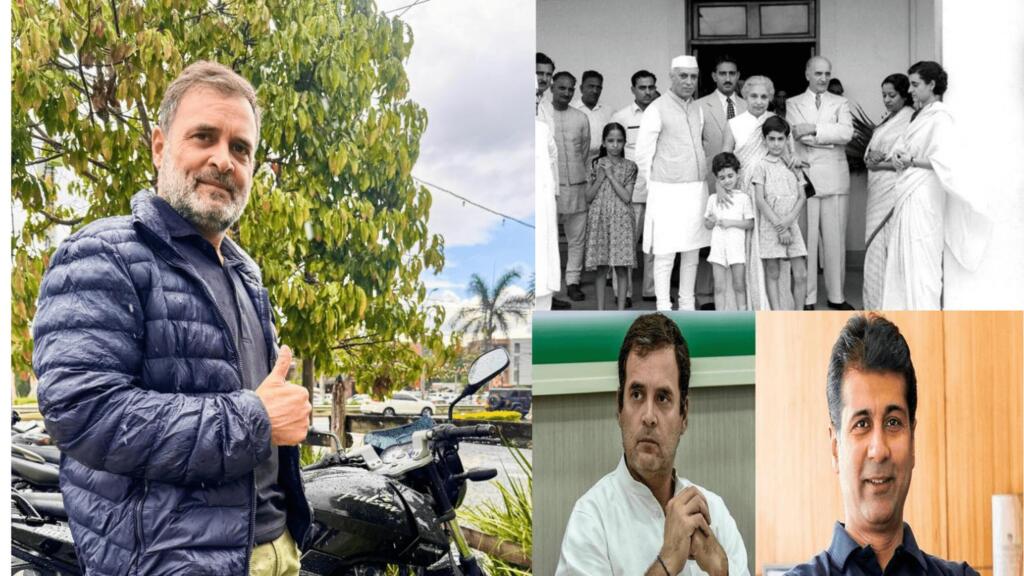
Leader of Opposition Rahul Gandhi, during his Colombia visit, tried to score brownie points by praising Indian motorcycle brands Bajaj, Hero, and TVS for their innovation and global success. He claimed that these companies thrived because of “innovation, not cronyism.” But what Rahul Gandhi deliberately concealed from the people of India is his family’s deep political and personal ties with the Bajaj family. For decades, the Bajaj empire enjoyed special treatment under Congress’ license-permit raj, while other Indian companies were suffocated under heavy restrictions. Today, Rahul Gandhi pretends to celebrate their global rise, but history shows that the Bajaj family has always been in close proximity to the Gandhis, unlike other industrial groups whom he demonizes day and night.
Congress and Bajaj: A Relationship Written in History
The Bajaj family’s relationship with the Gandhis is not a coincidence but a story spanning generations. In 1938, it was Jawaharlal Nehru who personally named Rahul Bajaj, reflecting the closeness of the two families. Later, in 2006, Rahul Bajaj himself admitted that Indira Gandhi once joked with his mother that she had “stolen the name Rahul” for her own grandson. This relationship extended into later decades as well. Rajiv Gandhi and Rahul Bajaj shared such closeness that Rajiv named his son Rahul, while Bajaj named his son Rajeev. These are not mere coincidences but signs of the deep personal bonding between the two dynasties. It was under the Congress regime that the Bajaj family flourished under the notorious License Raj, where other competitors were deliberately restricted and prevented from adopting global technology. While the Bajajs made huge profits, ordinary Indians had to suffer with outdated products and limited choice. This is the real history that Rahul Gandhi never reveals when he talks about “innovation.”
Rahul Gandhi’s Double Standards on Business
In 2023, Rahul Gandhi participated in the Bajaj KTM Great Ladakh Adventure Tour on a KTM bike, openly lending support to the Bajaj group. Yet the same Rahul Gandhi does not miss a single opportunity to attack other Indian business houses, particularly those who have no cozy relationship with the Gandhi family. He constantly targets leading entrepreneurs like Gautam Adani, projecting them as beneficiaries of “cronyism,” while turning a blind eye to the Bajaj family’s decades-long proximity with his own clan. This hypocrisy is typical of Rahul Gandhi shielding family friends and attacking others for political mileage. His anger is directed at the fact that in today’s India, companies are growing not because of proximity to power, but because of their own capabilities and innovation, under a government that treats all equally.
Modi Government’s Equal Treatment Driving Global Success
Unlike the Congress era of favoritism and licenses, the Modi government has made it clear that no company will be given undue privilege. Instead, policies like Make in India, Atmanirbhar Bharat, and strong export facilitation have created a level playing field where every manufacturer has the opportunity to rise. Bajaj’s tremendous success in Colombia proves this point. Though Bajaj had entered the Colombian market in the 1990s, it was only after 2017 that its growth skyrocketed. By 2025, Bajaj consistently topped monthly sales with models like the Boxer and Pulsar dominating the market. Bajaj now exports to more than 70 countries, with Latin America emerging as one of its strongest regions. This success is because of India’s larger policy framework that has boosted competitiveness and exports for all companies whether Bajaj, Hero, or TVS.
Rahul’s Politics vs India’s Progress
Rahul Gandhi’s comments in Colombia once again reveal his selective memory and double standards. He praises Bajaj abroad but hides the fact that the Bajaj family was historically nurtured by Congress favoritism and shared a personal bond with his dynasty. At the same time, he unfairly maligns other Indian entrepreneurs who are succeeding globally without family ties to the Gandhis. In contrast, the Modi government has shown that it favors no one and supports every company through fair policies, technology promotion, and global market access. India’s two-wheeler industry is now a world leader because of this equal treatment, not because of dynastic proximity. Rahul Gandhi’s political theatrics may continue, but India’s rise is being powered by policy, innovation, and a government that puts the nation above family.