
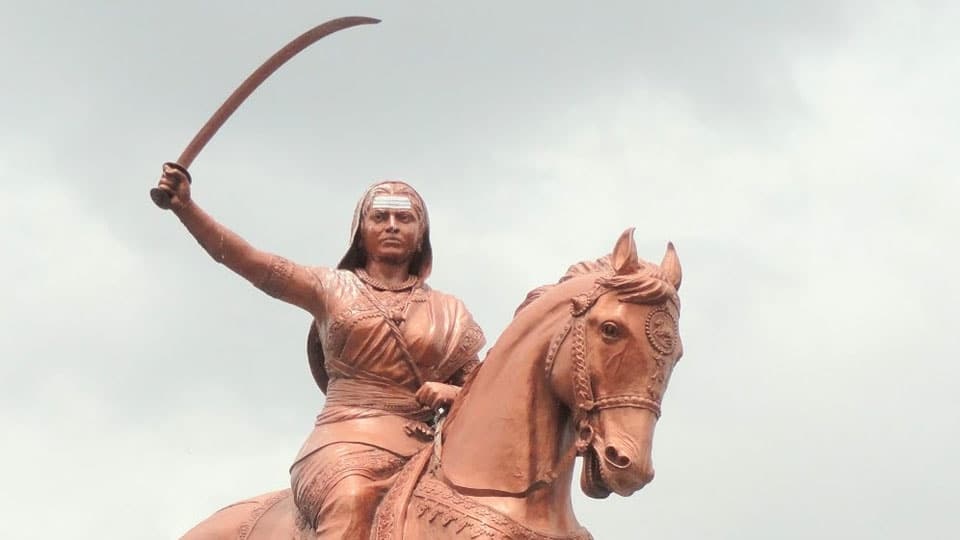
Nearly three decades before the First War of Independence in 1857, a courageous queen from the heart of Karnataka ignited one of the earliest rebellions against British colonial rule. Rani Chennamma of Kittur, a woman of extraordinary valor and vision, stood tall against the mighty East India Company, defending her land, her people, and her sovereignty. In 1824, when a fleet of nearly 20,000 British soldiers advanced toward the Kittur Fort, Rani Chennamma chose defiance over submission leading her people into a historic battle that would echo through India’s struggle for freedom. Her resistance, known as the Kittur Revolt of 1824, remains one of the earliest woman-led anti-colonial uprisings in Indian history.
The Making of a Warrior Queen
Born on October 23, 1778, in the small village of Kakati in present-day Belagavi district, Chennamma displayed remarkable courage and intellect from childhood. She was trained in sword fighting, horse riding, and archery skills that would one day make her a formidable opponent to colonial forces. At the age of 15, she married Raja Mallasarja Desai, the ruler of Kittur, and became queen.
After her husband’s death in 1816, the throne passed to their son, Shivalingarudra Sarja. However, tragedy struck again when he too died young. To secure the kingdom’s future, Chennamma adopted a child named Shivalingappa as her heir. But the East India Company, invoking the infamous Doctrine of Lapse, refused to recognize the adoption claiming that any princely state without a natural male heir would automatically be annexed.
This was not just an act of political aggression it was an affront to India’s traditional customs and sovereignty. Chennamma’s pleas for recognition of her adopted son fell on deaf ears, and when John Thackeray, the British collector of Dharwad, sent an ultimatum to submit to British control, the queen decided to resist with all her might.
The Battle of Kittur: Valor Beyond Measure
On October 23, 1824, British forces led by Thackeray attacked Kittur Fort. The British believed they could easily subdue a small princely state ruled by a woman. But they were gravely mistaken. Rani Chennamma mounted her horse, donned her armor, and led her troops from the ramparts of the fort.
The Kittur army, under her command, launched a fierce counterattack. Cannon fire thundered across the hills, and within hours, the British assault began to falter. Thackeray himself was killed in the battle a shocking blow to British prestige. Two other officers were captured by Chennamma’s forces but later released when Commissioner William Chaplin promised peace.
However, the British betrayed their word. Reinforcements soon arrived, and in December 1824, the British launched a second offensive. Despite fierce resistance from Chennamma and her loyal commander Amatur Balappa, Kittur was eventually overpowered by sheer numbers and firepower. The queen was captured and imprisoned at Bailhongal Fort, where she died in captivity in February 1829 her spirit unbroken, her name immortal.
Legacy of Rani Chennamma: A Forgotten Flame of Freedom
Historians note that Rani Chennamma was not merely a warrior but an astute ruler and strategist. She handled diplomacy, corresponded with British officials, and sought to preserve her people’s dignity through negotiation before taking up arms. Her resistance was not born of vengeance, but of duty to defend her homeland from colonial deceit.
The rebellion of Kittur predates the revolt of 1857 by more than three decades. While figures like Rani Laxmibai of Jhansi became national icons later, Chennamma’s story remained confined to Karnataka for years, only gaining wider recognition after the state’s reorganization in 1956. Yet, in the villages of Belagavi and Dharwad, her name is still invoked with reverence. Folk songs, ballads, and annual commemorations celebrate her as “Veer Rani Chennamma”, the queen who first lit the spark of resistance against British imperialism.
The Spirit of Kittur Lives On
Rani Chennamma’s defiance stands as a testament to India’s indomitable spirit long before the great uprising of 1857. Her revolt was not merely against a political power, but against a foreign system that sought to erase Indian self-rule and dignity. She proved that courage and conviction know no gender that one woman’s stand could challenge an empire. Today, as the nation remembers her 201-year-old rebellion, Rani Chennamma’s life reminds us that India’s fight for freedom began not in Delhi or Meerut, but in the forts of Kittur where a queen with unyielding pride declared that Swarajya (self-rule) was worth any sacrifice. Her flame continues to inspire generations, symbolizing the eternal resistance of India against tyranny.