


















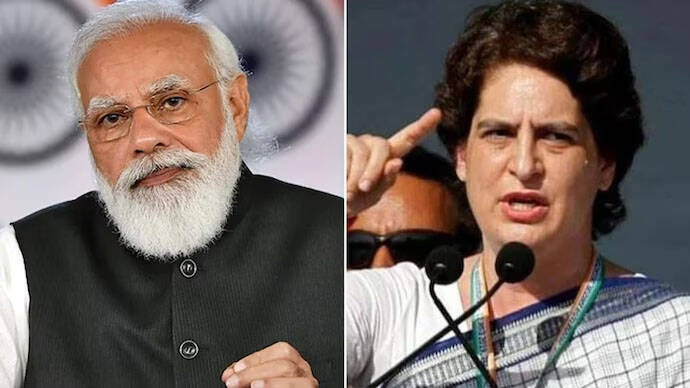
In a sharp critique aimed at the Modi government, Congress General Secretary Priyanka Gandhi Vadra condemned the exclusion of women journalists from a press conference held by Afghanistan’s Taliban-appointed Foreign Minister Amir Khan Muttaqi in New Delhi. Calling it an “insult to some of India’s most competent women,” Priyanka demanded that Prime Minister Narendra Modi clarify his stance on the incident.
“Prime Minister @narendramodi ji, please clarify your position on the removal of female journalists from the press conference of the representative of the Taliban on his visit to India,” she posted on X (formerly Twitter). She further questioned whether Modi’s recognition of women’s rights is genuine or mere “convenient posturing from one election to the other.”
While her outrage over the exclusion of women journalists is valid, the silence of Priyanka Gandhi—and the broader Congress leadership—on similar and arguably more pressing gender discrimination within India itself raises uncomfortable questions about political consistency and selective activism.
Silent on Mosques, Wayanad, and Kerala’s Taliban-Inspired Gender Segregation
Priyanka Gandhi’s indignation appears narrowly focused when viewed against the backdrop of systemic gender inequality unfolding within Indian society—often with the quiet acquiescence of the same leaders who vocally champion women’s rights on international matters.
Take, for example, the fact that women are still not allowed entry into many mosques across India. Unlike the single incident at the Afghan embassy, this is an entrenched and institutionalized form of gender discrimination that affects thousands of Indian Muslim women daily. Despite being one of the most prominent voices in the Congress party, Priyanka has remained conspicuously silent on this issue, never using her platform to challenge or even question this practice.
Worse still is the state of women’s representation in her own parliamentary backyard. In Wayanad—represented by her brother, Congress leader Rahul Gandhi—Muslim women candidates from certain communities are not even allowed to show their faces in election posters due to conservative religious dictates. These candidates are reduced to anonymous symbols, sometimes represented by flowers or other objects, in order to comply with extreme interpretations of modesty. Yet Priyanka Gandhi has not raised her voice against this glaring erasure of women’s political identity in a constituency governed by her own party.
CUSAT Gender Segregation: A Missed Opportunity
Priyanka’s silence during the recent gender segregation controversy at Cochin University of Science and Technology (CUSAT) further highlights the selective nature of her advocacy. The incident involved the Wisdom Islamic Organization enforcing Taliban-style gender segregation during an on-campus event in Kerala. Men and women were separated with curtains—a model disturbingly similar to the one enforced under Taliban rule in Afghanistan.
Despite the uproar and widespread coverage, the Congress leader did not issue a single statement condemning the event. This, despite Kerala being a state where Congress is a major political player, and where her intervention could have sent a powerful message against the creeping normalization of extremist practices in educational spaces.
Political Selectivity Undermines Women’s Rights
It is not uncommon for politicians to speak out on high-visibility issues that garner media attention. But when the same leaders remain mute on similar or worse injustices within their own sphere of influence, it calls their sincerity into question. Priyanka Gandhi’s swift condemnation of the Taliban-style press conference restrictions is welcome, but her failure to address the domestic manifestations of the same ideology weakens her credibility as a consistent advocate for women’s rights.
Whether it is the Taliban dictating rules for female journalists on foreign soil or hardline religious bodies doing the same within Indian institutions, the effect is the same—women are excluded, silenced, and marginalized. True leadership means confronting these injustices no matter where they occur, even when doing so risks political backlash or discomfort within one’s own voter base.
Conclusion
Priyanka Gandhi’s concern for women journalists excluded by the Taliban in Delhi is justified—but incomplete. Her silence on discriminatory practices within mosques, the erasure of Muslim women candidates in Wayanad, and the Taliban-style segregation at CUSAT reveals a pattern of selective outrage. For a leader who positions herself as a champion of women’s rights, it is time to look inward and speak up against the injustices occurring within her own party, constituencies, and country.
Real change demands more than performative outrage—it demands consistency, courage, and a willingness to confront uncomfortable truths at home, not just abroad.