
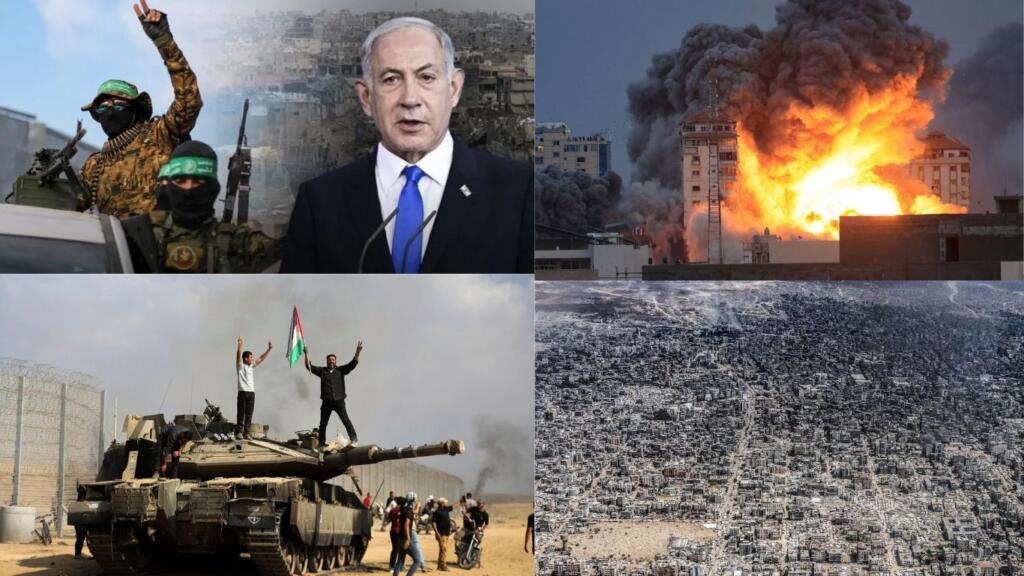
Two years ago, on October 7, 2023, Hamas launched what it thought would be a historic strike one that could force Israel and bring a separate Palestinian state closer to reality. Instead, it triggered a storm that buried that dream forever. The brutal attack that claimed 1,200 Israeli lives not only shook the Jewish nation but awakened a sleeping lion. Today, as Gaza lies in ruins, with aerial photos revealing nothing but flattened neighborhoods, one truth is unmistakable Hamas’s actions have ensured that the two-state theory, once seen as the path to peace, now lies dead in a coffin of its own making.
The Day the Lion Awoke: Hamas’s Calculated Misstep
On the morning of October 7, 2023, Hamas launched a coordinated and unprecedented assault on Israel. Over 2,200 rockets rained down within hours, overwhelming Israel’s Iron Dome defense system. At the same time, hundreds of armed militants stormed across the fortified border from Gaza using vehicles, paragliders, and even boats, targeting military bases and peaceful towns alike. What followed was pure horror 1,200 Israelis were massacred, many of them civilians, while 240 others were taken hostage, including women, children, and foreign nationals.
The attack’s most haunting moment unfolded at the Nova music festival, where hundreds of unarmed youth were brutally killed. For Israel, this was not just terrorism it was a declaration of total war. Within hours, Prime Minister Benjamin Netanyahu announced Operation Iron Swords, vowing that Hamas would “pay an unprecedented price.”
Operation Iron Swords: Israel’s Relentless Response
The Israeli Defense Forces responded with unmatched intensity. Aerial bombings, artillery strikes, and a full-scale ground invasion turned Gaza into a war zone. Within weeks, entire neighborhoods in Gaza City, Rafah, and Khan Younis were reduced to rubble. Hospitals, schools, and residential blocks crumbled under relentless air raids.
By early 2025, satellite images revealed a grim picture more than 70% of Gaza’s infrastructure destroyed, millions displaced, and thousands dead. While human rights groups condemned Israel’s campaign as “disproportionate,” Israel maintained that Hamas’s use of civilian shields made such destruction inevitable.
For Israelis, the war was about survival; for Hamas, it became a tragic miscalculation. The very attack that was supposed to revive Palestinian resistance instead provoked Israel into ensuring that the idea of a two-state solution would never resurface again.
The Global Fallout: A Divided World, A Shifting Narrative
Two years on, the war’s consequences ripple far beyond West Asia. Anger over Israel’s conduct accused by many international bodies of war crimes and genocide has grown worldwide. The death toll in Gaza, reportedly in tens of thousands, has eroded sympathy for Israel even among its closest allies. Yet, despite mounting criticism, the Israeli government shows no sign of retreat.
Even Washington’s patience is wearing thin. U.S. President Donald Trump, who once called Netanyahu a “great friend,” reportedly rebuked him over his refusal to accept a ceasefire deal tied to a U.S.-backed hostage-release plan. “I don’t know why you’re always so f***ing negative. This is a win. Take it,” Trump allegedly told Netanyahu, signaling growing frustration in Washington.
Meanwhile, across Europe, political shifts are visible. France, Spain, Ireland, and Finland have called for immediate recognition of a Palestinian state, with several Nordic and Western nations following suit. Yet, this newfound support for Palestine is not purely humanitarian it’s also political. Widespread pro-Palestine protests by Muslim immigrant populations have shaken cities like Paris, Milan, and London, forcing governments to appease domestic sentiment.
However, despite the diplomatic noise, the ground reality in Gaza remains unchanged the Palestinian dream lies shattered, and Israel’s determination to prevent any sovereign Palestinian entity is stronger than ever.
India’s Balancing Act: Standing by Israel, Upholding Peace
Throughout this volatile period, India’s foreign policy under Prime Minister Narendra Modi has stood out for its maturity and strategic balance. While reaffirming solidarity with Israel in the face of terrorism, India has consistently called for restraint, dialogue, and humanitarian aid for Palestinian civilians.
In June 2025, India abstained from voting on a UN General Assembly resolution titled “Protection of civilians and upholding legal and humanitarian obligations in Gaza.” The resolution, moved by Spain, was supported by 149 nations, opposed by 12, with 19 abstentions India among them. This move reflected New Delhi’s independent stance, diverging from both Western allies and its BRICS partners.
A few months later, Prime Minister Modi met Palestinian President Mahmoud Abbas on the sidelines of the UN General Assembly in New York. Modi reiterated India’s long-standing support for the Palestinian people while emphasizing the importance of restoring peace and stability in the region. Only a week later, Modi spoke with Netanyahu, urging restraint and reaffirming India’s friendship with Israel.
This balanced diplomacy underscores India’s growing global influence a nation that stands firmly against terror but equally advocates for humanity and peace. Unlike the West, India does not bow to populist street pressure; instead, it acts with strategic clarity and moral consistency.
The End of the Two-State Illusion
Today, Gaza’s skyline tells a grim story. What once were bustling streets are now endless ruins. For every building destroyed, for every family displaced, the dream of a Palestinian state fades further into the horizon. What Hamas believed would be a blow for freedom has instead become a self-inflicted wound on its people’s future.
Even as some Western capitals debate recognition of Palestine, Israel’s reality is unmistakable it will never allow a hostile state next door. The two-state theory, once championed by global diplomats as the cornerstone of Middle East peace, is now nothing more than a political relic.
Hamas’s October 7 attack was not the beginning of Palestinian liberation it was the beginning of its end.
Two years after Hamas’s fateful gamble, one truth echoes across the world Israel has emerged more resolute, Hamas more isolated, and Palestine more devastated. The war has redrawn not just Gaza’s map, but the entire political landscape of West Asia. While human suffering remains immense, the geopolitical reality is that Hamas’s aggression has killed the very cause it claimed to fight for.
In awakening the lion, Hamas ensured that the two-state dream would be buried beneath the rubble of Gaza a haunting reminder that terrorism can never build nations, only destroy them.