


















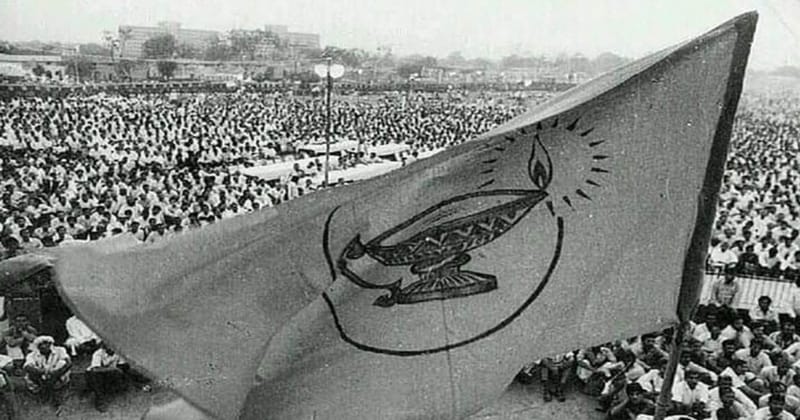
On this very day in 1951, in a modest school hall near Delhi’s Gole Market, nearly 200 delegates from across India gathered with one mission to build a political movement rooted in India’s civilizational pride, cultural unity, and self-respect. What emerged that day was the Bharatiya Jana Sangh (BJS) a party that would challenge the dominance of westernized politics and Nehruvian socialism. Seventy four years later, its ideological successor, the Bharatiya Janata Party (BJP), governs the world’s largest democracy. From a humble beginning at Raghumal Arya Kanya Vidyalaya to the corridors of power in Delhi this is the story of India’s nationalist awakening.
Birth of the Bharatiya Jana Sangh: A Revolt Against Westernized Politics
The early 1950s were marked by growing disillusionment among patriots and intellectuals who believed the post-Independence Congress had drifted away from India’s cultural and civilizational ethos. Dr. Syama Prasad Mookerjee, a scholar, freedom fighter, and staunch nationalist, emerged as the voice of this awakening. On 21 October 1951, under his leadership, the Bharatiya Jana Sangh was formally founded with the support of thinkers, social reformers, and nationalists many inspired by the Rashtriya Swayamsevak Sangh (RSS) and Arya Samaj movements.
Mookerjee, who had resigned from Jawaharlal Nehru’s cabinet in protest against the controversial Nehru-Liaquat Pact, became the party’s first president. The pact, which ignored the plight of Hindus in East Pakistan, convinced him that India needed a political force guided not by appeasement or imported ideologies but by Bharatiyata the essence of Indian nationalism.
The Jana Sangh adopted an eight-point programme focused on national unity, independent foreign policy, rehabilitation of refugees, self-reliance in industry, and equal rights for all citizens. It emphasized cultural nationalism and the vision of a united Bharat rejecting the divisive politics of caste, region, and religion that had begun to seep into independent India’s polity.
The Ideological Core: Hindutva and Integral Humanism
While Congress leaders of the time projected secularism as detachment from India’s Hindu civilizational identity, the Jana Sangh asserted that Hindutva was not about religion it was about culture, civilization, and identity. As K.R. Malkani, one of the party’s founding thinkers and editor of the Organiser, wrote in 1950, “If the unity of the country is to be made stronger, ancient foundations must be reinforced and suitably modernized. Communism can be conquered in Hindustan only through Hindutva.”
The Jana Sangh thus became the intellectual and moral opposition to the Nehruvian order. It believed India’s future could not rest on borrowed ideas from the West or the Soviet Union, but on its own civilizational wisdom.
In the 1960s, Deendayal Upadhyay, an RSS pracharak and one of the Jana Sangh’s most respected leaders, articulated the philosophy of Integral Humanism (Ekatma Manav Darshan) a vision of holistic development balancing material progress with spiritual well-being. This philosophy remains the ideological cornerstone of the modern BJP, defining its approach to governance, welfare, and economics.
The Organizational Revolution: Cadre, Discipline, and Growth
From its inception, the Jana Sangh understood that an enduring political movement needed a disciplined organization rather than a personality cult. It built a cadre-based structure that reached deep into society. Its smallest local units were called samitis, overseen by mandals at the next level, followed by district and state committees.
This structure decentralized yet ideologically united became the backbone of the Sangh’s political model. It ensured that the movement remained connected with ordinary citizens traders, teachers, farmers, and youth. Within a few years, the BJS had established vibrant state units across northern, central, and eastern India.
The party’s organizational efficiency was unmatched. In the 1950s and 1960s, it divided India into four zones with Balraj Madhok heading the North, Nanaji Deshmukh the East, Sunder Singh Bhandari the West, and Jagannath Rao Joshi the South. These leaders, known for their integrity and grassroots connect, expanded the Jana Sangh’s influence from small towns to major cities.
This disciplined model laid the foundation for the future Bharatiya Janata Party’s unparalleled organizational strength a strength that continues to power the BJP’s electoral success across states today.
From Struggle to Triumph: The Jana Sangh’s Political Journey
In the 1951–52 general elections, the Jana Sangh fielded 94 candidates and won three seats, including one from Bengal where Dr. Mookerjee himself triumphed. Though small in number, these victories were monumental in spirit for the first time, an unapologetically nationalist, pro-Hindu voice had entered Parliament.
The party grew steadily. In the 1957 elections, it secured nearly 6 percent of the national vote and four seats. Among its rising stars was a young Atal Bihari Vajpayee, who won from Balrampur in Uttar Pradesh a leader who would later become India’s Prime Minister.
By 1967, the Jana Sangh had expanded its influence significantly, winning 35 Lok Sabha seats with nearly 10 percent of the vote. It became the principal opposition voice to the Congress, challenging the Nehru-Indira model of centralized socialism with its call for “Self-reliant Bharat.”
Even during times of adversity, the Jana Sangh stood firm. When the Emergency was declared in 1975, its leaders including Vajpayee and Lal Krishna Advani were imprisoned for opposing authoritarianism. Two years later, the party’s ideals merged into the Janata Party, which defeated Indira Gandhi’s Congress in 1977 and formed India’s first non-Congress government.
However, ideological differences led to the Janata Party’s collapse in 1980. Out of its ashes rose the Bharatiya Janata Party (BJP) carrying forward the torch of Syama Prasad Mookerjee and Deendayal Upadhyay with renewed strength and clarity. On April 6, 1980, a new chapter began one that would soon redefine India’s political destiny.
From a Modest Hall to the Heart of Indian Democracy
The story of the Bharatiya Jana Sangh is not merely political history it is the saga of India’s ideological self-rediscovery. What began in a small Delhi classroom in 1951 as a modest gathering of patriots has today transformed into the ruling force of a resurgent India.
The BJP, the Jana Sangh’s ideological successor, now governs more than a dozen states and has led the nation through an era of global recognition and assertive nationalism. Its foundation rests not on opportunism or appeasement, but on decades of discipline, conviction, and service to the motherland.
From Dr. Syama Prasad Mookerjee’s call for a United Bharat to Narendra Modi’s vision of Viksit Bharat, the ideological thread remains unbroken a journey from sacrifice to success, from resistance to resurgence.
The Bharatiya Jana Sangh did not just create a political party; it ignited a movement that reclaimed India’s soul from colonial shadows. Seventy years later, its dream of a strong, self-reliant, and culturally confident Bharat stands fulfilled in the saffron flag that now flutters atop the nation’s highest seat of power