











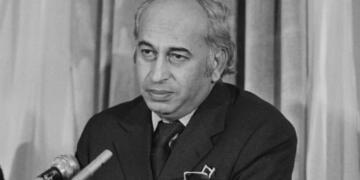







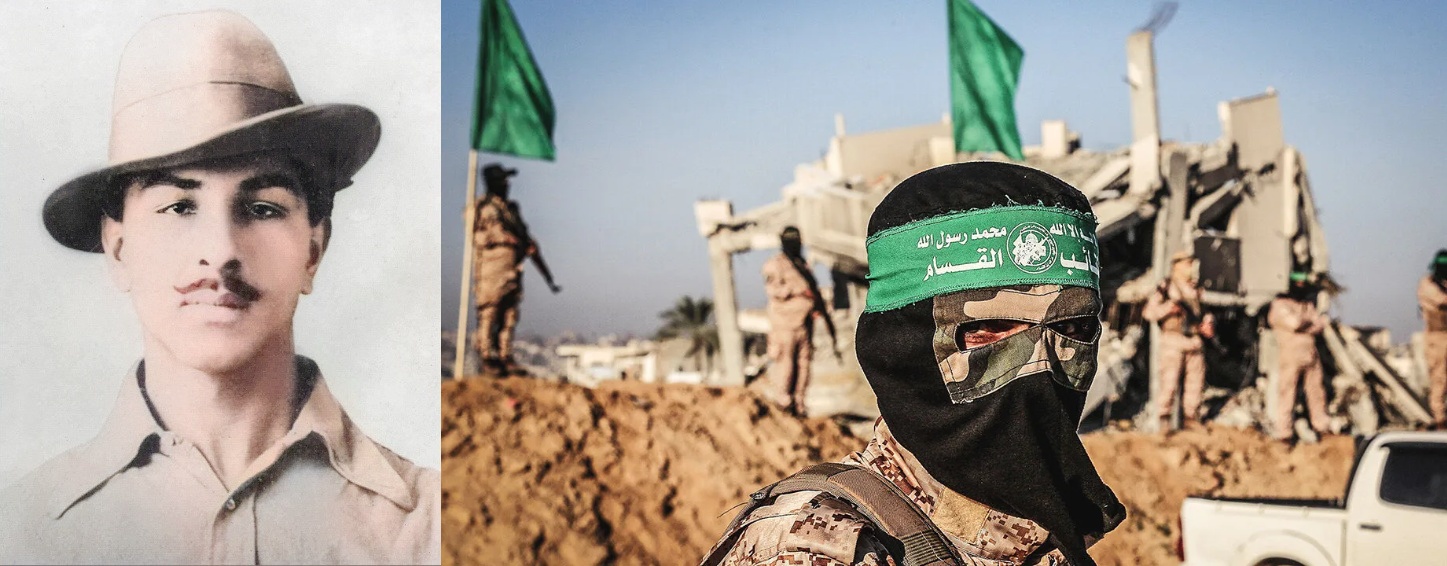
The recent comments by Imran Masood—a member of Indian National Congress—who compared the legendary freedom fighter Bhagat Singh with the Palestinian militant organisation Hamas, sparked a storm of controversy. Masood asserted in a podcast that “both were fighting for their land,” effectively equating the struggle of Bhagat Singh with the actions of Hamas.
But the comparison is fundamentally flawed — not only historically, but morally and politically. This piece aims to disentangle the nature of Bhagat Singh’s patriotism from Hamas’s terrorism, and explain why the difference matters.
Bhagat Singh: Patriotism Rooted in Anti-Colonial Justice
Bhagat Singh emerged in the 1920s and early ’30s in British India, as a revolutionary who believed in radical action against colonial rule. His executions in 1931 elevated him into a national symbol of sacrifice and anti-imperial resistance. His fight was not for religion, nor for the annihilation of a people — it was against foreign domination, for the restoration of rights and dignity of a subject population.
The moral arc of his actions is widely understood: he targeted symbols of colonial authority (for example, the Central Legislative Assembly bombing with no intent to kill civilians) and he accepted the legal consequences of his actions, remaining transparent and ideological in nature. His legacy is one of martyrdom, patriotism and national liberation — rather than terror per se.
Hamas: Terrorism with Mass Civilian Impact
In contrast, Hamas is designated a terrorist organisation by many countries, and its record includes attacks against civilian populations, hostage taking, and a strategy of asymmetric warfare that often courts heavy civilian harm.
While supporters argue that Hamas is fighting “for their land” — the Palestinian territories — the tactics deployed, the targeting of non-combatants, and the ideological framework anchored in religious supremacism and territorial maximalism place it firmly under the definition of terrorism. The very nature of terror groups involves employing violence to instil fear, destabilise societies, and often disregard lives of innocents.
Thus the label “terrorist organisation” is not merely rhetorical — it helps distinguish methods, targets, and legitimacy in international discourse.
Why the Comparison Fails: Three Key Differences
Legitimacy & Intent: Bhagat Singh’s struggle was undertaken with moral and political legitimacy in a context of a colonial occupying power. His cause had enormous popular support, and he accepted martyrdom. Hamas, while claiming legitimacy, operates with tactics that violate international humanitarian norms and deliberately seek to intimidate or kill civilians.
Tactics & Targets: Bhagat Singh avoided civilian massacres; his targets were the symbols of British rule and he accepted the possibility of arrest and execution. Hamas commits acts against civilians (including hostage taking), by design or effect, which is central to the definition of terrorism.
Aim & Outcome: Bhagat Singh’s aim was to liberate India from foreign rule, restore self-governance, and lay the groundwork for a free society. His legacy remains celebrated globally. Hamas, while claiming national liberation, pursues a mixture of ideology, militant tactics and is tied into an ongoing cycle of violence that often deadlocks any broader political solution.
The Political Fallout
Masood’s statement did not go unnoticed: it triggered sharp responses from the ruling Bharatiya Janata Party (BJP), which accused him of “insulting our freedom fighters” and equated his remarks to praise of a terror group.
Masood later attempted a clarification, saying he did not intend to directly compare Bhagat Singh with Hamas, but rather to speak about “people fighting for their land.”
But once made, the comparison opens up questions about the nature of resistance, the ethics of violence, and how freedom struggles and terror campaigns are framed in public discourse.
Why the Distinction Matters
In any political society, the line between freedom fighter and terrorist is critical. If legitimate struggle against oppression is conflated with indiscriminate violence, then the meaning of patriotism is diluted, and genuine sacrifice is cheapened.
Freedom movements like Bhagat Singh’s inspire across generations because they were grounded in moral clarity, strategic restraint, and national consensus. Terror groups like Hamas, even when supported by segments of a population, nonetheless challenge global norms around civilian protection, proportionality, and long-term peace. Holding them in the same category blurs moral lines, risks legitimising violent extremism, and undermines the memory of those like Bhagat Singh who died for a cause of national liberation — not for terror.
Conclusion
While Imran Masood’s intention might have been to highlight a principle of land-struggle, the comparison between Bhagat Singh and Hamas is neither accurate nor helpful. One was a patriot who embraced sacrifice under colonisation; the other is a militant organisation whose methods are rooted in terror and whose civilian impact is catastrophic. It is crucial, for both historical integrity and contemporary responsibility, that we maintain the distinction: patriotism — as embodied by Bhagat Singh — is about liberation, justice and collective self-determination, whereas terrorism — as represented by Hamas’s methods — is about fear, coercion and civilian harm. Only by recognising the difference can we honour true freedom struggles and avoid legitimising violence masquerading as liberation.