
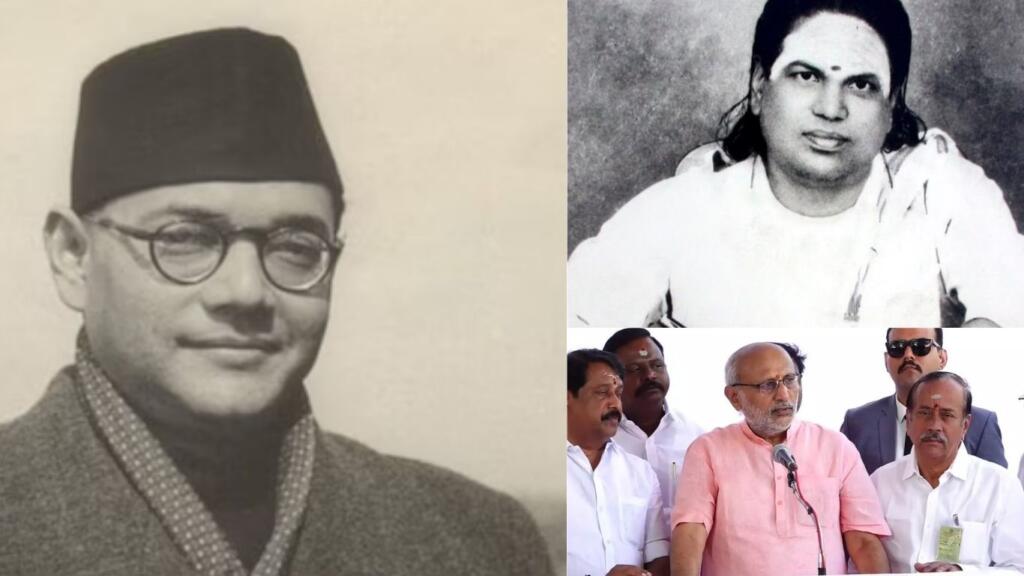
Vice President C.P. Radhakrishnan’s statement during Pasumpon Muthuramalinga Thevar Guru Puja on Thursday has once again reignited the decades-old mystery surrounding the death of Netaji Subhas Chandra Bose. Speaking at the event, the Vice President said, “Pasumpon Muthuramalinga Thevar was the most trusted lieutenant of Netaji Subhas Chandra Bose. I even today believe, though I do not have any evidence with me, that Netaji Subhas Chandra Bose did not die in that plane crash.” His assertion that Thevar had himself claimed to have met Bose after 1945 coupled with his belief that Thevar “never lied in his life” has brought the long-simmering debate back into public discourse.
According to Radhakrishnan, Thevar’s words hold immense weight because of his lifelong commitment to truth and spirituality. “He followed the path of high spirituality even in his political journey that was his greatness,” he added. The statement, coming from the second-highest constitutional office of the Republic, has stirred renewed attention toward one of the most enduring mysteries in India’s freedom history the alleged plane crash death of Subhas Chandra Bose on August 18, 1945, in Taipei.
The Vice President’s remarks draw from a long-standing belief held by Pasumpon Muthuramalinga Thevar and many of his followers in Tamil Nadu that Netaji never perished in the crash. Thevar, one of the most respected nationalist leaders from South India and a close associate of Bose in the Forward Bloc, had publicly stated that Bose was alive and would one day return.
Prominent author and researcher Anuj Dhar, who has written extensively on the Bose mystery, also backed this claim. In a post on X (formerly Twitter), Dhar said, “In 1950 or so, Muthuramalingam Thevar slipped out of India and met Subhas Chandra Bose (reported dead five years earlier). This account matches what the so-called Gumnami Baba said. Thevar was also the witness no. 1 before the Shah Nawaz Committee, where he sought the Government’s response on Netaji having been declared a war criminal.”
In 1950 or so, Muthuramalingam Thevar slipped out of India and met Subhas Chandra Bose (reported dead 5 years earlier). This account matches with what the so-called Gumnami Baba said. Thevar was also the witness no 1 before the Shah Nawaz Committee, where he sought Govt’s… https://t.co/qAGFIQtR71
— Anuj Dhar (@anujdhar) October 30, 2025
Further corroboration of Thevar’s claims comes from the writings of A.R. Perumal, a former MLA from Tamil Nadu. In his book Mudisooda Mannar Pasumpon Muthuramalinga Thevar, Perumal recounts Thevar’s speech made on January 23, 1949 Bose’s birthday at Tamukkam Grounds in Madurai. There, Thevar declared, “Netaji is well and safe. It is false that our leader Netaji died in the air crash. Our leader will appear before the people at the right time. Besides, I am in direct contact with Netaji.”
This revelation had electrified thousands of Tamil followers who revered Bose as a hero. In fact, during World War II, thousands of Tamils from Madurai, Ramanathapuram, Sivaganga, Tuticorin, and Tirunelveli districts, as well as from Burma, Singapore, and Malaysia, had joined the Indian National Army (INA) inspired by Netaji’s call for freedom. Thevar’s continued insistence that Bose was alive strengthened the spiritual and emotional bond many Tamils felt toward the INA legend.
The Indian government has formed three commissions of inquiry to unravel the mystery of Netaji’s alleged death: the Shah Nawaz Committee (1956), the Khosla Commission (1970), and the Mukherjee Commission (1999). The first two concluded that Bose died in the air crash at Taihoku airport in Japanese-occupied Taiwan on August 18, 1945. However, the Mukherjee Commission reached the opposite conclusion that Bose did not die in that crash.
The Mukherjee Commission based its findings on eyewitness inconsistencies and the absence of credible physical evidence, but its report was rejected by the government. Still, it reignited scholarly interest in the subject, with researchers and writers scouring global archives for clues.
In 2015, the West Bengal government declassified 64 files on Bose, which contained several references and correspondences suggesting that he may have been alive after 1945. Some letters referred to intelligence surveillance on individuals suspected to be Bose or his aides in the late 1940s. These disclosures, though inconclusive, lent further weight to theories that Bose might have survived the crash and lived incognito.
Adding a dramatic new layer to this puzzle, Paris-based historian J.B.P. More uncovered a French secret service report dated December 11, 1947, housed at the National Archives of France. According to More, the classified report titled “Archival Information on Subhas Chandra Bose” explicitly states that Bose’s whereabouts were “unknown” as late as December 1947, suggesting he was alive two years after the alleged crash.
The report was compiled by the Haut Commisariat de France for Indochina – SDECE (French Intelligence) and carried the number BCRI – No. 4128/3 cs/ah – Ex No. 6/16. It described Bose as the “ex-chief of the Indian Independence League and a member of Hikari Kikan,” a Japanese organization, and clearly mentioned that he had “escaped from Indochina,” though it did not detail how.
Dr. More points out that both Britain and Japan had quickly declared Bose dead after the alleged crash, but the French authorities, who controlled Indochina (Vietnam) at that time, never endorsed that version. He adds, “It is not stated in the document that Subhas Chandra Bose died in the air crash in Taiwan. Instead, it is reported that Bose’s present whereabouts were unknown as late as December 1947. This implies that the French did not buy the theory that Bose died in the air crash on August 18, 1945.”
This revelation, More asserts, confirms that Bose likely escaped from Indochina alive, and his trail went cold sometime between late 1947 and early 1950 precisely the timeline when Thevar claimed to have met him.
The mysterious figure known as Gumnami Baba, who lived in Faizabad, Uttar Pradesh, until his death in 1985, has often been linked to Bose. Several eyewitness accounts, along with items found in his residence including letters, INA memorabilia, and books in multiple languages sparked theories that he was, in fact, Subhas Chandra Bose living in disguise.
Anuj Dhar and other researchers have argued that testimonies like Thevar’s and documents like the French intelligence report strengthen the plausibility of this theory. Thevar’s alleged secret meeting with Bose in 1950 mirrors Gumnami Baba’s own claims of having remained in India after independence, maintaining contact with close associates under the radar.
Despite these revelations, successive Indian governments across political lines have hesitated to reopen the investigation comprehensively, leaving Bose’s fate one of modern India’s most haunting unsolved mysteries.
Vice President Radhakrishnan’s remarks have brought the debate back into public focus at a time when India continues to reassess its historical narratives. For decades, official records closed the chapter on Bose with the “Taihoku air crash,” but the combination of Thevar’s testimony, French intelligence reports, the Mukherjee Commission’s dissenting conclusion, and the Gumnami Baba evidence paints a picture far more complex and perhaps deliberately buried.
Bose’s legend endures precisely because his disappearance remains unresolved. His story is not just about how he died, but about how he continues to live in public memory, in political discourse, and now once again, in the words of India’s Vice President. As Radhakrishnan said, Pasumpon Muthuramalinga Thevar “never lied in his life.” If Thevar’s claim that he met Netaji after 1945 is true, then the final chapter of India’s greatest freedom hero is yet to be written.
Now that the Vice President of India the second-highest constitutional authority has spoken openly about the doubts surrounding Netaji Subhas Chandra Bose’s death, the debate can no longer remain confined to speculation. With new evidence, eyewitness claims, and historical documents resurfacing, the nation expects the government to take a decisive step toward uncovering the full truth. India deserves closure and history demands transparency.