


















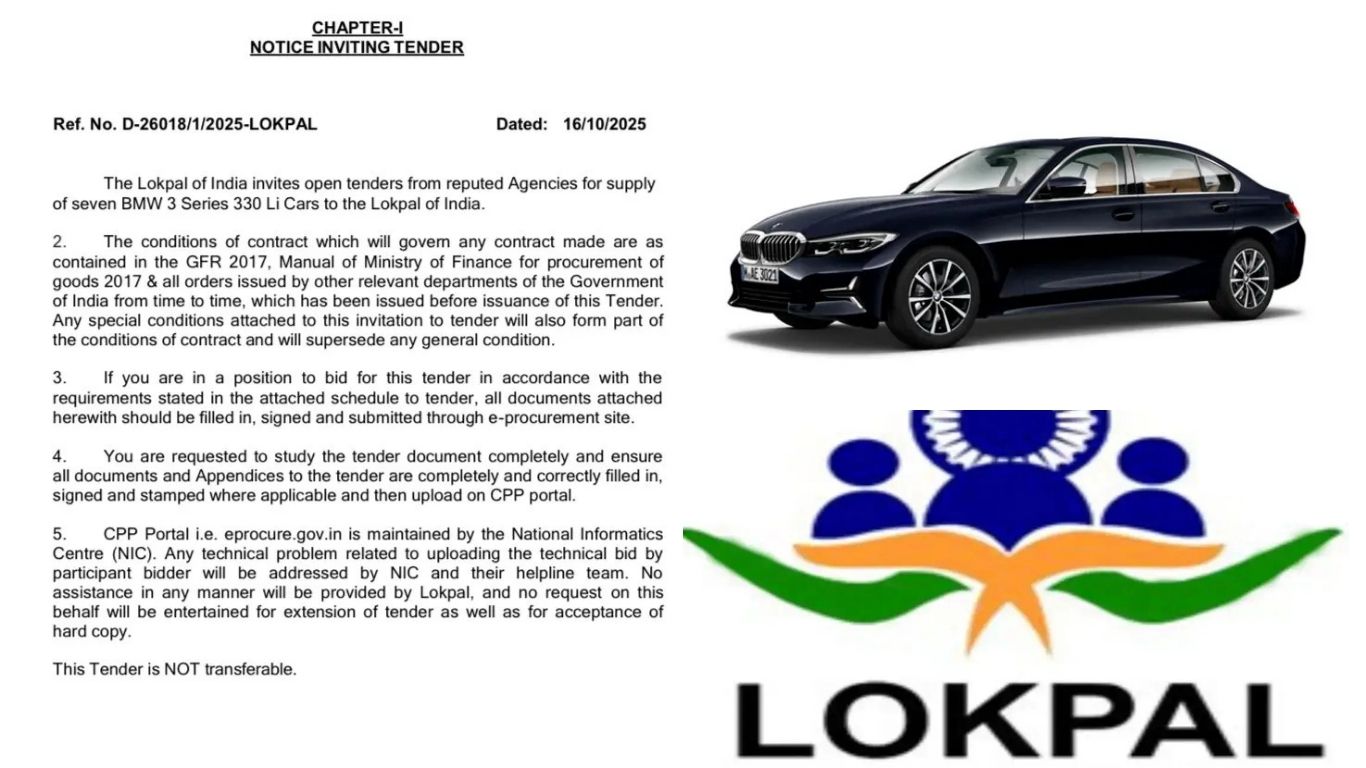
India’s top anti-corruption watchdog, the Lokpal of India, has found itself at the centre of a major controversy after it floated a tender to procure seven luxury BMW 3 Series Li sedans for its Chairperson and Members. The tender, issued on October 16, 2025, called for bids from reputed agencies to supply the vehicles, each costing around ₹70 lakh, and valid for 90 days from the opening date. The notice specifies that the cars should ideally be delivered within two weeks, and no later than 30 days after the supply order.
The decision has triggered widespread public anger, as many questioned the need for such high-end vehicles for an institution meant to combat corruption and uphold transparency. The Lokpal Chairperson, former Supreme Court Justice Ajay Manikrao Khanwilkar, along with six other Members, are the intended recipients of these BMW sedans. Critics argue that the move undermines the moral credibility of an anti-corruption body that has often been accused of inefficiency and elitism.
Lokpal’s performance of last 5 years.
Complaints received: Thousands
Complaints rejected: 90%
Investigations ordered: 24
Prosecution sanctioned: 6
Actual prosecution: 0If this was pvt sector, they would have been fired for being inefficient. But here we are. pic.twitter.com/jAv6BiX9fg
— Umed Pratap Singh (@umedpratapsingh) October 21, 2025
Adding to the controversy, the tender includes a clause mandating a seven-day training programme for drivers and staff to familiarize them with the vehicles’ advanced systems. The training, to be conducted by the vendor, will include both classroom sessions and practical road training, with all associated expenses honorarium, logistics, accommodation, and fuel borne by the vendor itself
The procurement plan has met with fierce criticism online, with activists, and citizens questioning the Lokpal’s priorities.
Social media users joined the chorus of criticism with biting sarcasm. One user wrote, “They could’ve gone for Rolls Royce worth ₹12 crore but didn’t, because they’re simple people who settled for BMWs instead.” Another quipped, “BMWs are fun to drive, but since they’ll be chauffeur-driven, they should’ve gone for Mercedes.”
However, some users offered a more cynical defence, pointing out that retired judges and senior bureaucrats who form the Lokpal deserve a certain level of comfort. Yet, this argument has done little to defuse the outrage, as many pointed out the disproportionate extravagance for an institution that has produced minimal results since its inception.
According to data, in the last five years, the Lokpal has received 8,703 complaints, but ordered probes in only 24 cases and granted prosecution sanction in just six. Nearly 90% of the complaints were rejected on technical grounds, primarily for not being filed in the prescribed format an indicator of how procedural rigidity has replaced meaningful action.
These are the current Lokpal members, an authority meant to check corruption in the central govt. Most are retired judges or babus.
They’ve floated tenders to buy BMW 3 Series Li cars worth ₹70 lakh each for all seven.
Lokpal is the most incompetent anti-corruption body. It… pic.twitter.com/LcUmi6oR6l
— THE SKIN DOCTOR (@theskindoctor13) October 21, 2025
Lokpal’s Defence: “We Follow the Law”
Amidst the uproar, sources within the Lokpal have dismissed the criticism as “totally unwarranted” and rooted in misunderstanding. Officials cited Section 7 of the Lokpal and Lokayuktas Act, 2013, which ensures parity in salary, allowances, and service conditions between Lokpal members and Supreme Court judges.
“Please see Section 7 of the Lokpal and Lokayuktas Act, 2013,” an official told Times Now. “It specifies that the Chairperson shall receive the same salary and benefits as the Chief Justice of India, while the other Members are entitled to the same as a Judge of the Supreme Court.”
The sources further explained that the decision followed a recent upgrade in official vehicles for Supreme Court judges, who shifted from Toyota Camrys and Skoda Superbs to BMW 3 Series Li. “Since the Lokpal Chairperson and Members are entitled to the same facilities, this is a logical and lawful upgrade,” the official added.
At present, the Lokpal Chairperson uses a Skoda Superb, while other members use Toyota Corolla Altis sedans. The decision to switch to BMWs, the sources claim, is merely aligning with established judicial entitlements rather than a display of luxury. Yet, this justification has failed to quell criticism from civil society, which views the move as tone-deaf amid mounting public distrust in institutions meant to ensure probity.
A Watchdog Losing Its Bite?
Established amid much fanfare after the anti-corruption movement led by Anna Hazare and the subsequent passage of the Lokpal and Lokayuktas Act in 2013, the Lokpal was envisioned as a powerful independent authority to investigate corruption in the highest offices. However, a decade later, it has largely failed to live up to its promise.
Critics argue that the Lokpal has turned into a symbol of bureaucratic red tape and judicial aloofness, rejecting a vast majority of complaints for procedural reasons instead of investigating them on merit. Several activists, including Prashant Bhushan, have repeatedly accused the body of “protecting the powerful rather than punishing the corrupt.”
The current controversy over luxury car purchases has deepened that perception. For an institution that was meant to embody simplicity, impartiality, and service to the people, the move to buy ₹70 lakh sedans projects an image of elitism and detachment. Many believe this incident could further erode public faith in a system already struggling with credibility.
The Lokpal’s decision to acquire BMW 3 Series Li sedans may be legally defensible, but it is morally indefensible at a time when corruption cases continue to pile up and accountability mechanisms remain weak. The symbolism of a corruption watchdog riding in luxury cars sends the wrong message to the public about its priorities.
While the Lokpal cites parity with Supreme Court judges as justification, critics argue that institutions of accountability must also practice ethical restraint and austerity, especially when public confidence in governance is fragile. The Lokpal was created to be a beacon of integrity and discipline, but decisions like this risk turning it into a bureaucratic relic of privilege.
If the Lokpal truly wants to restore its reputation, it must shift focus from comfort to credibility, from status to service and most importantly, from symbols of power to symbols of trust.





