








Kwame Nkrumah, the Ghanaian independence leader and politician, in his seminal work Neo-Colonialism, the Last Stage of Imperialism, succinctly defines :
“The essence of neo-colonialism is that the State which is subject to it is, in theory, independent and has all the outward trappings of international sovereignty. In reality its economic system and thus its political policy is directed from outside.”
And this is true across Africa. Africa is still colonised economically and psychologically, with the result that, despite vast natural resources and manpower, it remains poor and dependent on the west.
I. The Violent Foundations of Western Power in Africa
Africa’s modern story begins with a wound — the violent European scramble for its land, people, and resources. Between 1884 and 1885, the Berlin Conference formalised the partition of Africa, slicing the continent into artificial colonies with no regard for ethnic, cultural, or historical realities. European empires — Britain, France, Belgium, Germany, Portugal, Spain, and Italy — each claimed vast territories, exploiting them as private estates.
The human cost was staggering. In the Congo Free State alone, under King Leopold II of Belgium, an estimated 10 million people were killed between 1885 and 1908 in a campaign of forced rubber extraction. Britain’s imperial ventures across Africa uprooted communities, imposed heavy taxation, and conscripted millions into hard labour — not to build African economies, but to supply raw materials for Britain’s industrial base.
Economic looting was systematic. Between 1880 and 1960, Africa lost an estimated $1 trillion in today’s value through extraction of minerals, agricultural products, and forced labour without fair compensation. Gold, diamonds, ivory, palm oil, cocoa, and later uranium were shipped to Europe, fuelling industrialisation there while leaving African economies dependent, underdeveloped, and export-oriented. This exploitation, which still continues, impoverished African people while enriching the West.
Starting in the 1950s, a wave of independence swept across Africa. The peak of this movement was in 1960, a year often referred to as the “Year of Africa,” when 17 nations gained their sovereignty. By the end of the 1980s, the majority of African countries had achieved independence from European colonial rule.
However, Post-WWII, colonial powers had already established a framework of seemingly independent international bodies such as the UN, WTO, IMF, and World Bank etc to reorganise the world order. These organizations served as a facade of a new, unbiased global order, but in reality, they were designed to maintain colonial control through a framework of laws, regulations, and engineered global consent. And, where direct interference in African affairs was not possible, these organisations and their subsidiaries and ‘experts’ advised the newly formed African governments.
II. Colonial Currency: The Silent Noose
The exploitation wasn’t only physical — it was economic and financial. Colonial powers imposed their own currencies and banking systems, pegging African economies to European financial centres. This arrangement ensured that even after independence, many African nations’ reserves and foreign exchange policies were tied to Paris, London, or Brussels.
France’s CFA franc system is a glaring example — 14 African nations still use a currency pegged to the euro, with reserves held in the French Treasury. This colonial currency framework of highly over-valued western currencies allowed Europe to maintain a luxurious lifestyle despite low domestic production — funded by the continuous siphoning of value from African exports. By preventing African economies from diversifying and industrialising, Europe preserved its dominance without the costs of direct colonial administration.
The West’s most powerful tool of colonial hegemony has been its control over global finance through its currency. Their economies, though appearing big on paper due to inflated currency exchange rates, are in reality often underproductive and riddled with debt, homelessness, and incompetence. This unearned privilege is a direct result of the Global South doing the essential, hard work of producing raw materials and labor for the west, thus subsidizing the West’s luxurious lifestyles and hiding their internal decay.
This very fragility of the West’s economic dependence on the third world, has been exposed by the current tariff war, which is rapidly escalating into a full-blown global trade conflict. The BRICS bloc is a key player in this, actively promoting trade in non-Western currencies, realigning trade links and challenging the West’s financial dominance.
III. Post-Colonial Control: Neocolonialism’s Tools
When formal colonialism ended in the mid-20th century, its power structures did not vanish — they evolved into UN etc and its sub-organisations. Western control persisted through:
- Trade dependency — locking African economies into raw-material export cycles.
- Debt traps — offering loans tied to IMF/World Bank structural adjustment policies that forced cuts to education, healthcare, and public investment.
- Corporate monopolies — Western companies controlling mining, oil, and agricultural value chains.
- Military interventions and regime change — destabilising independent-minded leaders such as Patrice Lumumba in Congo and Thomas Sankara in Burkina Faso.
- Information warfare — Western media controlling global narratives on African governance and conflict.
IV. Psychological Colonisation: The Invisible Chain
Beyond the economic and political tools lay a deeper, more enduring form of control — psychological colonisation. The colonial education system glorified European history, culture, and governance models, while erasing or denigrating African achievements. Generations of Africans grew up believing progress could only come by imitating the West.
This mindset has had lasting effects:
- Policy mimicry — adopting Western economic models unsuited to African realities.
- Brain drain — valuing opportunities abroad over building at home.
- Cultural devaluation — viewing indigenous languages, governance structures, and knowledge systems as backward.
Today, this psychological conditioning still influences elites, economic planners, and even ordinary citizens, reinforcing a cycle where Africa remains a supplier of raw materials, a consumer of Western goods, and a follower of external agendas.
V. Africa’s Strength — and Its Exploitation
Africa is not poor — it is deliberately impoverished. The continent holds:
- 30% of the world’s mineral reserves
- 60% of the world’s uncultivated arable land
- 40% of global gold reserves
- The largest reserves of cobalt, platinum, and rare earths — critical for green technology.
Yet, these strengths have made Africa a target for exploitation and impoverishment. Western corporations and governments have worked to prevent large-scale industrialisation, fearing that a self-reliant Africa would compete rather than supply. From manipulating commodity prices to sabotaging infrastructure projects, Africa’s potential has been systematically constrained.
VI. Geopolitical Polarisation and the Rise of BRICS
The post-1945 world order — shaped by the victors of World War II — entrenched Western economic and political dominance. Institutions like the UN Security Council, IMF, and World Bank disproportionately empowered the West.
But today, this monopoly is cracking. BRICS (Brazil, Russia, India, China, South Africa) now represents over 31% of global GDP (PPP), surpassing the G7’s share. The bloc’s expansion — with interest from Egypt, Ethiopia, Nigeria, and others — signals a shift towards multipolarity.
This repolarization of the world is a historic opportunity for Africa to finally break its chains of neocolonialism by embracing South-South cooperation and building a robust trade network that is not dependent on the dollar or euro.
VII. Tariff Wars, Trade Wars, and Africa’s Opening
The West’s tariff regimes still operate on a worldview frozen in 1945 — imposing high duties on processed African goods while granting low-tariff access to raw materials. This discourages local value addition. As global trade tensions rise — notably between the US, EU, India, Russia and China — opportunities open for Africa to diversify partnerships, renegotiate trade deals, and align with nations that support industrial growth rather than resource extraction.
VIII. Resource Nationalism: Africa’s New Assertiveness
A growing wave of resource nationalism is sweeping Africa by assertion of a deliberate strategy to claim greater control over its mineral wealth and natural resources. This is being achieved by imposing new laws, increasing royalties, and demanding local processing of materials before export.
Countries like Namibia are banning raw lithium exports, insisting on local processing. Zambia and the DRC are planning joint battery manufacturing hubs. These moves threaten the old colonial supply chain and create a window for Africa to partner with nations — like India — that bring technology, markets, and respect for sovereignty.
IX. India’s Strategic Role in Africa’s Development
This is where India’s role becomes pivotal. India, having gone through a similar colonial experience, has successfully used its own people and resources to rapidly grow into the world’s 4th largest economy. Its civilizational culture is one of helping others, as demonstrated by many initiatives like the Vaccine Maitri during the COVID-19 pandemic and its Neighborhood First policy etc. India’s internal strengths—a stable government, a massive manufacturing and technological base, and indigenous high-tech advancements in space, electronics, and defense—can be replicated in Africa. Its success with Atmanirbhar Bharat (Self-Reliant India) and Make in India initiatives offers a powerful blueprint for Africa.
And, India understands Africa’s struggles and problems because it has lived a parallel history of colonisation, economic extraction, and cultural suppression.
India’s support for Africa is multi-faceted. Direct aid is a small part of it at around $27 million (₹225 crore) annually. However, India’s larger commitment includes over $12 billion in Lines of Credit for projects and significant trade and private investments, which reached nearly $98 billion in 2024.
Over the past three decades, India has emerged as:
- A major trade partner — India–Africa trade reached $98 billion in 2022–23.
- A development partner — over $12 billion in concessional credit lines have funded power plants, railways, and water projects in 42 African countries.
- A healthcare ally — Pan-African telemedicine initiatives connect Indian hospitals to African clinics, while affordable Indian pharmaceuticals serve millions.
- An agricultural partner — sharing expertise in dryland farming, irrigation, and cooperative models.
India’s people-oriented economy, focus on self-employment generation, and success in IT, pharmaceuticals, and agro-industries, apart from high technology sectors, offer a blueprint for Africa’s own inclusive growth.
X. Indian Diaspora: A Bridge Across Continents
The highly skilled, disciplined, and culturally adaptive Indian diaspora is a global asset, with over 3 million Indians employed in skilled jobs across the West. They form a critical part of the technology, industry, and government sectors in these regions.
Meanwhile, over 3 million people of Indian origin reside in Africa, with some families having been there for over a century. This community has built successful businesses, created jobs, and maintained strong cultural connections. Globally, the diaspora’s success in technology transfer, trade facilitation, and diplomatic goodwill represents a powerful, untapped resource that Africa can leverage by strengthening its ties with India.
XI. Towards a Shared Future
Africa and India share not just history, but destiny. Together, they can pioneer a new development model — one based on mutual respect, self-reliance, and equitable trade. By combining Africa’s vast resources with India’s technology, manufacturing, markets, and development experience, both can rise as pillars of the Global South.
The expected effects of such a strategic shift would be transformative. Within five years, Africa could see a significant decrease in its dependency on Western aid and imports, with a corresponding increase in intra-African, south-south and India-Africa trade. By 2035, with a concerted effort towards industrialization, Africa could become a net exporter of manufactured goods, creating a booming job market and a stable middle class. The biggest benefit would be the geopolitical empowerment that comes with economic independence, allowing Africa to set its own terms in the global arena.
XII. Strategic Roadmap for Africa–India Partnership
To benefit from Indian partnership, Africa must form a country specific strategy. This involves a joint development agenda focused on food security, skill development, and local manufacturing. Such initiatives will allow Africa to judiciously use its resources, dismantle psychological slavery, and transcend colonial borders.
Step 1 – Establish Africa–India Development Council
- Action: Create a permanent joint body between the African Union (AU) and India to coordinate projects, resolve bottlenecks, and align long-term strategies.
- India’s Role: Provide funding for the secretariat, share digital governance systems, and deploy sectoral experts.
- Timeline: Short-term (1–2 years)
- Expected Result: Streamlined coordination; reduced project delays; faster approval for Africa–India joint ventures.
Step 2 – Diversify Trade from Raw Materials to Value-Added Goods
- Action: Build African processing plants for minerals, agro-products, and textiles using Indian technology.
- India’s Role: Provide machinery on concessional finance, training, and market access in India.
- Timeline: Medium-term (4–6 years)
- Expected Result: +25% increase in Africa’s manufacturing output; creation of 2–3 million jobs.
Step 3 – Joint Medical and Pharmaceutical Hubs
- Action: Set up India-backed pharma manufacturing units in Africa to produce affordable medicines and vaccines locally.
- India’s Role: Transfer pharmaceutical technology, ensure WHO certification, and integrate African facilities into India’s supply chain.
- Timeline: Short to medium-term (3–5 years)
- Expected Result: 50% reduction in Africa’s medical import bills; increased healthcare access for 200 million people.
Step 4 – Agricultural Revolution via India’s Cooperative Model
- Action: Adapt India’s Amul and Farmer Producer Organisation (FPO) models to African conditions.
- India’s Role: Send agronomists, supply irrigation tech, create seed banks, and run farmer training.
- Timeline: Medium-term (4–7 years)
- Expected Result: 30% rise in crop yields; millions of small farmers lifted above subsistence level.
Step 5 – Digital Governance and Skills Transfer
- Action: Deploy India’s Aadhaar-style ID, UPI payment systems, and e-governance tools in African states.
- India’s Role: Offer open-source versions, training, and cybersecurity expertise.
- Timeline: Short-term (1–3 years)
- Expected Result: Reduced corruption; faster service delivery; 200 million Africans in formal financial systems.
Step 6 – Infrastructure Financing via BRICS Bank
- Action: Use the New Development Bank to fund roads, ports, and power projects jointly led by African and Indian firms.
- India’s Role: Co-invest in projects and push for concessional lending rates.
- Timeline: Medium to long-term (5–12 years)
- Expected Result: Lower logistics costs by 20%; increased intra-African trade by 35%.
Step 7 – Education and Research Exchanges
- Action: Double African student intake in Indian universities and set up joint research centres in Africa.
- India’s Role: Offer scholarships, faculty exchange programs, and online learning platforms.
- Timeline: Short to medium-term (2–5 years)
- Expected Result: Creation of 500,000 Africa-trained professionals in IT, medicine, engineering, and management.
Conclusion
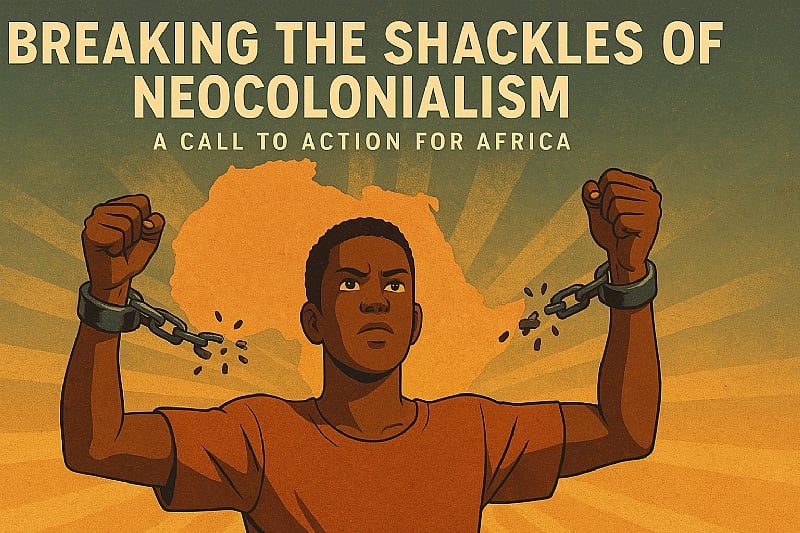
The present global turmoil is not a crisis for Africa but a golden opportunity. By rejecting the extractive neocolonial model and embracing a true partnership with India and other nations of the Global South, Africa can finally break its shackles. This means building a self-sufficient economy, reclaiming its cultural and psychological sovereignty, and taking its rightful place as a major and equal power in a truly multipolar world. The journey will be challenging, but the prize is the end of centuries of exploitation and the dawn of a new, prosperous future for the African continent.