
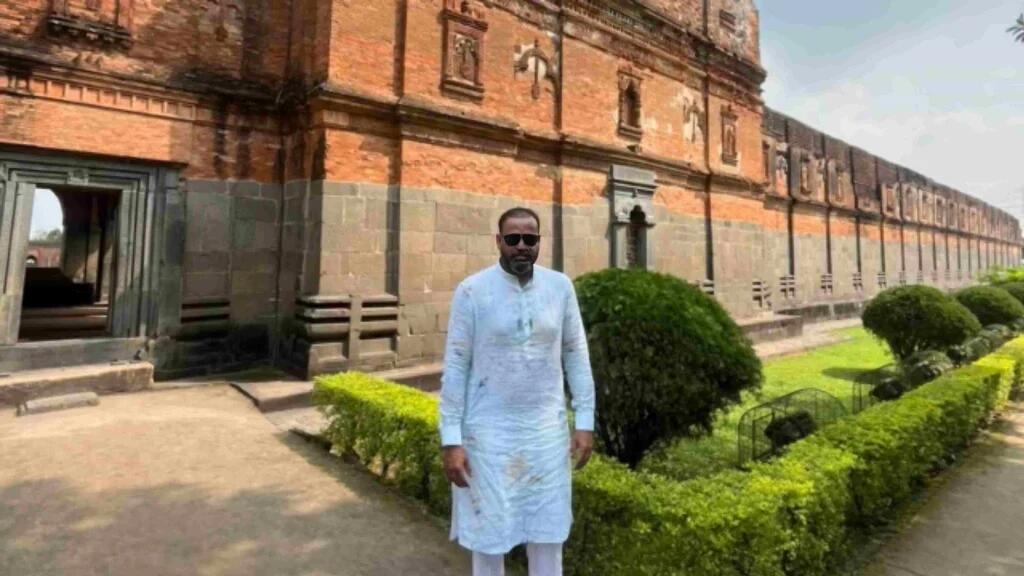
On October 16, Trinamool Congress (TMC) MP and former Indian cricketer Yusuf Pathan posted a seemingly innocuous update on social media from his visit to the Adina Mosque in West Bengal’s Malda district. Lauding its architecture, Pathan described it as a “historic mosque” built by Sultan Sikandar Shah in the 14th century, calling it the largest mosque of its time in the Indian subcontinent. However, what began as a routine appreciation of heritage architecture quickly spiraled into a social media storm—one that reignited deep historical wounds and questions over Islamic desecration and appropriation of Hindu temples.
Netizens were quick to fact-check Pathan’s claims and expose what they believe is a whitewashing of India’s pre-Islamic architectural and religious legacy. Many pointed out that the Adina Mosque stands on the ruins of the grand Hindu temple, Adinath Mandir, and retains clear visual evidence of its past in the form of carvings of Hindu deities like Lord Ganesha still visible on its walls.
Advocate Shekhar Kumar Jha, among others, posted images showing these carvings, stating, “Historic: Adinath Mandir became Adina Mosque.” Other users on X (formerly Twitter) also chimed in with photos and archaeological evidence that challenge the official narrative surrounding the monument. One user remarked, “Dear Yusuf Pathan, you are standing in the campus of one of the largest Hindu Temples, Adinath Temple, which was desecrated and occupied by Islamic invaders… It is time to undo the injustice and barbarity, and reestablish the temple’s glory.”
Another user, going by the handle “Abdul Kitabi,” echoed a surprising but significant sentiment. Sharing similar visual evidence, he wrote, “As a true Muslim, we must give this mosque back to Hindus.” This statement highlighted a rare, yet growing, acknowledgment among a section of the Muslim community about the darker aspects of Islamic conquest in India and the need for historical justice.
The controversy around Adina Mosque is not an isolated one. It is a piece of a much larger and deeply contentious puzzle: the Islamic vandalism and takeover of Hindu temples that occurred over centuries of invasions and rule. From the destruction of the Somnath Temple in Gujarat to the erection of the Gyanvapi Mosque in Varanasi and the Babri structure in Ayodhya, the subcontinent has witnessed a systematic campaign of religious and cultural erasure under successive Islamic regimes.
Historians, both Indian and foreign, have extensively documented these acts of temple destruction and conversion. Persian chroniclers of medieval India, often employed by Muslim rulers themselves, recorded such events with pride—seeing them as demonstrations of Islamic power and the subjugation of infidel cultures. Sultan Sikandar Shah, the builder of the Adina Mosque, ruled during the height of the Ilyas Shahi dynasty’s expansion and is known to have followed this well-established practice of constructing Islamic monuments using the ruins of temples.
In the case of Adina, its very architecture betrays its Hindu origins. The use of pre-existing temple columns, stone slabs, and iconography—some even left intact—reflects not just convenience, but a deeper symbolism: the dominance of a new faith over the old. Rather than being an architectural marvel born in a vacuum, the mosque is arguably a reused and refashioned site—a grave marker for a once-majestic temple complex.
The political and cultural implications of this episode are significant. While Pathan’s post may have been innocently intended, it unintentionally reopened debates around temple restoration, the reassertion of Hindu heritage, and the continued misrepresentation of history in India’s public discourse. The response on social media shows a growing consciousness among Hindus about reclaiming their sacred sites and calling out what they see as centuries of historical injustice.
This demand isn’t new, but in the age of digital connectivity and open-source archaeology, it’s gaining unprecedented momentum. While past generations may have accepted the official line of secular indifference or historical amnesia, the current generation is challenging long-held narratives, armed with facts, images, and an unflinching resolve.
In sum, the Adina Mosque controversy is not just about one structure in Malda. It is emblematic of a centuries-long saga of cultural obliteration and religious appropriation that has scarred India’s civilizational landscape. And as voices grow louder calling for the truth to be acknowledged—and, where possible, rectified—it becomes ever harder to silence or ignore the demand for justice rooted in historical memory.