
Every year on 27 October, two nations tell two stories about the same day.
In Islamabad, Pakistan’s Ministry of Foreign Affairs mourns “Black Day,” pretending that Indian troops “occupied” Kashmir.
In New Delhi and Srinagar, India marks Infantry Day — remembering the morning in 1947 when Indian soldiers landed in Srinagar to stop Pakistan’s invasion and rescue an entire people from slaughter.
Seventy-eight years later, the record is unshakable: Pakistan was the aggressor, and India the defender. What happened that week in October 1947 decided not just the fate of a state but the moral compass of a region.
The Day That Saved Kashmir
On 22 October 1947, thousands of tribal lashkars armed and guided by Pakistan’s military stormed across the Muzaffarabad-Baramulla axis. They torched homes, looted shops and massacred civilians — including patients and nuns at Baramulla’s Mission Hospital.
The State Forces collapsed. Srinagar was next.
Desperate, Maharaja Hari Singh signed the Instrument of Accession on 26 October, formally joining India. Governor-General Lord Mountbatten accepted it the next day.
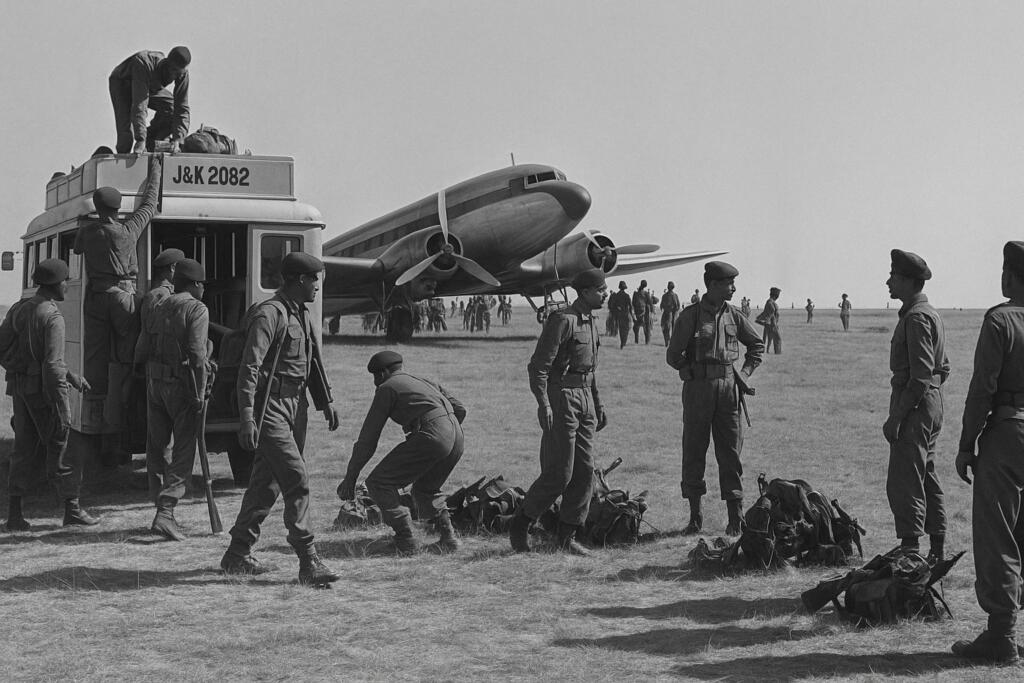
At dawn on 27 October, the first Dakota aircraft of the Indian Air Force touched down at Srinagar airfield carrying men of the 1st Battalion, The Sikh Regiment, commanded by Lt Col Dewan Ranjit Rai. They secured the runway and pushed back the raiders. Ranjit Rai was killed in action two days later — independent India’s first commanding officer to fall in battle.
On 3 November, Major Somnath Sharma of 4 Kumaon and his men held Badgam against seven-to-one odds. His final radio message — “We shall fight to the last man and the last round” — still echoes through Indian military history. Sharma became the first Param Vir Chakra awardee.
That stand saved Srinagar. It also saved Kashmir from a Pakistan-backed occupation that had already shown its brutality.
Infantry Day vs Pakistan’s Propaganda Day
Pakistan’s MoFA still recycles its 1947 talking points every October — ignoring the simplest timeline:
22 Oct: Pakistan’s invasion begins.
26 Oct: Jammu & Kashmir legally accedes to India.
27 Oct: Indian troops land with the ruler’s consent to defend his state.
There is no moral ambiguity. The Indian Army entered a territory that had already joined India under international law.
Pakistan, by contrast, crossed a border it had no claim to — the textbook definition of aggression.
The Watch That Never Ended
When the ceasefire took effect in 1949, two-thirds of the state remained with India. The rest — what Pakistan now calls “Azad Kashmir” and “Gilgit-Baltistan” — became occupied territories without rights or representation.
Since then, India’s infantry has maintained an unbroken vigil along mountains and valleys. From Zojila to Tangdhar, from Poonch to Gurez, generations of soldiers have guarded the frontier in freezing winds, floods and insurgencies.
They have also been first responders in crises: rescuing over 90,000 people during the 2014 floods, running schools and clinics under Operation Sadbhavana, and keeping roads and bridges open in the dead of winter.
For many Kashmiris, the olive-green uniform has meant not occupation but the arrival of help.
Pakistan’s Double Standards Laid Bare
This year’s “Black Day” statement from Islamabad rings especially hollow.
In September and October 2025, Pakistan’s own security forces opened fire on protesters in Pakistan-Occupied Kashmir. Demonstrations over electricity prices and resource plunder in Muzaffarabad and Dadyal left at least ten dead and more than 150 injured. The region was sealed under curfew; communications were blacked out. The same Pakistan that claims to speak for Kashmiris is gunning them down on its own streets.
Modern Warriors, Same Creed
Today’s infantrymen face new challenges — drones, cross-border narcotics networks, encrypted handlers — but the creed is unchanged: protect without provocation, respond without hesitation.
During Operation Sindoor earlier this year, launched after the Pahalgam terror attack, infantry units once again spearheaded India’s precision counter-terror strikes along the Line of Control. The legacy of 1947 continues in every patrol that defends sovereignty on the world’s most volatile frontier.
The Soldier’s Human Side
In Kashmir’s villages, soldiers still share tea with families during Eid or Diwali, distribute notebooks to schoolchildren and clear snow so ambulances can pass. These acts rarely trend online, but they sustain trust.
As one elderly resident once said, “They come with weapons, yes — but sometimes they also bring warmth.”
The Truth Pakistan Fears
Infantry Day 2025 demolishes Pakistan’s annual charade.
It reminds the world that India’s Army entered Kashmir to defend, not to seize; that its presence is rooted in law, not conquest; and that Pakistan’s “Black Day” is in fact the anniversary of its own first aggression.
And while Islamabad fires on its own citizens in PoK, Indian soldiers in the Valley are rebuilding schools, rescuing flood victims and keeping peace.
The Real Black Day
If any day deserves that name, it is 22 October 1947 — the day Pakistan sent armed raiders to loot and murder. 27 October, by contrast, is India’s Day of Deliverance — when the tricolour first flew over a free Srinagar.
Seventy-seven years later, the same spirit endures. The infantryman on a snow ridge in Gurez, the patrol in Kupwara, the quick-reaction team in Pulwama — they are all part of that first promise made in 1947: to guard every inch of Indian soil and every life under its flag.
So when Pakistan calls this day “black,” India answers with truth, pride and remembrance.
Because for the people of the Valley, 27 October is the day the Indian soldier came — and Kashmir never fell.
(Ashu Mann is an Associate Fellow at the Centre for Land Warfare Studies. He was awarded the Vice Chief of the Army Staff Commendation card on Army Day 2025. He is pursuing a PhD from Amity University, Noida, in Defence and Strategic Studies. His research focuses include the India-China territorial dispute, great power rivalry, and Chinese foreign policy.)