













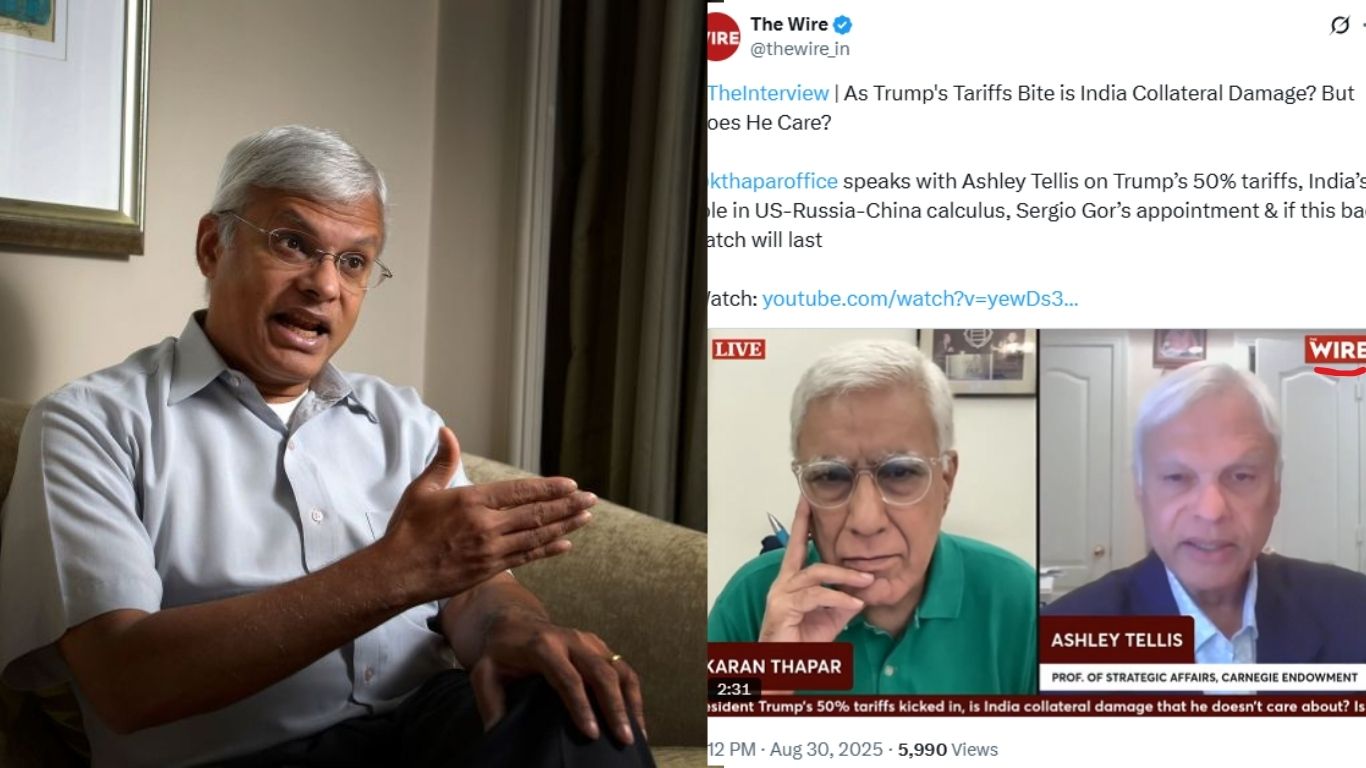
In a dramatic twist that has sent shockwaves through diplomatic and academic circles, Indian-origin US defence and foreign policy scholar Ashley J. Tellis long celebrated as a leading authority on South Asian affairs has been arrested in Virginia for unlawfully retaining classified national defence documents. Tellis, 64, a senior fellow and Tata Chair for Strategic Affairs at the Carnegie Endowment for International Peace, has been charged under 18 USC § 793(e), which deals with unauthorised possession of defence-related information.
The allegations are grave: investigators accuse Tellis of removing restricted government material from secure offices, storing classified files in his home, and even meeting with Chinese officials during private engagements. If convicted, he faces up to 10 years in prison and a fine of $250,000. The US Attorney for the Eastern District of Virginia, Lindsey Halligan, described the case as one involving “a grave risk to the safety and security of our citizens.”
This shocking revelation not only dismantles the credibility of one of Washington’s most quoted South Asia experts but also exposes the web of intellectual influence that has often operated against India’s national interests under the guise of academic neutrality.
The Man Who Spoke Against India Now Facing His Own Reckoning
Born in Mumbai, Ashley Tellis graduated from St. Xavier’s College before pursuing his higher studies at the University of Chicago, where he earned advanced degrees in political science. Over the years, he built an impressive resume in Washington serving as Special Assistant to President George W. Bush and Senior Director for Strategic Planning and Southwest Asia at the National Security Council. He was a key negotiator in the historic US-India Civil Nuclear Agreement, an achievement that made him a celebrated figure in Indo-American policy circles.
However, in recent years, Tellis became a favoured voice among India’s left-liberal establishment and the Congress-linked media ecosystem, frequently cited by platforms like The Wire and interviewed by Karan Thapar, where he often launched sharp attacks on the Modi government’s foreign policy. His arguments packaged as “academic critique” were often echoed by opposition leaders to undermine India’s global image.
It now appears that the very man who accused New Delhi of authoritarianism and poor strategic judgment was himself allegedly violating national security laws in the United States, and possibly cozying up to China the country most invested in weakening India’s rise.
The Classified Documents and The China Connection
According to an FBI affidavit, Tellis accessed and printed sensitive US Defence and State Department documents between September and October 2025. Surveillance footage allegedly captured him leaving a secure government facility with a leather briefcase, which prosecutors believe contained restricted files.
When the FBI raided his residence in Vienna, Virginia, agents reportedly recovered over 1,000 pages of “Top Secret” and “Secret” documents, some stashed inside locked cabinets, others in trash bags and basement drawers. Investigators also uncovered digital traces suggesting communications and meetings with Chinese government representatives.
One particularly concerning incident occurred in September 2025, when Tellis was seen entering a restaurant in Fairfax, Virginia, with a manila envelope. Surveillance footage showed him leaving empty-handed. Prosecutors have also cited prior meetings in 2023 and 2022 where Tellis reportedly discussed China’s relations with Iran, emerging technologies, and even policy papers exchanged under the guise of “academic collaboration.”
Though the FBI has not formally charged him with espionage, the allegations strongly suggest patterns of engagement consistent with influence operations, particularly those designed to manipulate US and Indian policy discourse in favour of Beijing.
The Tata Connection and India’s Think Tank Dilemma
Tellis’s arrest has also sparked questions in India especially because his chair at the Carnegie Endowment, titled “The Tata Chair for Strategic Affairs,” was funded by Indian corporate houses mainly by the TATA. Many observers now argue that Indian businesses must audit and review where their endowments are going, and whether their funds are indirectly supporting voices critical of India’s national interests.
Several prominent US-based policy think tanks including Carnegie, Brookings, and CSIS have long benefited from Indian corporate philanthropy. While the intention was to build India’s global intellectual presence, some of these endowments appear to have been weaponised, providing platforms for so-called “brown sepoys” Indian-origin experts who criticise India while aligning with Western or Chinese narratives.
Ashley Tellis, for instance, frequently questioned India’s defence strategy, criticised the Modi government’s global diplomacy, and often spoke of “Hindu majoritarianism” echoing talking points typically amplified by anti-India lobbies in Washington. His sudden arrest by US authorities has thus shattered the illusion that these intellectuals were purely independent or objective voices.
A Broader Pattern: The Western “India Experts” Under Scrutiny
Tellis’s case comes at a time when Washington has begun taking a closer look at foreign influence operations conducted through academic institutions, research fellowships, and policy circles. The revelation that someone as respected and well-connected as Ashley Tellis could be under investigation for classified document theft and China links has already rattled the Beltway establishment.
For India, this serves as a critical reminder of the need for vigilance in how Western academia shapes narratives about its democracy, foreign policy, and national security. Many of these “India experts” educated in elite Western institutions but deeply disconnected from India’s realities often echo positions sympathetic to China or Pakistan while dismissing India’s legitimate security concerns.
Tellis’s downfall, therefore, is not an isolated scandal. It represents the crumbling façade of a foreign policy ecosystem that once dictated how India was perceived in the world. And it’s telling that those who used his opinions to attack the Modi government are now silent.
As one political observer remarked online: “Thank God it’s the U.S. framing him and not India, otherwise Rahul Gandhi and his gang would be screaming that Modi framed him for speaking against the government.”
The arrest of Ashley Tellis marks a watershed moment in how both Washington and New Delhi view the intersection of intellectual power, influence, and loyalty. Here was a man born in India, celebrated in the U.S., quoted by Indian opposition leaders, and idolised by the Western media as the conscience of South Asia now facing charges that strike at the very core of trust and national security.
His alleged connections with Chinese officials, possession of secret U.S. documents, and misuse of his academic position expose the moral bankruptcy of a class of self-styled “liberal intellectuals” who have long undermined India’s interests while claiming to represent “objective analysis.”
This case should push Indian corporations, policymakers, and the media to scrutinise where they channel their intellectual capital and funding. The arrest of Ashley Tellis is more than a criminal case it’s the symbolic unmasking of a generation of global elites who forgot where their loyalties lie.