
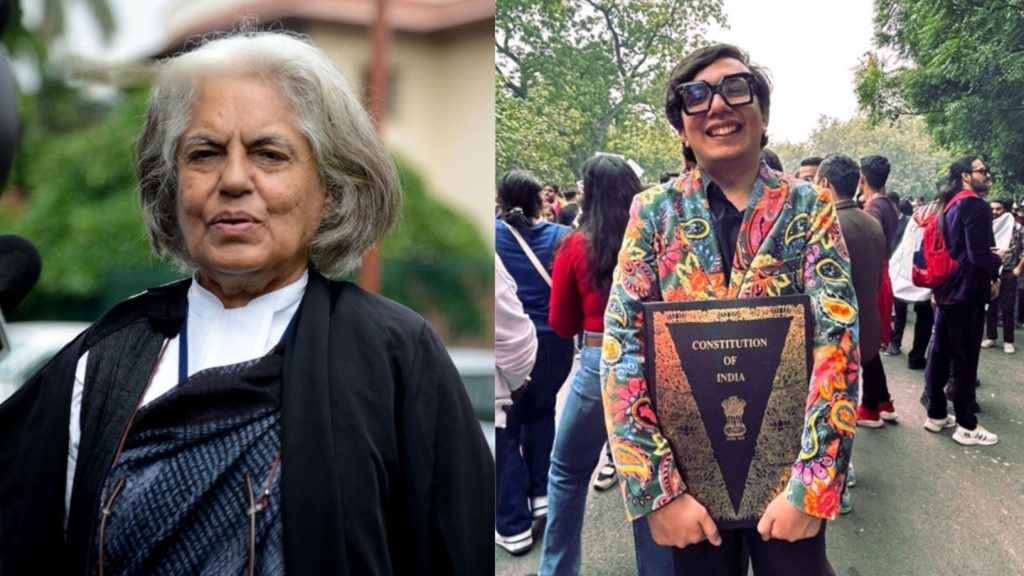
Supreme Court advocate Indira Jaising, often hailed as a champion of human rights and social justice, has come under renewed scrutiny—not for her activism, but for her conspicuous silence. Despite consistently speaking out on issues of gender justice, patriarchy, and harassment, Jaising has failed to comment on serious sexual assault allegations levelled against her close associate, lawyer-activist Rohin Bhatt, by transgender woman lawyer Raghavi. This silence is being seen by many as deeply hypocritical—especially from someone who positions herself as a feminist icon and moral compass on social issues.
More significantly, critics argue that this isn’t just a one-off omission but part of a broader pattern in Jaising’s public conduct, where she has routinely made statements perceived as anti-Hindu, while turning a blind eye to transgressions within her own ideological or professional circle.
The Allegations: A Troubling Account
Raghavi, a transgender woman and a lawyer, recently came forward with a harrowing account of sexual assault by Rohin Bhatt, a gay rights activist closely associated with Jaising. According to Raghavi, the incident occurred two years ago when she was undergoing hormone therapy. She alleges that during a casual gathering at a mutual friend’s house, Bhatt inappropriately touched her while they were all lying on a bed. She was too shocked to react immediately, and although their mutual friends were taken aback, Bhatt brushed off the incident as a “joke.”
Raghavi did not pursue the matter legally at the time, largely due to fear, lack of clarity about her rights, and trauma. But the psychological toll of the experience lingered. It was only after seeing Bhatt speak publicly on issues of rape and harassment that the emotional weight of his past actions compelled her to finally break her silence. She posted her account on X (formerly Twitter), detailing the incident and accusing Bhatt of never apologizing or acknowledging his misconduct.
Who is Rohin Bhatt?
Bhatt is a Harvard-educated lawyer-activist who has gained public prominence for his role in LGBTQIA+ rights litigation in India. He joined the legal team of Indira Jaising and Anand Grover in July 2022 and has worked on high-profile same-sex marriage cases in the Supreme Court. With elite academic credentials and a growing public persona, Bhatt is seen as a poster child for liberal activism in India.
His close professional relationship with Indira Jaising is noteworthy. Not only did she bring him onto her legal team, but Bhatt’s legal arguments and research have contributed to several of her ongoing cases. Given their public alignment and shared ideological space, Jaising’s silence on the serious charges against Bhatt stands out starkly.
A Pattern of Hypocrisy?
Indira Jaising has never shied away from targeting Hindu traditions and festivals under the guise of human rights. From opposing Sabarimala temple entry restrictions to making controversial statements during the Shaheen Bagh protests and the Citizenship Amendment Act debates, Jaising has routinely painted Hindu cultural norms as patriarchal and oppressive. Yet, when confronted with clear instances of sexual misconduct within her immediate circle—particularly involving a man from a minority group lauded for his activism—her vocal outrage disappears.
Critics argue this double standard reveals a selective moral compass: swift condemnation when the accused is linked to traditional or Hindu institutions, but calculated silence when the accused belongs to her own ideological camp or minority identity. This pattern, they say, is deeply troubling for someone who claims to stand for all women, especially those from marginalized communities like Raghavi.
Feminist or Opportunist?
What makes this silence even more egregious is Jaising’s long-standing reputation as a feminist lawyer who has taken up countless cases involving women’s rights and gender justice. She has built her career on championing the causes of sexual assault victims, demanding accountability from powerful institutions. But in this instance, the power dynamic clearly favors her protégé—and she appears to have chosen complicity over confrontation.
This contradiction undermines the very principles Jaising claims to uphold. For many observers, it reinforces the view that her activism is less about consistent justice and more about political and ideological convenience.
Silence That Speaks Volumes
Raghavi’s case is not just a personal grievance—it reflects the broader challenges trans women face in seeking justice, even within supposedly progressive and inclusive spaces. The lack of response from someone as influential as Indira Jaising not only hurts Raghavi but sends a chilling message to other victims: that their trauma will be ignored if it doesn’t fit a convenient narrative.
Until Jaising addresses this issue openly and honestly, the accusations of selective outrage and ideological bias will only grow louder. Her silence, in this case, does not protect her credibility—it destroys it.
In conclusion, the gap between Indira Jaising’s public activism and her personal inaction exposes a troubling hypocrisy, especially as she continues to make statements that many perceive as hostile to Hindu traditions while shielding those accused within her own circle. If justice truly matters, it must be blind to ideology, identity, or convenience.