
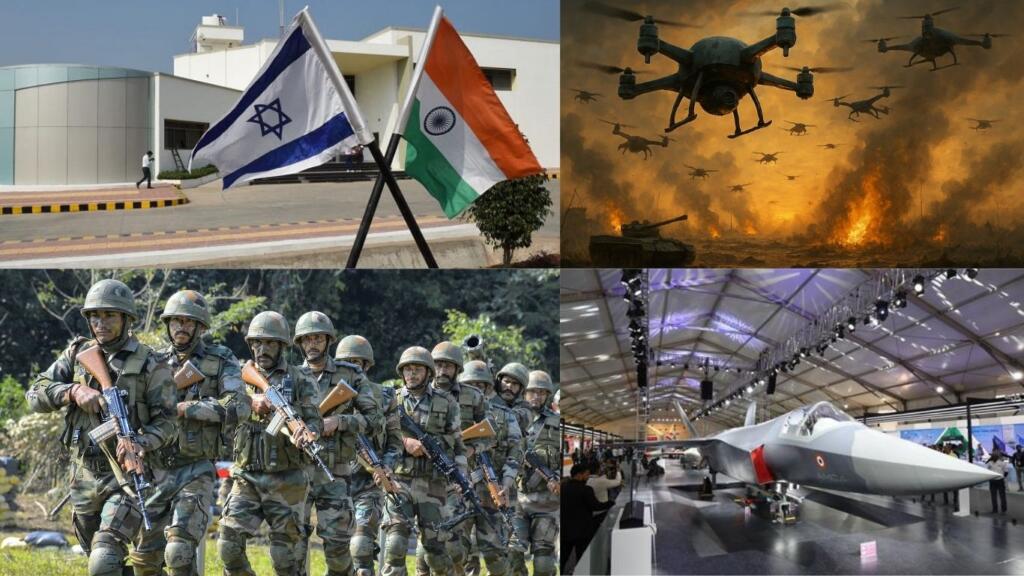
Israel’s defense excellence stems from universal military experience, fostering innovation rooted in battlefield needs. India must integrate soldiers into R&D, empower startups, reform DRDO, and create dual-use tech hubs. By aligning innovation with combat realities, India can surpass global leaders and become a dominant defense exporter to the world. Israel, despite being a small country with limited natural resources, a population of under 10 million, and surrounded by hostile nations, has built one of the world’s most advanced military-industrial complexes. Its weapons R&D and production systems are regarded as top-tier—agile, precise, and highly effective. Behind this lies a unique national psychology: every Israeli citizen has served in the Israel Defense Forces (IDF), and most have experienced conflict firsthand. This continuous state of alertness and practical understanding of warfare shapes how they innovate, design, and build technology—not only for military use but also for civilian applications.
This military-to-civilian innovation ecosystem is something India, with its vastly larger population, immense talent pool, and extensive military needs, can learn from. Despite having a large defense budget and several DRDO labs, India’s defense innovation still trails behind not only Israel but also nations like Germany, France, and Japan. Much of this lag can be attributed to a disconnect between developers and real battlefield needs. In India, most of the defense R&D is led by individuals who’ve never been in combat or received military training. As a result, they often miss obvious battlefield-use cases and struggle to convert technologies into real-world solutions.
To evolve into a defense and technology powerhouse, India must understand what makes Israel successful and rewire its own R&D ecosystem to harness its military experience, youth potential, and strategic urgency. Here’s how.
What India Can Learn from Israel
1. Warfare as a National Mindset
In Israel, military service is compulsory. This creates a population where most adults are veterans with battlefield experience. Soldiers-turned-engineers become the backbone of the country’s innovation system. They carry with them a problem-solving attitude focused on survival, speed, and efficiency. Whether they later work in aerospace, AI, cyber defense, or agriculture, they think like warriors solving life-or-death challenges.
In contrast, most Indian R&D personnel have no exposure to real combat. They design systems based on theoretical assumptions or lab simulations, leading to delays, inefficiencies, and flawed products. Incorporating real military experience into India’s R&D system could bring radical change.
2. Tight Integration Between Military, Industry, and Academia
In Israel, the IDF works closely with companies like Rafael, Elbit, and IAI, and collaborates with academic institutions. This real-time loop ensures that battlefield needs, technological developments, and product deployment are aligned. Innovations like the Iron Dome, Trophy active protection system, and drone swarms emerged from such close cooperation.
India, on the other hand, suffers from silos. DRDO, the armed forces, and private companies rarely work as integrated teams. This must change. Defense and civilian R&D must operate together, and the military must play an advisory role from the design phase to final deployment.
3. Dual-Use Technology and Civilian Spillover
Many Israeli startups, especially in cybersecurity, drones, and surveillance, emerged from elite military units like Unit 8200. Technologies developed for defense quickly evolve into high-value civilian products, fueling economic growth and national resilience.
India should actively encourage dual-use innovation. R&D from defense labs should be commercialized quickly, and vice versa—civilian startups working in AI, robotics, and sensors should be invited to solve defense challenges.
India’s Roadmap to Surpassing Global Defense Tech Leaders
To rise beyond even Israel, France, and Germany, India must craft its own strategic model that leverages its size, diversity, and depth. Here’s a blueprint:
1. Embed Soldiers in R&D
Establish a policy where ex-servicemen, especially those with field experience, are embedded in DRDO labs, design teams, and development units. They would act as Combat-Tech Advisors, helping R&D teams understand real battlefield needs and stress conditions. Every defense product—from boots to missiles—should pass the scrutiny of battle-hardened eyes.
2. Mandatory Military Training for Scientists and Engineers
Introduce short-term military exposure (3–6 months) for all DRDO recruits, PSU engineers, and private-sector R&D professionals working on defense projects. Firsthand experience of soldiering would transform how they approach design, durability, ease of use, and battlefield ergonomics.
3. Launch a ‘Soldier Innovation Corps’
Create a special unit of veterans, young engineers, and startups to rapidly solve frontline military challenges. This team could operate outside bureaucratic controls and have full access to frontline feedback, prototyping labs, and funding. Similar to Israel’s Talpiot or LOTEM, this could act as India’s engine for mission-driven innovation.
4. Reform DRDO and Cut Bureaucracy
DRDO and other defense PSUs need urgent reform. Autonomy, accountability, and agility must replace sluggish paperwork and hierarchy. Time-bound delivery, open-market competition, and field deployment success should be the new KPIs. Projects should be regularly evaluated and reviewed by military users.
5. Private Sector and Startups Must Lead
India must go beyond token involvement of private companies. The government should create incentives, grants, and guaranteed purchase agreements for private sector innovation in:
- Smart loitering munitions
- Anti-drone systems
- Battlefield communication
- Swarm robotics
- AI-enabled surveillance
- Quantum-secure networks
This will not only increase competition but also bring in world-class agility, cost-efficiency, and future-proof thinking.
6. Civilian-Military Tech Convergence Hubs
Set up integrated defense-tech hubs in regions like Bengaluru, Hyderabad, and Pune where PSUs, private companies, academic labs, and military units co-locate and co-develop technologies. These must be mission-focused: one hub for drones, one for electronic warfare, another for smart munitions, etc.
Beyond Self-Reliance: Becoming a Global Export Power
India should not just aim for self-reliance (Atmanirbharta) in defense but must become a net exporter of high-end military technologies. Countries across Asia, Africa, and Latin America are looking for affordable yet reliable weapons systems—a space India can dominate if it offers:
- Combat-proven gear designed with soldier feedback
- Dual-use systems adaptable for border control and civilian infrastructure
- Indigenous fighter jets, submarines, and UAVs with modular upgrades
India’s goal must be to become a “weapon systems exporter to the Global South”—reliable, scalable, and aligned with the needs of emerging nations.
Steps for Developing a Dual-use Technology Development Culture
To build world-class defense capabilities and dual use technologies culture, India must systematically channel its vast youth talent, especially engineers and management graduates. In the short term, colleges should integrate defense technology modules, innovation hackathons, and short military exposure camps, beyond NCC. Engineering students can take up small practical problem solving projects with industry as part of curriculum, intern in DRDO, DPSUs, and defense-focused startups, while management students assist in logistics, systems planning, and defense procurement simulations. Simultaneously, create campus-linked innovation cells focused on solving real battlefield problems in collaboration with ex-servicemen.
Long term, convert universities into innovation centers, establish dedicated Defense Innovation Universities that combine R&D labs, battlefield simulators, and industry accelerators. A national “Soldier-Engineer Corps” can induct young professionals into multi-year stints solving frontline challenges. Bridge academia, industry, and the military with unified innovation hubs specializing in AI, robotics, EW, and dual-use technologies. Provide funding, career security, and national recognition to incentivize youth. By embedding a mission-driven, soldier-centric innovation culture, India can develop self-reliant, export-capable defense systems led by its young minds.
Final Thought: Build with a Warrior Mindset
India’s future strength will not lie in copying Western models but in creating a unique fusion of battlefield experience, youthful energy, and indigenous innovation. The nation has the size of a continent, the military experience of several conflicts, and a highly talented engineering base. What’s needed is the integration of soldier-thinking into scientific development.
If India aligns its R&D, manufacturing, and innovation systems around real combat needs—led by veterans and technocrats—it can not only catch up but outpace even the most advanced nations. Like Israel, India must innovate not for prestige, but for survival. The future wars will be won by the nations that can think, build, and adapt faster—and India, if it chooses the right path now, can lead that race.