
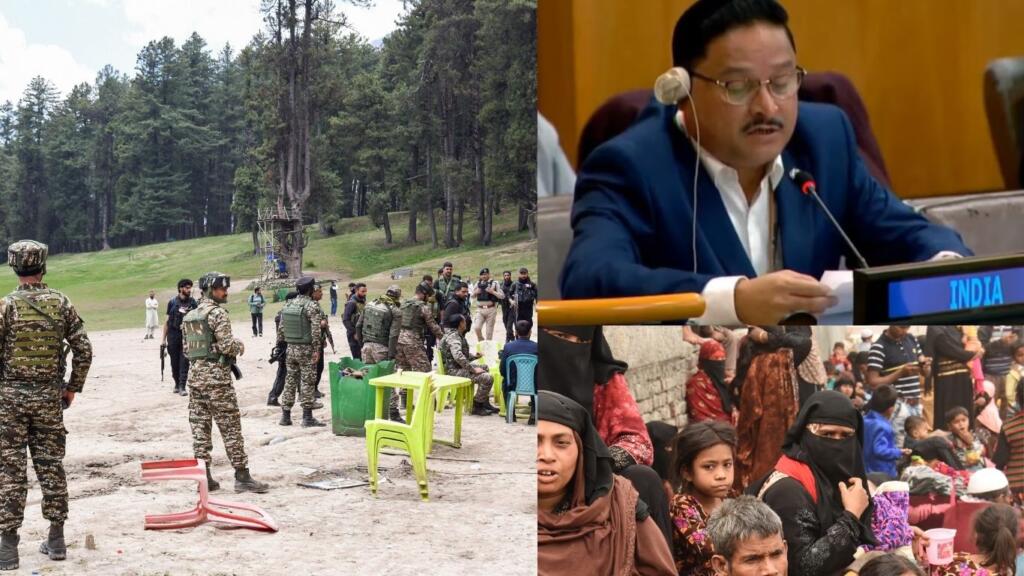
Despite its failure to stop wars or protect human rights across the world, the United Nations seems more interested in targeting developing nations like India. In recent years, the UN has miserably failed to prevent or even meaningfully intervene in global conflicts whether in Ukraine, Gaza, or West Asia. Yet, instead of addressing its own credibility crisis, it has now turned its focus towards publishing baseless and politically motivated reports against sovereign nations. The latest example of this misplaced activism comes in the form of the UN’s so-called human rights report on Myanmar, which bizarrely links the Pahalgam terror attack in India with displaced persons from Myanmar. India has rightly and strongly rejected this report, calling it a “blinkered and baseless analysis.”
Delivering India’s statement at the UN General Assembly’s Third Committee, Lok Sabha MP Dilip Saikia dismantled the claims made by UN Special Rapporteur Thomas H. Andrews. The UN expert alleged that refugees from Myanmar in India were facing harassment and threats of deportation after the Pahalgam terror attack in April 2025 an attack that targeted Hindu pilgrims in Jammu and Kashmir. But as Saikia pointed out, there is absolutely no factual basis to this claim and the connection drawn by the UN is not only wrong but malicious. Saikia described the report as biased, prejudiced, and designed to malign India’s global image.
India’s response was firm and factual. The MP from Assam stated that India rejects such prejudice and baseless assumptions and urged the UN not to rely on unverified, skewed media reports that serve specific political agendas. India reminded the world that it is home to over 200 million Muslims, nearly 10 percent of the global Muslim population, who live peacefully and harmoniously with people of all faiths. This fact alone exposes the hypocrisy of those who attempt to paint India as intolerant or discriminatory.
This is not the first time the United Nations has unfairly targeted India. Earlier this year, in March, India slammed the remarks made by the UN Human Rights Chief Volker Turk on Manipur and Jammu and Kashmir. The UN High Commissioner had mentioned India in his global update to the Human Rights Council, referring to the internal situation in both regions. India’s Permanent Representative in Geneva, Arindam Bagchi, hit back sharply, calling the comments “unfounded and baseless.” He reminded the UN that Jammu and Kashmir is an integral part of India and any attempt to internationalize the issue reflects a poor understanding of ground realities and the Indian Constitution.
This pattern of bias is not new. In June 2018, India had rejected a UN report that made controversial recommendations on Kashmir and even went to the extent of asking India to “respect the self-determination of the people of Kashmir.” India called that report a “false narrative” that ignored terrorism sponsored by Pakistan. The following year, the UN released yet another report repeating the same propaganda. Clearly, this has become a pattern the UN turning a blind eye to cross-border terrorism while questioning the world’s largest democracy.
At a time when the UN should be questioning Pakistan’s open support for terror outfits and its role in destabilizing South Asia, it instead chooses to lecture India. The UN has failed to call out Islamabad for sheltering terrorists, funding radical networks, and allowing its soil to be used for cross-border attacks. The 2025 Pahalgam terror attack, which the UN casually mentioned, was traced directly to Pakistan-backed groups. India responded decisively, neutralizing multiple terror camps across the border. Yet, the UN remained silent on that choosing instead to invent imaginary allegations against India.
Saikia also used the platform to highlight a crucial point that India is deeply concerned about the deteriorating situation in Myanmar, especially the spillover effects such as drug trafficking, arms smuggling, and human trafficking across the border. He warned that rising radicalization among some displaced groups is posing law and order challenges for India’s northeastern states. But India has not responded with hostility; it has responded with humanity. Following the devastating March 2025 earthquake in Myanmar, India launched Operation Brahma, dispatching over 1,000 metric tonnes of relief material and medical assistance. This built upon earlier humanitarian operations such as Operation Sahayata during Typhoon Hiyaki and Operation Sadbhav, part of India’s consistent support to Myanmar’s people.
India has always stood by the principle of a Myanmar-owned and Myanmar-led peace process, working closely with ASEAN and the UN Secretary-General’s office to restore stability and democracy in the region. Ironically, while India continues to provide humanitarian aid and promote dialogue, the UN is busy accusing it of wrongdoing without evidence. This is the height of hypocrisy.
External Affairs Minister Dr. S. Jaishankar has also been vocal about the UN’s growing irrelevance and its failure to live up to its founding purpose. Speaking at the UN General Assembly’s 80th session, Jaishankar described the organization as “gridlocked” and incapable of dealing with modern challenges. He pointed to ongoing conflicts in Ukraine, the Middle East, and other regions, asking bluntly “How has the UN lived up to expectations?” The minister also condemned the slow progress of the Sustainable Development Goals, calling it a “sorry picture,” and criticized wealthy nations for lecturing others while insulating themselves from energy and food crises.
India’s frustration is justified. The UN has lost its moral standing. It preaches human rights but turns a blind eye to terror sponsors. It talks about democracy but ignores authoritarian regimes when convenient. It demands accountability from developing nations but never questions Western powers for their wars and interventions that have destroyed entire regions.
India, on the other hand, has faced the brunt of illegal immigration due to instability in neighboring countries like Bangladesh and Myanmar. Yet, it is not a signatory to the 1951 Refugee Convention or its 1967 Protocol, which means it is under no legal obligation to host refugees. Still, India has shown compassion and restraint. Prime Minister Narendra Modi himself has repeatedly warned about the dangers of unchecked illegal immigration. In his Independence Day address recently, he announced that a National Demography Mission will be launched to protect India’s social balance and national security from the threats posed by infiltrators. The Prime Minister said that infiltrators are snatching jobs, threatening women’s safety, and attempting to alter the country’s demographic structure under a well-orchestrated conspiracy.
This is the reality the UN refuses to acknowledge. India is not the aggressor it is the victim of terrorism, illegal migration, and global double standards. The UN, instead of addressing these real threats, chooses to issue politically motivated reports that serve the interests of Western lobbies and Pakistan’s propaganda machinery.
India’s stand is clear and consistent. It supports a peaceful, democratic Myanmar. It provides humanitarian relief where needed. It protects its borders and its people from threats. And it refuses to be lectured by an institution that has lost its credibility. The UN must introspect. It must ask itself why it has failed to stop wars, prevent genocide, or curb terrorism. Until it does that, its reports and resolutions will remain what they have become today irrelevant, biased, and completely disconnected from reality.