














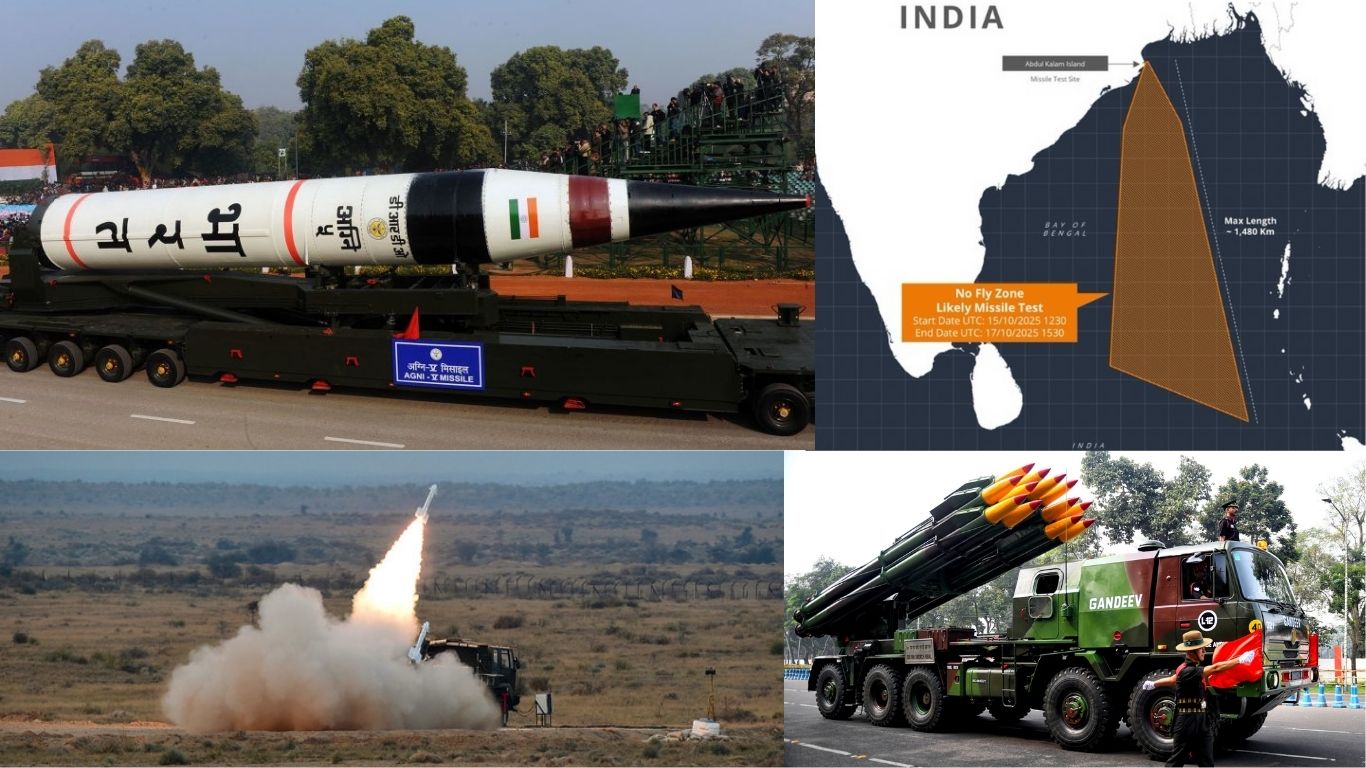
India is preparing for a major missile test over the Bay of Bengal, signaling yet another stride in the country’s growing strategic and technological prowess. A Notice to Airmen (NOTAM) issued by Indian authorities indicates a designated test window between October 15 and 17, 2025, covering a massive stretch of 1,480 kilometers southeast from Abdul Kalam Island, the nation’s premier missile testing site off the coast of Odisha. This development has stirred speculation within defense circles about which advanced weapon system India is set to test potentially a long-range anti-ship missile or an upgraded member of the Agni missile family.
A High-Range Test Window Suggesting a Major Trial
The NOTAM area extending deep into the Bay of Bengal strongly suggests that this is no routine missile validation. The restricted air and sea zone indicates a long-range or intermediate-range ballistic missile test, far exceeding the parameters of short-range trials. The three-day test window, from 12:30 UTC on October 15 to 15:30 UTC on October 17, provides a broad timeframe for technical preparations and favorable weather coordination.
Analysts believe the range and trajectory pattern match the profile of India’s Long Range Anti-Ship Missile (LRAShM) a hypersonic system under development by the Defence Research and Development Organisation (DRDO). This missile, when operational, will enable India to strike enemy naval assets at ranges beyond 1,000 km, providing the Indian Navy with unmatched maritime strike flexibility across the Indo-Pacific.
Possible Agni Variant or Hypersonic Platform in Focus
The test comes just weeks after India’s successful trial of the Agni-V intercontinental ballistic missile (ICBM) in August 2025 a test that reaffirmed India’s credible second-strike capability and strengthened its nuclear deterrence posture. Following that milestone, this new NOTAM points to either a follow-up trial of an Agni-series variant like Agni-III or Agni-IV, or potentially the first developmental flight of the LRAShM.
The 1,480 km range envelope fits perfectly between medium- and intermediate-range classes, suggesting that DRDO and the Strategic Forces Command (SFC) may be testing a missile bridging tactical and strategic roles. It also aligns with India’s doctrine of layered deterrence, where multiple missile types cover different threat spectrums from battlefield support to long-range deterrence.
Strategic Timing and the Indo-Pacific Context
The timing of this missile test is crucial. India’s defense modernization drive is accelerating amid increasing tensions in the Indo-Pacific, where China’s naval presence and missile proliferation are reshaping security dynamics. By testing from Abdul Kalam Island, India underscores its operational readiness and expanding technological autonomy.
The Bay of Bengal has historically served as India’s testing corridor due to its vast uninhabited expanse and low risk to civilian traffic. Every test conducted here from Agni series missiles to BrahMos variants represents another layer in India’s effort to strengthen deterrence and maritime strike capabilities.
Enhancing Precision and Operational Readiness
Each missile trial contributes not only to deterrence but also to refining propulsion efficiency, guidance systems, and warhead delivery accuracy. The upcoming test will allow India’s defense scientists to evaluate flight stability, telemetry data, and real-time control systems, ensuring readiness for operational deployment. DRDO’s growing expertise in composite materials, solid-fuel propulsion, and heat-resistant alloys has made India one of the few nations capable of independently designing and testing such systems.
A Step Toward Greater Strategic Autonomy
This upcoming Bay of Bengal missile test symbolizes more than just another weapon trial it represents India’s pursuit of complete defense self-reliance and strategic autonomy. Whether the test involves an Agni variant or the cutting-edge LRAShM, it marks a critical step toward fortifying India’s long-range precision strike capability.
As the global order evolves and threats diversify, India’s ability to project deterrence power across both land and sea will define its role as a leading strategic player in Asia. Each test from Abdul Kalam Island reaffirms a single message that India’s security and technological independence will be defended, built, and powered by Indian innovation.