















At a time when the United States has imposed steep 50 per cent tariffs on several categories of Indian goods, the spotlight has shifted toward Europe. The India-European Union Free Trade Agreement (FTA), years in the making, now stands as a defining moment in India’s economic diplomacy. With an EU trade delegation arriving in New Delhi on November 3 for the 15th round of negotiations, both sides are racing to conclude one of the most comprehensive and future-ready trade agreements in India’s history. Commerce Minister Piyush Goyal’s recent visit to Brussels has already bridged many gaps, signalling a strong mutual commitment to an equitable, technology-driven partnership. As Western economies wrestle with protectionism and slow recovery, India’s steady growth, diversified markets, and resilient manufacturing base have positioned it as a reliable alternative. The India-EU FTA could, therefore, reshape global trade dynamics with India emerging as the new axis of stability and opportunity.
The 15th round of India-EU negotiations is set to begin on November 3, shortly after Commerce Minister Piyush Goyal’s visit to Brussels, where he held extensive talks with European Trade Commissioner Maros Sefcovic. Both sides acknowledged that while sensitive issues remain particularly in the automobile and agriculture sectors significant headway has been achieved in other key areas such as digital services, investment protection, and intellectual property rights.
Goyal emphasised that “outstanding issues have been significantly reduced” and that a strong framework is being laid for a “win-win outcome” benefiting businesses and consumers across both regions. The Indian delegation has focused on ensuring that the deal protects domestic interests while opening up new export opportunities for Indian goods and services in Europe.
Sefcovic, addressing a gathering in Brussels, echoed similar optimism, stating that “concrete guidance has been given to negotiating teams on industrial tariffs.” He also noted that the upcoming visit of the EU delegation to India would be crucial for finalising the technical aspects of tariff negotiations a sign that both sides are eager to conclude the agreement by the December 2025 deadline.
The Strategic Context: India Emerges as Europe’s Natural Partner
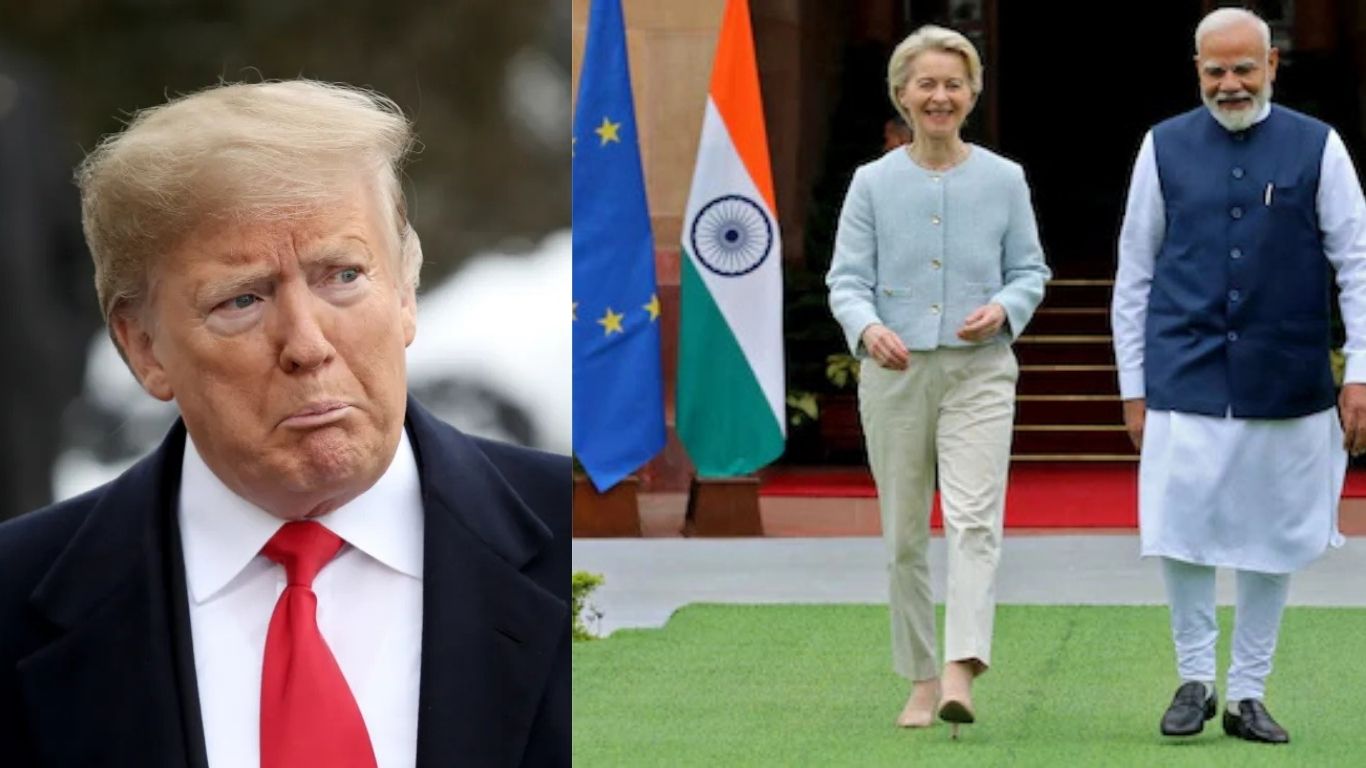
The EU’s decision to fast-track talks with India is not merely an economic calculation it is a strategic shift. With the United States adopting a more protectionist stance under President Donald Trump’s tariff policy, global trade equations have shifted. Trump’s 50 per cent tariff barrier on select Indian products has created uncertainty in traditional export markets, compelling India to diversify its trade relationships.
Europe, facing its own set of challenges from slow post-COVID recovery to rising energy costs and supply chain disruptions sees India as a natural, reliable, and rapidly growing partner. The European Commission’s latest report to the European Parliament highlights that the EU is India’s largest trading partner, while India stands as the EU’s biggest partner in the Global South. Bilateral trade in goods has reached €120 billion in 2024, marking a 90 per cent surge over the last decade.
In a world marked by geopolitical realignments, the India-EU FTA offers both sides a chance to reinforce the rules-based multilateral trade order while reducing dependence on volatile markets. For India, it opens doors to high-end technology, clean energy investments, and advanced manufacturing ecosystems. For Europe, it offers access to one of the world’s fastest-growing consumer markets and a stable democratic partner in Asia.
Despite the optimism, some hurdles remain. Negotiations have slowed in sensitive sectors such as agriculture and automobiles, where both sides have differing priorities. While the EU seeks greater access for its dairy and automotive sectors, India is pushing for concessions in labour-intensive industries like textiles, footwear, and engineering goods.
A recent EU status report acknowledged that while progress had been made on rules of origin, sanitary and phytosanitary measures, and investment standards, “sufficient progress in sensitive areas such as automotives and agricultural products” was yet to be achieved. However, officials on both sides remain confident that the political will now exists to resolve these issues.
In parallel, a delegation from the European Parliament’s Committee on International Trade (INTA) led by Cristina Maestre and Brando Benifei visited India for two days to build trust and understanding. As INTA plays a key role in finalising trade agreements, this visit was seen as a strong political signal that Europe is serious about sealing the deal.
India’s Economic Strength: The Case for a Balanced FTA
India’s growing economic muscle is the foundation on which the FTA stands. The country’s trade with the EU has expanded from $90 billion in 2020–21 to $136 billion in 2024–25 a growth rate faster than its trade with the United States. The top 20 export items, including pharmaceuticals, machinery, electronics, textiles, and chemicals, now account for over 80 per cent of India’s total exports to the EU.
Equally, India’s imports from Europe primarily machinery, reactors, electronics, and renewable energy equipment are helping strengthen domestic capabilities under Make in India and Atmanirbhar Bharat. The EU’s investments in India, totalling over $117 billion, are a testament to Europe’s long-term faith in India’s economic and regulatory framework. Indian investments in Europe, meanwhile, have crossed $40 billion, particularly in pharmaceuticals, IT, and clean energy showing how the partnership is truly two-way.
Economists note that the FTA could help Indian exporters gain preferential access to a market of over 450 million consumers, while boosting India’s competitiveness against China and Southeast Asian economies. For Europe, India offers demographic vitality, political stability, and a vast skilled workforce a combination few other emerging economies can match.
The India-EU Free Trade Agreement is no longer just about tariffs or trade volumes it is about shaping a new global economic front built on trust, resilience, and shared democratic values. As the United States retreats into protectionism under Trump’s tariff walls, the India-EU corridor offers an alternative model of open, fair, and mutually beneficial trade.
Both sides have already made substantial progress in customs facilitation, intellectual property rights, transparency, and dispute resolution. The December 2025 deadline is now within sight, with negotiators determined to deliver a framework that anchors future cooperation in technology, green energy, digital transformation, and innovation.
For India, the FTA represents not only access to high-value markets but also a recognition of its new status as a global manufacturing and innovation hub. For Europe, it represents a partnership with the world’s most stable democracy in the Global South. If successfully concluded, the India-EU Free Trade Agreement will mark the birth of a new trade axis in the post-US tariff world one that celebrates fairness over fear, cooperation over coercion. It will not only strengthen India’s economic rise but also redefine how the world views strategic trade in the 21st century: not as a tool of dominance, but as a bridge of shared prosperity.