
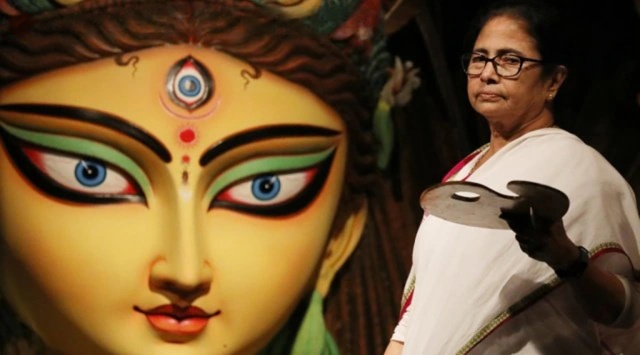
In West Bengal — a land that venerates Maa Durga, the divine embodiment of feminine strength and courage — the reality for women is strikingly different. Despite centuries of cultural reverence toward female power, women in the state continue to face humiliation, victim-blaming, and systemic neglect when it comes to their safety. The latest example of this contradiction unfolded in Durgapur, where a young MBBS student from Odisha was allegedly gang-raped near her college campus — an incident that has once again laid bare the grim underbelly of gender violence in Bengal.
Rather than focusing solely on justice and institutional accountability, Chief Minister Mamata Banerjee’s public remarks in response to the crime have triggered outrage. Speaking on October 11, 2025, Banerjee stated that “girl children at night time… should not be allowed to come outside,” adding that “they have to protect themselves also.” These comments, perceived by many as deeply insensitive, have reignited the debate over how the state approaches women’s safety — and how it consistently fails them.
A Culture of Victim Blaming
Banerjee’s statement effectively shifts responsibility from perpetrators to victims. Instead of questioning how assailants were emboldened enough to commit such a heinous act near a college campus, the Chief Minister implied that the victim was at fault for stepping out at night. The underlying message is clear: safety is a woman’s burden to carry, and any failure results in consequences she must endure, even if it means sexual violence.
This form of victim-blaming is not new. It has deep roots in patriarchal societies where control over women’s mobility is framed as a protective measure. But when such rhetoric comes from a female Chief Minister in a state that worships goddesses with swords in their hands, the hypocrisy becomes even more glaring.
“Zero Tolerance” or Zero Accountability?
In her address, Banerjee also claimed that West Bengal has a “zero tolerance” policy towards crimes against women. However, this statement rings hollow when viewed in the context of repeated failures in ensuring women’s safety. The Durgapur incident is not isolated. Just last year, following the brutal rape and murder of a female doctor at Kolkata’s R.G. Kar Medical College, the government issued guidelines suggesting that women should be discouraged from working night shifts — another instance where the state’s solution was to restrict women rather than confront the root problem: male violence.
Although that advisory was later withdrawn under legal and public pressure, the underlying mindset has clearly persisted. When the first response to sexual violence is to question the presence of the victim in public spaces — not the actions of the perpetrators — it sends a chilling message to women: you are not safe, and if anything happens to you, you will be questioned before the criminals.
Political Fallout and Public Anger
The Chief Minister’s remarks have drawn sharp criticism from opposition leaders, civil society, and ordinary citizens alike. BJP leaders such as Agnimitra Paul and Samik Bhattacharya publicly condemned the comments, accusing Banerjee of abdicating her responsibility toward women in the state.
“Instead of ensuring justice and safety, the Chief Minister is blaming women themselves, which is a clear example of victim-blaming,” said Bhattacharya. He further stated that this was an attempt to cover up administrative failures and shift the conversation away from the government’s accountability.
Protests erupted on the streets, led by BJP’s women’s wing and various student bodies. Many demanded a retraction of Banerjee’s statements and a public apology. Others took to social media, sharing their anger and despair, using hashtags like #BlameTheRapist and #JusticeForDurgapurVictim.
Law Enforcement and Progress in the Case
In response to the crime, the Asansol Durgapur Police Commissionerate has arrested three suspects and continues to conduct raids to apprehend the remaining accused. The arrested individuals are reportedly locals and were tracked down through raids in nearby forested areas. While these arrests are a step toward justice, the larger concerns remain unresolved: Why are such crimes recurring in and around educational institutions? Why aren’t there better safety measures in place?
Odisha Chief Minister Mohan Charan Majhi also intervened, urging Banerjee to take swift and strict action to ensure justice for the survivor, who hails from his state. His statement added inter-state pressure on the West Bengal administration to act decisively — and sensitively.
Distortion or Damage Control?
Later on Sunday, Banerjee accused the media of twisting her words and engaging in “nasty politics.” According to her, the comments were taken out of context and distorted for sensationalism. However, the damage was already done. Regardless of intent, the impact of such statements, especially from someone in a position of power, cannot be dismissed lightly.
Words matter — particularly when they come from the highest authority in the state. In the context of gender-based violence, words can either embolden perpetrators or empower survivors. Unfortunately, in this case, they did neither. Instead, they reinforced a dangerous narrative that normalizes policing women’s behavior instead of punishing those who harm them.
The Crux: Worshipping Goddesses, Humiliating Women
West Bengal takes immense pride in Durga Puja, a festival that celebrates the power, strength, and independence of the goddess Durga. Streets across the state light up in honor of a divine feminine force who vanquishes evil with her ten arms. Yet in the same land, real women are warned not to step out at night, are blamed for their assaults, and are told to “protect themselves” instead of being protected by the law and order machinery.
This contradiction is not just ironic — it’s humiliating. It speaks to a deeply embedded hypocrisy that celebrates the divine female symbolically but fails to respect, safeguard, or even believe real women when they are violated.
Conclusion: Time to Confront the Real Evil
The true evil isn’t just the perpetrators lurking in the shadows. It is the systemic apathy, the misplaced priorities, and the rhetoric that strips women of their agency and dignity. If Bengal truly wants to live up to the ideals symbolized by Maa Durga, then it must do more than put up pandals and chant hymns. It must ensure that every woman — student, doctor, daughter —is safe not only during the day but also in the darkest hours of the night. Because in the land of the goddess, women should never have to fear walking alone.